
To season a carbon steel pan the first time, wash off the factory coating, dry the pan, wipe on a paper-thin layer of high smoke point oil, and heat it until it smokes and darkens — then repeat two or three times. It takes under an hour, and the pan gets more nonstick every time you cook with it after that.
A new carbon steel pan looks underwhelming out of the box: pale grey steel, a waxy coating, and a surface that grabs an egg like glue. That is normal. Seasoning turns that bare steel into the slick, dark cooking surface carbon steel is known for — and it is far simpler than the internet makes it sound. We compared the published care guidance from the makers themselves (de Buyer, Lodge, Misen, and Made In) and the method used by America’s Test Kitchen.
What is seasoning, exactly?
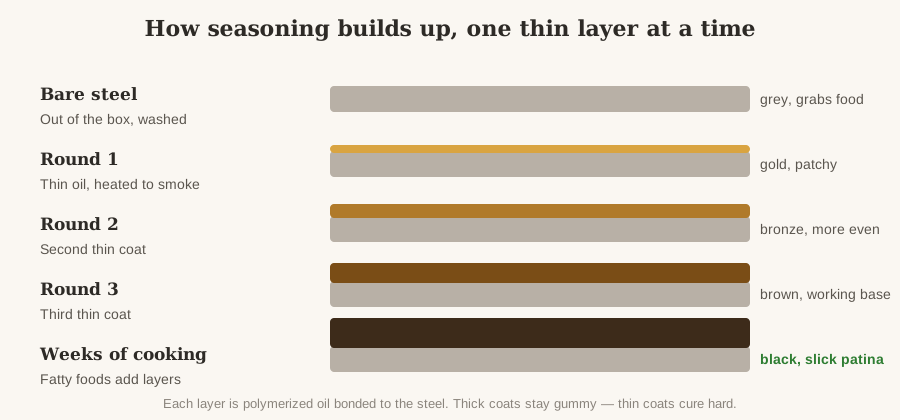
Seasoning is not a coating you paint on. It is a chemical change: when a thin layer of oil is heated past its smoke point on bare steel, the oil polymerizes — its molecules link together into a hard, dry layer bonded to the metal. Repeat that a few times and you get a thin, dark patina that protects the steel from rust and keeps food from sticking.
Two consequences follow. First, the oil layer must be thin: a thick layer cannot polymerize all the way through, so it stays soft, sticky, and gummy instead of curing hard. Second, the heat must be high enough — oil that never reaches its smoke point produces a tacky pan instead of a seasoned one. Nearly every first-seasoning failure traces back to one of those two mistakes.
Seasoning is also a process, not an event. The first three or four coats give you a working base layer, but the real nonstick surface builds up over the first weeks of cooking, as fats from bacon, seared chicken, and sautéed vegetables add layer after layer.
What do you need before you start?
Very little: the pan, a neutral oil with a high smoke point, paper towels or a lint-free cloth, and a stove or an oven. That is the whole kit.
The pan. Check what is on it out of the box, because the first step depends on it:
- Beeswax coating (de Buyer Mineral B and most French carbon steel): the pan ships with a layer of food-safe beeswax to stop it rusting in transit. Wash it off with hot, soapy water. de Buyer says it is fine if a trace of wax stays behind — it helps the first seasoning along.
- Pre-seasoned (Lodge carbon steel): Lodge seasons its carbon steel pans at the factory with soybean oil, so the pan arrives dark. Do not strip it. Wash it, dry it, wipe on a thin layer of oil, and start cooking. One or two rounds of the method below still help, because factory seasoning is a thin starting coat.
- Bare steel with a light oil film (Matfer, Misen, Made In): wash with hot, soapy water and dry it thoroughly.
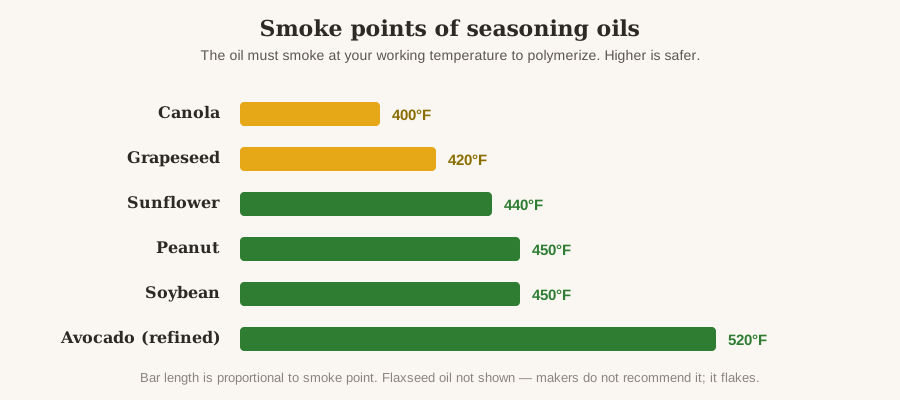
The oil. Use a neutral oil with a high smoke point. The makers’ lists agree: grapeseed, canola, refined avocado, peanut, sunflower, and soybean oil all work. What matters is the smoke point — the oil has to smoke at the temperature you are working at for polymerization to happen.
| Oil | Smoke point | Notes |
|---|---|---|
| Refined avocado oil | ~520°F (271°C) | Highest smoke point; pricier than the rest |
| Peanut oil | ~450°F (232°C) | Polymerizes into a hard layer; avoid with a peanut allergy in the house |
| Refined soybean oil | ~450°F (232°C) | What Lodge uses for its factory seasoning |
| Sunflower oil | ~440°F (227°C) | Cheap and widely available |
| Grapeseed oil | ~420°F (216°C) | de Buyer’s first recommendation; very neutral |
| Canola oil | ~400°F (204°C) | The most common choice; works fine |
One oil to skip: flaxseed oil. It is popular in online seasoning guides, but it tends to dry into a brittle layer that flakes off in sheets, and no major pan maker recommends it.
The cloth. Paper towels work, though they can leave lint on a hot pan. A lint-free cotton cloth or an old t-shirt rag works better.
How do you season a carbon steel pan on the stovetop?
The stovetop is the method most makers give first, and it works for any pan whatever its handle. Wooden handles cannot go in the oven, so if your pan has one, this is your method. It takes about 30 to 45 minutes for three rounds.
Step 1: Wash and dry the pan. Remove the factory wax or oil as described above. Towel the pan dry, then set it on low heat for a minute or two until every trace of water is gone.
Step 2: Wipe on a very thin coat of oil. Add a few drops — about a quarter of a teaspoon for a 10-inch pan; Misen suggests 4 to 5 drops. Rub it over the whole cooking surface with a paper towel, then take a clean towel and wipe as if you were trying to remove it all. The pan should look almost dry, with a faint sheen and no pools or drips. This is the step most people get wrong, and it is the step that matters most.
Step 3: Heat it until it smokes and darkens. Put the pan on medium-high heat — de Buyer says about 75% power. After a few minutes it will start to smoke and the steel will turn gold, then bronze or brown. Keep it there until the smoking slows, usually 5 to 10 minutes. Open a window and turn on the range hood: there will be smoke, and that is the point.
Step 4: Let it cool, then repeat. Turn off the heat and let the pan cool until you can handle it. Repeat steps 2 and 3 two or three more times — de Buyer suggests one to three rounds in total, Misen three or four — then start cooking. A first seasoning that looks bronze, blotchy, and slightly uneven is a successful one.
How do you season a carbon steel pan in the oven?
The oven method is more hands-off and gives a more even coat, because the whole pan heats at once instead of just the spot over the burner. Use it only if the handle is oven-safe — de Buyer Mineral B Pro and most all-steel pans qualify; any pan with a wooden handle does not.
Step 1: Wash and dry the pan. Same as the stovetop method: hot, soapy water to remove the factory coating, towel dry, then a minute on low heat to drive off the last moisture.
Step 2: Heat the oven past your oil’s smoke point. Put a foil-lined baking sheet on the bottom rack to catch drips, and preheat the oven to about 450 to 475°F (232 to 246°C). de Buyer suggests 475°F.
Step 3: Warm the pan, then oil it thin. Set the pan on the stove over medium heat for about two minutes to drive off any remaining moisture. Take it off the heat and rub a thin layer of oil over the inside and the outside — the exterior needs seasoning too, for rust protection. Wipe it back off until the surface looks dry, with no drips.
Step 4: Bake it upside down for an hour. Place the pan upside down on the center rack so excess oil runs off instead of pooling. Bake for 60 minutes, then turn the oven off and let the pan cool inside it completely before touching it.
Step 5: Repeat once or twice. One round in the oven gives a good base coat; a second or third round makes it more even. After that, start cooking — normal cooking does the rest of the work.
What should the first seasoning look like?
A realistic first seasoning is bronze or brown, uneven, and patchy — darker in the middle, lighter near the edges. That is normal, and it is not a problem to fix. What a good first seasoning is not: glossy black, perfectly even, or mirror-smooth. That finish takes months of cooking, and chasing it on day one with more oil or more rounds gives you the opposite — a thick, sticky layer that never fully hardens.
What should you cook first?
The first few things you cook matter more than the first seasoning itself, because they are what actually build the nonstick surface. Cook fatty foods for the first week: bacon, seared chicken thighs, pan-fried potatoes, or sautéed vegetables in a generous slick of oil. These lay down fat with every use and thicken the patina fast.
Avoid three things for the first few cooks: eggs, fish, and anything acidic like tomato sauce or wine reductions. Eggs stick to a young seasoning; fish tears easily; acids strip a thin, new seasoning faster than fat can rebuild it. After a week or two of regular fatty cooking, the pan will handle all three.
Use plenty of oil in those early cooks, even if you normally cook lean — it is the seasoning process continuing. And preheat the pan before the food goes in: a hot pan with oil shimmering in it is what keeps food from bonding to the steel.
How do you clean it without ruining the seasoning?
While the pan is still warm, wipe it out with a paper towel, then wash it with hot water and a soft sponge or a chain-mail scrubber for stuck bits. Dry it immediately — towel it off, then set it on low heat for a minute or two. Finish with a few drops of oil wiped over the surface while it is still warm.
A drop of mild dish soap is fine once the seasoning is established — Lodge’s own care guidance says so. But skip the soap for the first few weeks while the seasoning is young and thin, and never soak the pan or put it in the dishwasher: soaking invites rust, and the dishwasher’s long hot cycle strips seasoning fast.
The single most important cleaning habit is the drying step. Carbon steel rusts fast — a wet pan left in the sink for an hour can show orange spots by dinner. Towel dry, heat dry, light oil.
How do you fix the common problems?
Sticky or gummy spots. The oil layer was too thick. Scrub the sticky area with hot water and a chain-mail scrubber or a paste of coarse salt, dry the pan, and redo one thin round. Next time, wipe the oil off until the pan looks dry before you heat it.
Rust spots. Scrub them off with coarse salt and a little oil, or a chain-mail scrubber, until the orange is gone. Dry the pan on heat, wipe on a thin layer of oil, and do one seasoning round.
Food sticking. Usually a young seasoning, not a failed one. Cook fattier foods for a few more days, use more oil, and make sure the pan is properly preheated before food goes in.
Flaking black bits in food. The seasoning layer was too thick and is peeling. Scrub the loose flakes off with hot water and a scrubber, dry the pan, and redo a thin round. Do not try to seal the flakes down with more oil — that makes the problem worse.
Frequently asked questions
Do I need to season a carbon steel pan before the first use?
Yes, unless it arrived pre-seasoned. Bare carbon steel rusts quickly and food sticks to it, so wash off the factory coating, do two or three thin seasoning rounds, and cook fatty foods for the first week.
How many times should I season a carbon steel pan the first time?
Two to four thin rounds is the consensus across the makers: de Buyer suggests one to three rounds, Misen three or four. More rounds do not help if the layers are thick — thin coats are what matter.
Can I use olive oil to season a carbon steel pan?
Extra-virgin olive oil is a poor choice because its smoke point is around 375°F, too low to polymerize well at seasoning temperatures. Grapeseed, canola, or peanut oil are cheaper and more reliable for this job.
Why is my carbon steel pan sticky after seasoning?
The oil layer was too thick. A layer that cannot polymerize all the way through stays soft and tacky, so scrub the sticky spots off, dry the pan, and redo one round with the oil wiped back until the pan looks dry.
Can I use soap on a carbon steel pan?
A drop of mild dish soap is fine once the seasoning is established, according to Lodge’s care guidance. Skip soap for the first few weeks while the seasoning is young, and never soak the pan or put it in the dishwasher.
The bottom line
Seasoning a carbon steel pan the first time takes under an hour, three thin coats of oil, and heat past the oil’s smoke point — and the real work happens in the weeks after, every time you cook. Wash off the factory coating, wipe the oil on thin enough that the pan looks dry, heat it until it smokes and darkens, and repeat two or three times. Then cook fatty foods for a week, dry the pan on heat after every wash, and let the cooking finish what the seasoning started. As of November 2026, the method above follows the published care guidance of de Buyer, Lodge, and Misen.
Sources: de Buyer USA seasoning guides (Mineral B and Blue Carbon Steel); Lodge carbon steel care guidance; Misen seasoning instructions; America’s Test Kitchen carbon steel method, as summarized by Cup and Lindy (October 2026).