
Choose an 8-inch chef’s knife in stainless steel with a comfortable full-tang handle. That size suits most hands and most everyday tasks. German steel at about 56–58 HRC is tougher and easier to maintain, while Japanese steel at about 60–61 HRC holds an edge longer but chips more easily. Expect to pay $40–$150.
A chef’s knife is the one tool every cook reaches for first, and it is also the one most people buy wrong. Shoppers fixate on brand names or Damascus patterns, then end up with a blade too long for their board. Choosing well comes down to three decisions — length, steel, and handle — and none of them requires a big budget.
We compared specs, prices, and verified owner reviews across the most recommended chef’s knives, from $20 workhorses to $180 Japanese blades, to explain what each specification means in daily use.
What blade length should you choose?
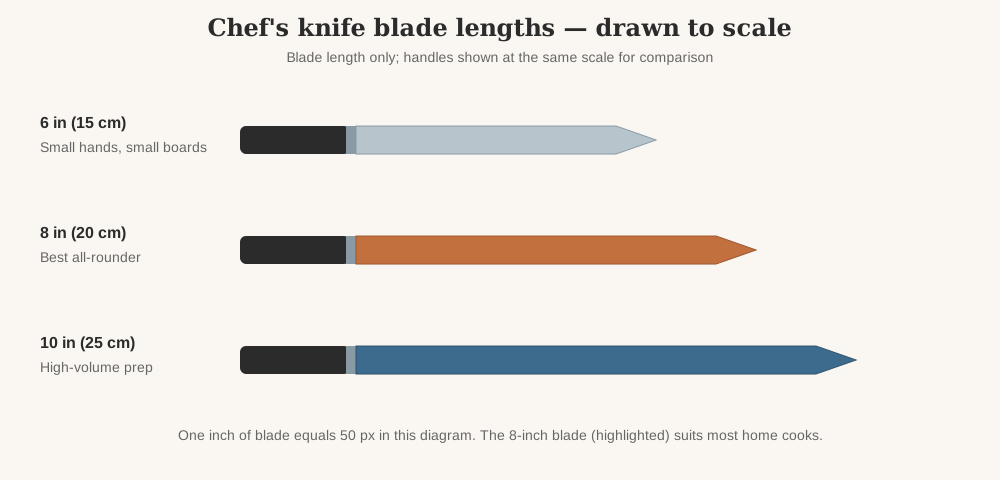
Blade length is measured from the tip to the heel, and it is the single biggest factor in how a knife feels. Most chef’s knives come in 6, 8, and 10 inches, and the right choice depends on your hand size, your cutting board, and what you cook.
An 8-inch blade (about 20 cm) is the default recommendation for a reason: it is long enough to slice a large onion in one stroke and to rock-chop herbs efficiently, yet short enough to control precisely. For most adults, it is the best first chef’s knife.
A 6-inch blade (about 15 cm) suits smaller hands, smaller boards, and smaller kitchens. It is lighter and more nimble, which makes it a good choice if an 8-inch knife feels unwieldy. If you have small hands, our guide to the best chef’s knife for small hands covers short-blade options in detail.
A 10-inch blade (about 25 cm) is the professional’s choice for volume work: slicing large cuts of meat or processing case quantities of vegetables. It covers more board per stroke, so prep goes faster — but it needs a large board (at least 18 inches long) and confident technique.
Buy the longest blade you can control comfortably on the board you own. Blade length is not the same as overall length — a knife listed as “8-inch” should have an 8-inch blade, and if the listing only gives total length, the blade is usually 2–3 inches shorter.
| Blade length | Best for | Watch out for |
|---|---|---|
| 6 in (15 cm) | Small hands, small boards | Too short for large produce |
| 8 in (20 cm) | Most home cooks, most tasks | Can feel long with very small hands |
| 10 in (25 cm) | High-volume prep, large cuts | Needs a large board; harder to control |
Which steel is right for your kitchen?
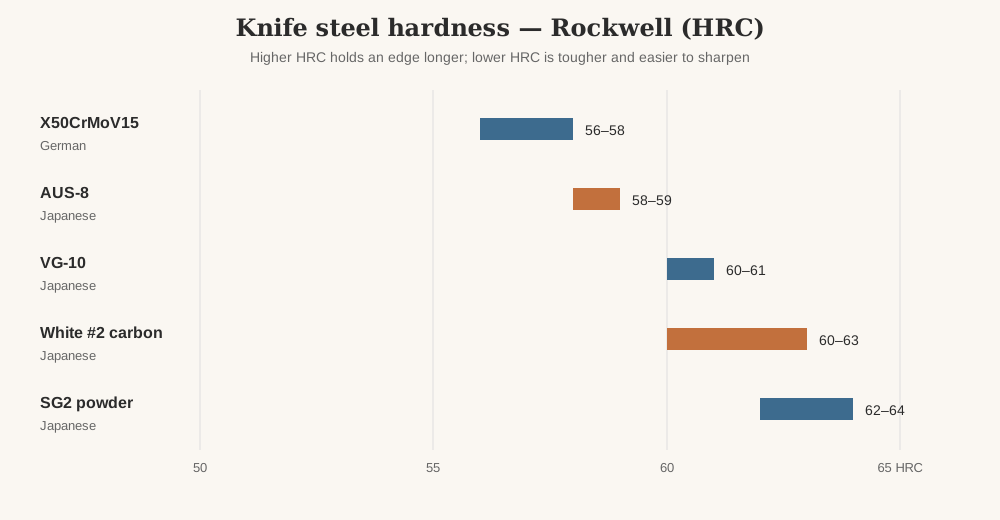
Steel determines how sharp a knife gets, how long it stays sharp, and how much care it demands. Two numbers matter most: the steel type and its Rockwell hardness (HRC). Higher HRC means a harder blade that holds an edge longer but is more brittle; lower HRC means a softer blade that dulls faster but is tougher.
German stainless steel, typified by X50CrMoV15, is the forgiving option. Wüsthof and Zwilling harden it to about 56–58 HRC, which makes the edge easy to restore with a honing steel and resistant to chipping. The trade-off is edge retention: it needs honing every few uses and sharpening a few times a year.
Japanese stainless steel, typified by VG-10, is the sharper option. Shun and Tojiro harden VG-10 to about 60–61 HRC, so the edge stays keen noticeably longer and the blade can be ground thinner for cleaner cuts. The trade-off is brittleness: a hard Japanese edge can chip if you twist it or cut frozen food.
AUS-8, used in many mid-priced Japanese-style knives, sits between the two at about 58–59 HRC — a good compromise of edge retention and toughness at a lower price than VG-10. Powder steels such as SG2 (about 62–64 HRC) hold an edge longest of all but cost $200 or more and chip most easily, so they are overkill for a first knife. Traditional carbon steel, such as White #2 at about 60–63 HRC, takes the keenest edge of all but rusts if left wet.
| Steel | Typical HRC | Edge retention | Toughness | Typical price |
|---|---|---|---|---|
| German X50CrMoV15 | 56–58 | Moderate | High — resists chipping | $100–$180 |
| Japanese VG-10 | 60–61 | High | Moderate — can chip | $80–$180 |
| Japanese AUS-8 | 58–59 | Good | Good | $40–$90 |
| Global Cromova 18 | 56–58 | Moderate | High | $100–$140 |
| Powder steel SG2 | 62–64 | Very high | Low — chips easily | $200+ |
| Carbon steel White #2 | 60–63 | Very high | Low, and rusts if wet | $90–$200 |
One specification matters more than the steel name: full tang. A full-tang knife has a single piece of steel running through the entire handle, which gives better balance and a handle that cannot loosen over time. Every knife recommended in this guide is full tang; avoid partial-tang knives, which are weaker by design.
What handle shape and material actually matter?
The handle is where your hand meets the knife, and it matters more than most shoppers think. A handle that does not fit your grip will tire your hand and make the knife feel clumsy, no matter how good the steel is.
Western handles, found on Wüsthof, Zwilling, and Victorinox, are thicker, heavier, and often shaped with a palm swell. They balance the knife toward the handle, which feels stable and reassuring for a rocking chop.
Japanese handles, found on Shun, Tojiro, and most gyuto knives, are lighter and slimmer — often octagonal (wa-style) or a slim D-shape. They shift the balance point forward toward the blade, which makes the knife feel agile and precise for push-cutting and slicing.
Handle material is mostly about maintenance. Synthetic handles never crack or swell and tolerate the dishwasher in theory, though hand washing is still recommended. Wood handles feel warmer but need occasional oiling and must never soak in water. Pakkawood — wood impregnated with resin — splits the difference: the look of wood with the water resistance of plastic.
Two practical tests beat any specification sheet. First, hold the knife with a pinch grip: thumb and forefinger pinching the blade just above the handle, other fingers wrapped around the handle. The knife should feel balanced, and your knuckles should clear the cutting board. Second, check the bolster — the thick junction between blade and handle. A full bolster adds weight and protects your fingers, but it makes sharpening the heel harder.
How much should you spend — and what does the extra money buy?
Under $50, you get a capable workhorse. The Victorinox Fibrox Pro 8-inch, about $38–$45, is the most recommended budget chef’s knife in the world: a stamped high-carbon stainless blade at about 55–56 HRC, a grippy Fibrox handle, and a light, nimble feel. It will not hold an edge as long as a forged knife, but it sharpens easily. The Mercer Culinary Genesis 8-inch, about $18–$22, is the cheapest knife worth buying — anything below that price is usually soft steel that will not hold an edge at all.
From $50 to $100, you get better steel and a forged blade. The Tojiro DP Gyuto 210 mm, about $80–$90, puts a VG-10 core in a beginner-friendly package and is the cheapest way into Japanese steel. If you are curious about Japanese knives, our guide to the best Japanese knife under $100 for beginners walks through the options in this range.
From $100 to $180, you get the classics: the Wüsthof Classic 8-inch at about $150–$170, the Zwilling Professional S 8-inch at about $130–$150, the Global G-2 8-inch at about $100–$120, and the Shun Classic 8-inch at about $150–$180. All are forged, full-tang, and backed by lifetime warranties. This is the sweet spot for a buy-it-once knife.
Above $180, you pay for hand finishing, premium powder steel, and craftsmanship — real qualities a home cook will rarely notice in daily use. A $250 knife does not cut an onion twice as well as a $125 one. Spend the difference on a good cutting board and a sharpening stone instead.
Whatever you spend, buy one good chef’s knife before you buy a set — sets bundle one good blade with several mediocre ones you will never use. A single 8-inch chef’s knife plus a small paring knife covers about 95 percent of home cooking.
How do you hold and care for a chef’s knife?
Grip it with a pinch grip, not a hammer grip. Pinch the blade between your thumb and forefinger just above the handle, then wrap your remaining fingers around the handle. This gives you control over the tip and keeps your wrist straight. Your other hand uses the claw grip: fingertips curled under, knuckles guiding the blade.
Hone the edge before most uses. A honing steel does not sharpen — it realigns the microscopic edge that bends during cutting. Hold the steel vertically, place the heel of the blade against the top at about a 15-degree angle, and draw the blade down and across in a smooth arc, alternating sides. When honing no longer restores the bite, the knife needs sharpening on a whetstone or by a professional. Our guide explains how to sharpen a kitchen knife at home if you want to learn the full process.
Store the knife so the edge never touches anything hard. A knife block, a magnetic wall strip, or a blade guard all work; a loose drawer does not, because the edge bangs against other utensils and dulls. Wash by hand and dry immediately — every major knife maker recommends hand washing, even for knives labelled dishwasher-safe.
Use a kind cutting board. Wood and soft plastic protect the edge; glass, marble, granite, and ceramic dull it quickly and can chip a hard Japanese blade.
What are the most common mistakes when buying a chef’s knife?
The most common mistake is buying a knife set instead of one good knife. Sets look like value, but they pad the box with steak knives, a bread knife, and kitchen shears you may already own, while the chef’s knife inside is often a lesser model. One excellent 8-inch chef’s knife beats a seven-piece set every time.
The second mistake is choosing by looks. A dramatic Damascus pattern or a coloured handle says nothing about the steel’s hardness or the blade’s geometry. Judge a knife by its steel type, its HRC, its tang, and its weight — the specifications that determine how it cuts. “Damascus” usually describes the layered pattern on the blade’s sides, not the cutting edge.
The third mistake is buying too big and never learning to sharpen. A 10-inch knife impresses in the store and frustrates at home if your board is small and your hands are average — when in doubt, choose the 8-inch version. And even the best knife dulls: a dull knife is more dangerous than a sharp one because it slips instead of cutting, so budget for a honing steel and learn basic sharpening within the first year.
Which knife should you buy first?
There is no single best chef’s knife, but there is a best first chef’s knife for most people, and it depends on your budget and your temperament.
Buy the Victorinox Fibrox Pro 8-inch if you want the best value. At about $38–$45 as of November 2026, it is the cheapest knife that professional cooks actually respect.
Buy the Wüsthof Classic 8-inch if you want one knife for the next twenty years. At about $150–$170, it is the benchmark German chef’s knife: forged X50CrMoV15 steel at about 58 HRC, a full bolster, and a lifetime warranty.
Buy the Tojiro DP Gyuto 210 mm if you want to try Japanese steel without the Japanese price. At about $80–$90, its VG-10 core holds an edge longer than any German knife at this price. Treat it gently — no frozen food, no twisting.
Buy the Shun Classic 8-inch if you love the craft and want a knife that feels special. At about $150–$180, its VG-10 core, 32-layer Damascus cladding, and D-shaped pakkawood handle make it the prettiest knife here, and it cuts as well as it looks.
Whichever you choose, remember the decision order: length first, then steel, then handle, then price. Get the length right for your board and your hands, pick a steel that matches how much maintenance you will actually do, and choose a handle that feels balanced in a pinch grip.
Frequently asked questions
What size chef’s knife is best for a beginner?
An 8-inch chef’s knife is the best size for most beginners, because it is long enough for large produce and rocking cuts but short enough to control. Cooks with small hands or small cutting boards should consider a 6-inch blade instead.
Is German or Japanese steel better for a chef’s knife?
Neither is better overall — German steel at 56–58 HRC is tougher and easier to maintain, while Japanese steel at 60–61 HRC holds a sharper edge longer but chips more easily. Choose German steel for a forgiving everyday knife, Japanese steel for maximum sharpness.
Is an expensive chef’s knife worth it?
Yes, up to about $150–$180, where you get forged full-tang construction, better steel, and a lifetime warranty. Above that price the improvements are mostly in finishing and premium steel that most home cooks will not notice in daily use.
Can a chef’s knife go in the dishwasher?
No — hand wash it even if the manufacturer calls it dishwasher-safe. Detergent is abrasive, heat can damage the handle, and blades knock against other items during the cycle.
How often should I sharpen my chef’s knife?
Hone the edge with a steel before most uses, and sharpen it properly when honing no longer restores the bite — typically every few months for a home cook who uses the knife daily.