
A Damascus steel chef knife is a knife whose blade shows a wavy, water-like pattern created by layering different steels together. In modern kitchen knives the pattern is mostly cosmetic: the cutting edge comes from a hard steel core, while the patterned layers around it protect that core and give the blade its look.
As an Amazon Associate I earn from qualifying purchases.
The pattern is the reason most people buy one. It looks like flowing water frozen into steel, and no two blades show exactly the same swirls. But the pattern also causes most of the confusion around these knives: sellers use the word “Damascus” for everything from hand-forged layered blades to a printed pattern on cheap stainless steel.
What is Damascus steel, exactly?
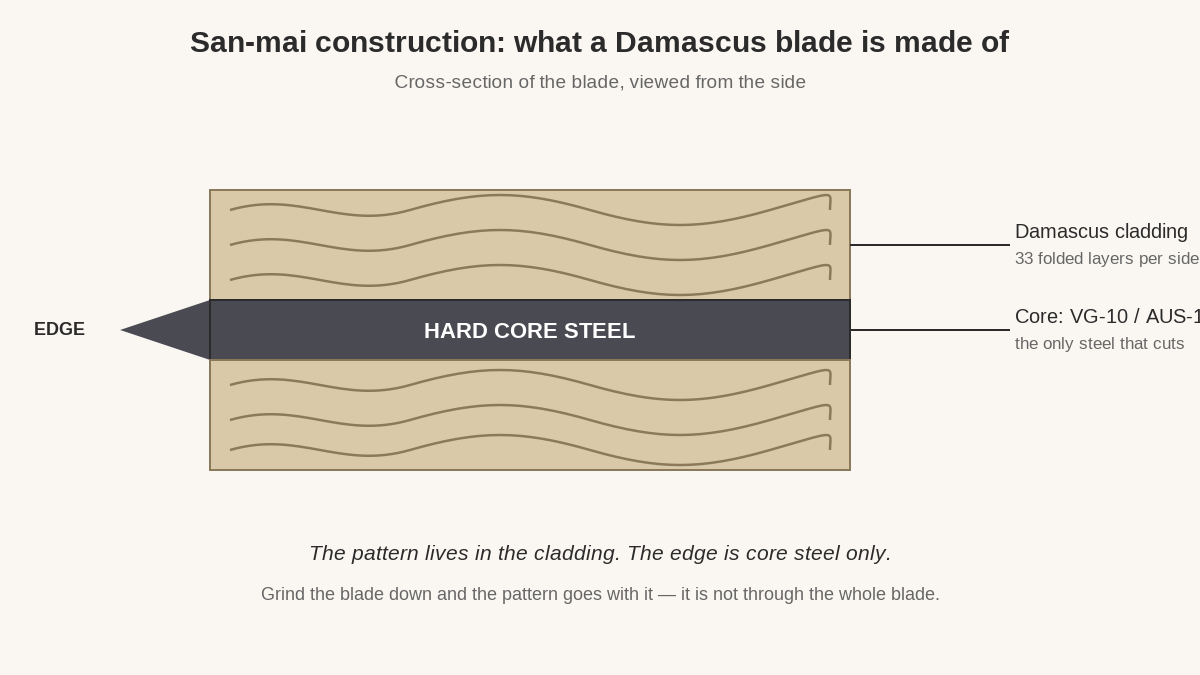
Modern Damascus steel in kitchen knives is pattern-welded steel: a hard steel core sandwiched between many alternating layers of softer stainless steel, forged together, then ground and acid-etched so the layers show as a wavy pattern on the blade’s flat.
The name comes from the legendary blades of old Damascus, Syria, made from wootz steel imported from India. That original steel’s recipe was lost centuries ago; today’s “Damascus” is a modern technique that recreates the look by welding layers.
Most Damascus chef knives use a three-part construction called san-mai, Japanese for “three layers”: a hard core steel forms the cutting edge, and softer steel is laminated on both faces. The core is the only part that ever touches food at the edge. The outer layers are folded or stacked many times — 33 layers per side is common, giving the familiar “67-layer” total — then the blade is ground flat, which slices through the folded layers and exposes the pattern. Acid etching then makes the layers show up as contrasting light and dark waves.
What does the Damascus pattern actually do for performance?
The Damascus pattern does almost nothing for cutting performance. The pattern is a side effect of how the cladding is built, not a feature that makes a knife sharper.
That is the honest answer, and it is the key to buying well. A Damascus chef knife cuts as well as its core steel, its edge geometry, and its heat treatment allow — the pattern contributes nothing to sharpness, edge retention, or toughness.
What the layered cladding does do is practical, just not magical. The softer outer layers protect the hard, brittle core from chipping and corrosion and add toughness to the blade. Some hammered (tsuchime) finishes on top of the Damascus cladding also help food release from the blade face. But the rippled pattern alone does not make food slide off, and it does not make the edge stay sharp longer.
What core steels are used in Damascus chef knives?
The core steel is the part that matters most, because it forms the entire cutting edge. Three core steels dominate the Damascus chef knives sold in the US.
| Core steel | Typical hardness | Edge retention | Ease of sharpening | Typical price range |
|---|---|---|---|---|
| VG-10 | 60–61 HRC | Very good | Moderate; needs a whetstone or professional service | $45–$190 |
| AUS-10 | 59–60 HRC | Good | Easier than VG-10 | $50–$150 |
| SG2 (R2) | 62–63 HRC | Excellent | Hardest to sharpen; best left to a whetstone or pro | $200–$400 |
VG-10 is the workhorse: a Japanese stainless steel with cobalt and molybdenum for edge retention and corrosion resistance. It takes a very keen edge, holds it for weeks of home use between sharpenings, and is the core in the Shun Classic, the Enso HD, and most mid-priced Damascus knives. If you are buying your first Damascus knife, VG-10 is the safe default.
AUS-10 is VG-10’s slightly softer, tougher cousin. It gives up a little edge retention in exchange for being less likely to chip and easier to sharpen, and it appears in many sub-$100 Damascus knives. For a home cook still learning to sharpen, that trade is often the right one.
SG2 — also sold as R2 — is a powder steel, made by atomizing molten steel into fine particles before forming it. The result is an extremely fine, uniform grain structure that supports a harder, longer-lasting edge: 62–63 HRC against VG-10’s 60–61. Miyabi’s Birchwood line is the best-known SG2 Damascus knife. The trade-off is real: at 63 HRC the edge is more brittle, so it can chip on bone, frozen food, or a hard board, and it is the hardest of the three to sharpen at home.
How can you spot fake Damascus?
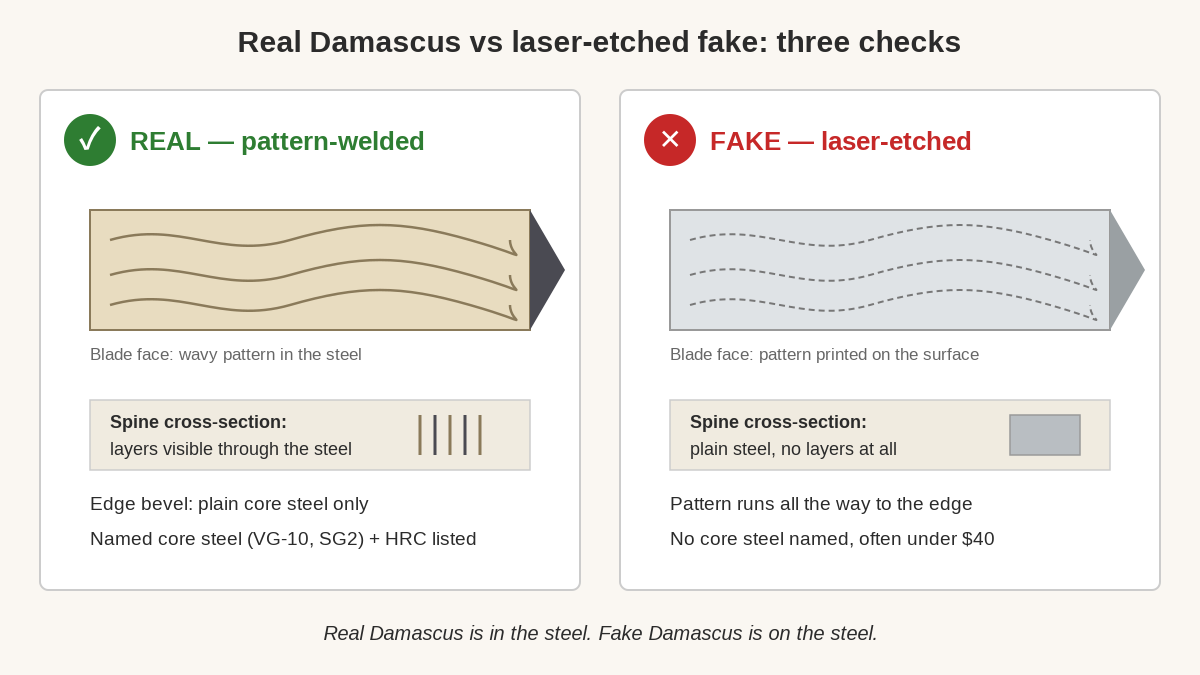
Fake Damascus is common, especially under $40, and the test is simple: real Damascus is in the steel, fake Damascus is on the steel.
A genuine pattern-welded blade shows its pattern in the metal itself. Look along the spine and the choil (the curved cutout where the blade meets the handle): on a real Damascus knife, the layers are visible in the cross-section, like rings in a cut tree trunk. A laser-etched fake shows the pattern only on the flat faces — the spine is plain, and the pattern stops dead at the edge instead of running through the steel.
Price is the second giveaway. Real pattern-welded VG-10 Damascus costs money to make: the steel is laminated, folded, forged, and etched by hand or in small batches. A genuine 8-inch VG-10 Damascus chef knife rarely sells below $40, and the established Japanese brands start around $100.
- Read the listing for a named core steel. Real makers name the core — VG-10, AUS-10, SG2 — and the hardness in HRC. A listing that says only “Damascus steel” without naming the core is hiding something.
- Check the pattern at the edge. On a real Damascus knife, the edge bevel is a single bright steel: the cladding is ground away at the edge, leaving only the core. If the wavy pattern runs all the way to the cutting edge, it was printed or etched on, not forged in.
How do you choose the right Damascus chef knife?
Start with the core steel and your sharpening habits, then let the pattern and handle decide between knives that are otherwise equal. Shun, Miyabi, and Enso all back their knives with lifetime warranties against defects — a no-name brand with no warranty has little reason to use real layered steel.
Match the steel to your maintenance. If you sharpen on a whetstone, VG-10 or SG2 will reward you. If you rely on a pull-through sharpener or a professional service once or twice a year, AUS-10 or VG-10 is the safer pick. Our guide to how to choose a chef’s knife covers blade length, handle shape, and balance in more detail. One newer steel worth comparing is MagnaCut, a US-made powder steel built to balance toughness, edge retention, and corrosion resistance — see our MagnaCut chef knife steel guide.
Pick 8 inches for most cooks. An 8-inch (210 mm) blade handles everything from mincing garlic to slicing a roast, and every Damascus line makes one. Go shorter only if your cutting board or your hands are small.
Hold the handle before you commit, if you can. Japanese Damascus knives use D-shaped or octagonal handles designed for a pinch grip. The Shun Classic’s D-shaped PakkaWood handle feels different from the Miyabi Birchwood’s rounded Karelian birch — neither is better, but one will fit your hand better.
Set your budget by the core, not the layer count. “67 layers” and “101 layers” sound like performance claims, but they are mostly marketing: once the cladding reaches about 33 layers per side, more layers change the look, not the cut.
Which Damascus chef knives are worth buying in 2026?
We compared specs, prices, and verified owner reviews across the Damascus chef knives sold on Amazon in the US, and three knives stand out at three budgets. Prices are as of November 2026.
| Knife | Core steel | Hardness | Layers | Handle | Price as of November 2026 |
|---|---|---|---|---|---|
| Sunnecko 8-inch Damascus Chef Knife | VG-10 | 60 HRC | 67 | ABS, full tang | ~$46 |
| Shun Classic 8-inch Chef’s Knife (DM0706) | VG-MAX | 60–61 HRC | 68 + core | Ebony PakkaWood, D-shape | ~$150–$190 |
| Miyabi Birchwood SG2 8-inch Chef’s Knife | SG2 | 63 HRC | 100 + core | Karelian birch, D-shape | ~$300–$365 |
Best budget pick: Sunnecko 8-inch Damascus Chef Knife — about $46
The Sunnecko is the cheapest honest Damascus knife we found with a named VG-10 core and a verified 67-layer construction. Its 8-inch blade is ground to a 10–12 degree edge per side — finer than most Western knives — and the full-tang ABS handle keeps the price down without making the knife feel flimsy. Owner reviews consistently praise how sharp it arrives out of the box. The ABS handle is plain next to wood, but the steel is the real thing. If you are new to Japanese knives, our guide to the best Japanese knife under $100 for beginners covers what else to expect at this price.
Check the price of the Sunnecko 8-inch Damascus Chef Knife on Amazon
Best all-rounder: Shun Classic 8-inch Chef’s Knife (DM0706) — about $150–$190
The Shun Classic is the reference Damascus chef knife. Its VG-MAX core — Shun’s proprietary steel, similar to VG-10 with added tungsten and cobalt — is clad in 68 layers of stainless Damascus, hand-ground to a 16-degree edge on each side, and hardened to 60–61 HRC. At 6.7 ounces it is light and nimble, the D-shaped ebony PakkaWood handle suits a pinch grip, and Shun sharpens its knives free for life in the US. Shun lists it at $189.95, and it regularly sells on Amazon for around $150–$165.
Check the price of the Shun Classic 8-inch Chef’s Knife on Amazon
Best premium pick: Miyabi Birchwood SG2 8-inch Chef’s Knife — about $300–$365
The Birchwood is the showpiece. An SG2 micro-carbide powder-steel core sits inside 100 layers of flower Damascus cladding — 101 layers in total — ice-hardened to 63 HRC and hand-honed to a 9.5–12 degree edge. The Karelian birch handle is the most beautiful of the three, and the blade’s “flower” pattern is finer and more detailed than the straight-wave pattern on the Shun. SG2 holds its edge noticeably longer than VG-10 between sharpenings, but the hard edge is also the least forgiving — keep it off bones, frozen food, and glass boards, and budget for whetstone sharpening. Zwilling lists it at $364.99, and it frequently sells for around $300.
Check the price of the Miyabi Birchwood SG2 8-inch Chef’s Knife on Amazon
How do you care for a Damascus chef knife?
A Damascus knife is stainless, but “stainless” means stain-resistant, not stain-proof — and the hard core steels in these knives need more care than a soft Western blade.
Hand wash, then dry immediately. The dishwasher’s heat, detergent, and rattling will dull the edge, loosen the handle, and can spot the Damascus pattern. Wash by hand with mild soap and hot water, then dry the blade at once — never leave it sitting wet in the sink.
Hone rarely, sharpen properly. These hard steels do not respond well to a grooved steel honing rod — a ceramic rod or a fine whetstone is the right tool. A 1000/6000-grit combination whetstone covers most home sharpening, and Shun’s free lifetime sharpening service is a real perk if you buy the Classic. Our guide to how to sharpen a kitchen knife at home walks through the whetstone routine step by step.
Frequently asked questions
Is a Damascus steel chef knife worth it?
Yes, if you value the look and buy for the core steel. A Damascus knife with a VG-10 or SG2 core cuts as well as any premium knife — but a $40 “Damascus” knife with an unnamed core is not worth it at any price.
Does Damascus steel stay sharp longer?
No — the pattern has no effect on edge retention. Edge retention comes from the core steel and its hardness: SG2 at 63 HRC holds an edge longer than VG-10 at 60 HRC, and both hold an edge far longer than soft Western stainless at 56–58 HRC.
Is real Damascus steel better than regular stainless steel?
For the cutting edge, no. The core steel in a Damascus knife is itself a stainless steel, and a plain VG-10 knife cuts exactly like a Damascus-clad VG-10 knife. Damascus is better only in that its layered cladding adds toughness and corrosion protection around the hard core.
How many layers should a good Damascus knife have?
Layer count is mostly cosmetic beyond about 33 layers per side. A 67-layer knife (33 + 33 + core) is the standard for VG-10 Damascus, and a 101-layer knife like the Miyabi Birchwood looks finer — but neither number tells you how sharp the knife is. Judge by the named core steel and hardness first.
The bottom line
A Damascus steel chef knife is a good knife with a beautiful pattern. The pattern is real craftsmanship, but it is the cladding — the part of the blade you look at, not the part that cuts. Buy for the core steel: VG-10 for most cooks, AUS-10 if you want easier sharpening, SG2 if you want the longest-lasting edge and are willing to care for it.