
The best Japanese knife under $100 for beginners is the Tojiro DP Gyuto 8.2-inch, at about $64–80 on Amazon (Nov 2026). It pairs a hard VG-10 stainless core with a familiar Western handle, so it feels like a normal chef’s knife and cuts like a Japanese one. If you are just starting out, this is the knife to buy — the rest of this guide explains why it wins and what to buy if your budget or your cooking is different.
As an Amazon Associate I earn from qualifying purchases.
TL;DR — the verdict for 2026:
- Best overall: Tojiro DP Gyuto 8.2-inch — VG-10 steel, 60 HRC, ~$64–80
- Best brand-name value: Shun Sora 8-inch Chef’s Knife — ~$60–70
- Best santoku: Tojiro DP Santoku 6.7-inch — ~$55–65
- Best pro-kitchen workhorse: Kai Wasabi Black 8-inch Chef’s Knife — ~$74
- Best budget pick: Mercer Culinary Genesis 8-inch — ~$30–40
We compared specs, prices, and verified owner reviews rather than testing units in a lab; prices move, so check the live Amazon price before you buy.
What makes a Japanese knife different from a Western chef’s knife?
A Japanese knife is thinner, harder, and sharpened to a narrower angle than a typical Western chef’s knife. The blade is usually ground to 15 degrees per side instead of 20, so it slices with less force and feels sharper even at the same hardness.
The trade-off is care. Hard, thin steel chips instead of bending when it hits something it shouldn’t, so you don’t cut bones, frozen food, or hard squash rinds with it, and you never put it in the dishwasher.
The other difference is blade shape: the gyuto is the all-purpose chef’s knife, the santoku is the shorter, flatter vegetable knife, and the nakiri is the straight-edged vegetable specialist. For a first Japanese knife, the gyuto is the safest shape.
What should a beginner look for in a Japanese knife under $100?
Steel: VG-10 or equivalent, at 58–61 HRC. VG-10 is the workhorse stainless of entry-level Japanese knives: hard enough to hold a 15-degree edge, stainless enough to forgive a beginner who doesn’t dry it perfectly.
Handle: Western-style for your first Japanese knife. Traditional Japanese handles (wa-handles) are light and beautiful, but the grip and balance feel unfamiliar at first. A Western handle feels like the knife you already own.
Blade length: 210 mm (8.2 inches) for a gyuto, 170 mm (6.7 inches) for a santoku. Shorter blades are easier to control but limit your rocking cut; 210 mm is the standard length for a reason.
Weight: under 8 ounces, balanced at the bolster. Japanese knives are light by design. A knife over 8 ounces stops feeling like a Japanese knife and starts feeling like a Western one.
Price: $55–80 buys the sweet spot. Below about $35, you are usually buying softer steel that won’t hold an edge; above $100, you are paying for fit and finish a beginner can’t feel yet.
The 5 best Japanese knives under $100 for beginners
1. Tojiro DP Gyuto 8.2-inch — best overall
The Tojiro DP Gyuto is the most recommended beginner Japanese knife in the world: a VG-10 cobalt-alloy steel core sandwiched between softer stainless layers, sharpened to 15 degrees, at a price that has barely moved in a decade.
- Blade: 210 mm (8.2 in), VG-10 core clad in 13-chrome stainless, 60 HRC
- Handle: black laminated wood, Western-style, full tang, triple-riveted
- Weight: about 7 oz (200 g)
- Price: ~$64–80 on Amazon (Nov 2026)
- Check the Tojiro DP Gyuto price on Amazon
2. Shun Sora 8-inch Chef’s Knife — best brand-name value
Shun is the best-known Japanese knife brand in the United States, and the Sora line is its cheapest way in: a VG10 composite blade with a textured polymer handle, hand-sharpened to a 16-degree edge.
- Blade: 8 inches (200 mm), VG10 composite core, 16-degree edge, hand-sharpened
- Handle: textured polymer, lightweight, slip-resistant
- Weight: about 6 oz
- Price: ~$60–70 on Amazon (Nov 2026)
- Check the Shun Sora price on Amazon
3. Tojiro DP Santoku 6.7-inch — best santoku
If most of your prep is vegetables, the santoku is the better first Japanese knife than a gyuto, and the Tojiro DP Santoku is the same VG-10 blade in a shorter, lighter shape.
- Blade: 170 mm (6.7 in), VG-10 core clad in 13-chrome stainless, 60 HRC
- Handle: black laminated wood, Western-style, full tang, triple-riveted
- Weight: about 6.7 oz (190 g)
- Price: ~$55–65 on Amazon (Nov 2026)
- Check the Tojiro DP Santoku price on Amazon
4. Kai Wasabi Black 8-inch Chef’s Knife — best pro-kitchen workhorse
The Kai Wasabi Black is the knife Japanese restaurant kitchens buy in bulk: built to be used hard, washed often, and sharpened fast, at a price a home cook can justify.
- Blade: 200 mm (8 in), Daido 1K6 stainless steel, 58 HRC
- Handle: matte black polypropylene with bamboo powder, water-resistant, sealed
- Weight: about 6.5 oz
- Price: ~$74 (Nov 2026; Amazon availability varies)
- Check the Kai Wasabi Black price on Amazon
5. Mercer Culinary Genesis 8-inch — best budget pick
The Genesis is the cheapest forged 8-inch knife on this list at around $30–40: a full-tang, forged German-steel chef’s knife that is not Japanese in steel or style, but is the best knife you can buy for the money if $35 is your ceiling.
- Blade: 8 inches, forged German high-carbon stainless steel (X50CrMoV15)
- Handle: Santoprene, textured, ergonomic, NSF-certified
- Weight: about 8 oz
- Price: ~$30–40 on Amazon (Nov 2026)
- Check the Mercer Genesis price on Amazon
How do the 5 knives compare?
| Knife | Blade | Steel / Hardness | Weight | Price (Nov 2026) | Best for |
|---|---|---|---|---|---|
| Tojiro DP Gyuto | 210 mm | VG-10 / 60 HRC | ~7 oz | ~$64–80 | Best overall |
| Shun Sora Chef’s | 200 mm | VG10 / 60 HRC | ~6 oz | ~$60–70 | Brand-name value |
| Tojiro DP Santoku | 170 mm | VG-10 / 60 HRC | ~6.7 oz | ~$55–65 | Vegetables, small hands |
| Kai Wasabi Black | 200 mm | 1K6 / 58 HRC | ~6.5 oz | ~$74 | Tough daily use |
| Mercer Genesis | 200 mm | X50CrMoV15 / 57–58 HRC | ~8 oz | ~$30–40 | Tightest budget |
The pattern is simple: $55–80 buys genuine VG-10 steel and a full tang. The Tojiro DP Gyuto is the default choice; the Shun Sora is the brand-name alternative; the Tojiro DP Santoku is the pick for vegetable-heavy cooking and smaller hands.
Gyuto vs santoku vs nakiri — which blade shape should you buy first?
The three shapes look similar on a shelf and cut very differently on a board. A gyuto has a pointed tip and a curved belly for rocking cuts; a santoku has a sheepsfoot tip and a flatter edge for straight chopping; a nakiri has a straight, rectangular blade made for vegetables.
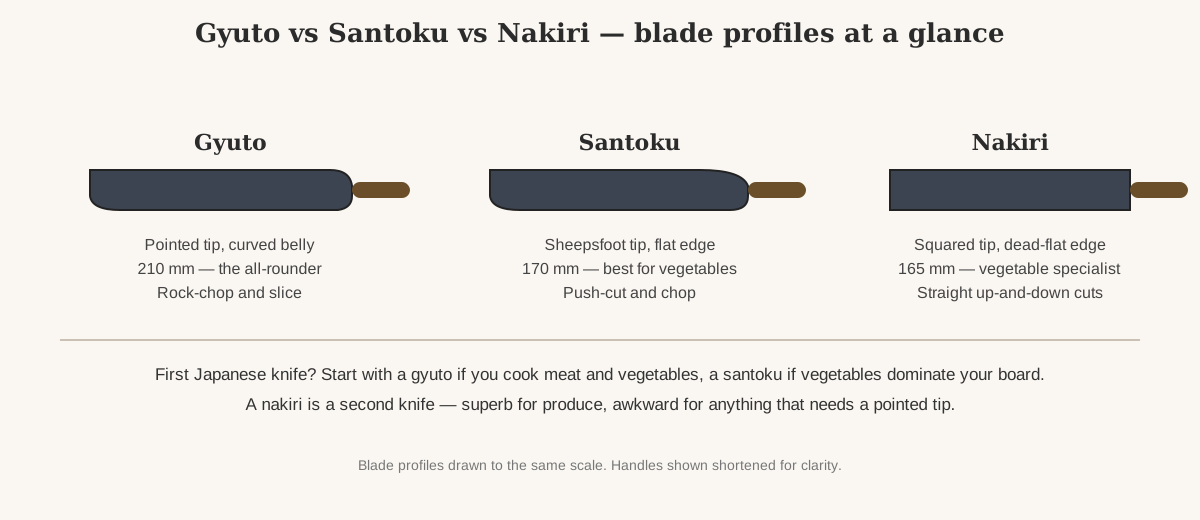
Buy the gyuto if you cook meat and vegetables in roughly equal measure, the santoku if vegetables dominate your prep, and the nakiri only as a second knife.
How hard is the steel, and why does the edge angle matter?
Harder steel (60–61 HRC) holds a narrow 15-degree edge longer, so the knife stays sharp for weeks of home use. Softer steel (57–58 HRC) dulls sooner but is tougher and more forgiving if you twist the blade or hit a bone.
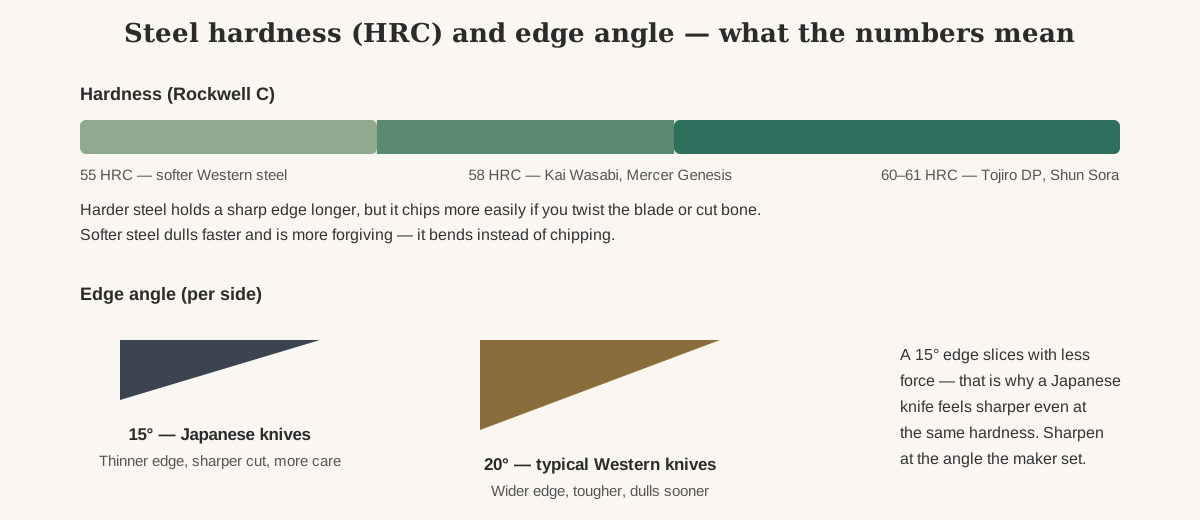
Sharpen at the angle the maker set. A Tojiro or Shun sharpened at 15 degrees per side will cut like new; a pull-through sharpener that grinds both sides at a fixed Western angle will undo that geometry. A whetstone and five minutes of practice are all it takes — a pull-through sharpener grinds both sides at a fixed Western angle and undoes the edge geometry, so leave it in the drawer.
How do you care for a Japanese knife?
Hand-wash the blade with warm water and mild soap, then dry it immediately — never leave it soaking, and never put it in the dishwasher, where heat, detergent, and rattling will dull and chip the edge. Store it on a magnetic strip or in a blade guard. Hone it lightly every few uses, then sharpen it properly two to four times a year. Don’t cut bones, frozen food, or hard squash rinds with a thin Japanese edge — use a heavier Western knife for those jobs. Don’t twist the blade while it is in food, and don’t scrape chopped food across the board with the edge; flip the knife and use the spine.
Frequently asked questions
What is the best Japanese knife under $100 for a beginner?
The Tojiro DP Gyuto 8.2-inch: a hard VG-10 steel core with a familiar Western handle at about $64–80.
Is VG-10 steel good for a first Japanese knife?
Yes — VG-10 holds a sharp 15-degree edge for weeks, resists rust well, and is the standard steel in entry-level Japanese knives.
Should a beginner buy a gyuto or a santoku first?
Buy a gyuto if you cook meat and vegetables equally, a santoku if vegetables dominate your prep.
Can I put a Japanese knife in the dishwasher?
No — dishwasher heat, detergent, and rattling dull and chip the thin, hard edge, so always hand-wash and dry it.
The bottom line
The best Japanese knife under $100 for beginners is the one that gets out of your way: a 210 mm gyuto or a 170 mm santoku, VG-10 steel at 60 HRC, a Western-style handle, and a price in the $55–80 band. The Tojiro DP Gyuto is the default answer; the Shun Sora is the brand-name alternative; the Tojiro santoku is the pick for vegetable-heavy cooking.