
The best chef knife for small hands is a 6-inch blade with a slim handle and a weight under 7 ounces — not the smallest knife on the shelf, but the one your hand can control through a full prep session. For most cooks with smaller hands, the Victorinox Fibrox Pro 8-inch is the best value at about $47, while the Mercer Culinary Genesis 6-inch is the best true small-hand fit at around $25–40.
As an Amazon Associate I earn from qualifying purchases.
TL;DR — the verdict for 2026:
- Best overall value: Victorinox Fibrox Pro 8-inch — about $47, light for an 8-inch knife with a grippy handle.
- Best true small-hand fit: Mercer Culinary Genesis 6-inch — around $25–40, a short forged blade and slim handle.
- Best lightweight Japanese pick: Global G-2 8-inch — about $100, one-piece stainless with a slim handle and thin, sharp edge.
- Best premium German pick: Wüsthof Classic 6-inch — about $120, forged high-carbon steel at 58 HRC, full tang.
- Best pro-level pick: MAC MTH-80 8-inch — about $150, a dimpled hollow edge that stops food sticking.
We compared specs, prices, and verified owner feedback across the current chef’s knife lineup rather than testing units in a lab. Prices are typical Amazon street prices as of November 2026 and move often.
Why does a standard chef’s knife feel too big for small hands?
A standard 8-inch chef’s knife is designed around an average adult male hand, and three things go wrong when your hand is smaller. First, the handle is too thick to close your fingers around, so you grip harder and tire faster. Second, the blade is long enough that the tip wanders when you rock-chop, because your wrist can’t lever the extra length. Third, a heavy forged knife — 9 to 10 ounces — pulls your wrist down during a long prep session.
None of this means you need a paring knife for everything. It means the right chef’s knife for small hands optimizes three numbers: blade length, handle circumference, and weight.
What should you look for in a chef’s knife for small hands?
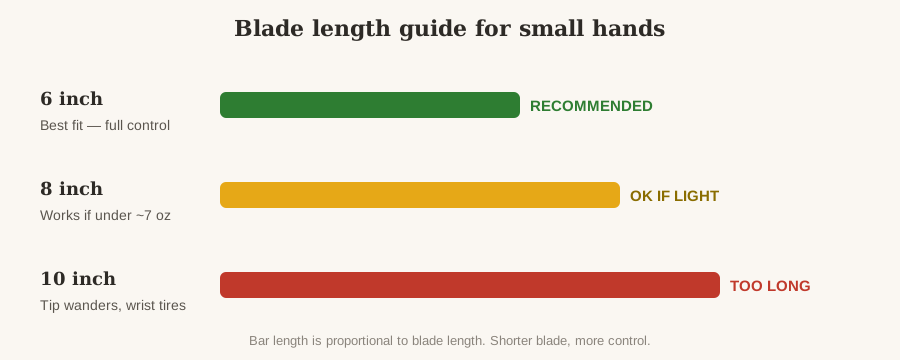
Blade length: 6 inches is the sweet spot, 8 inches works if it’s light. A 6-inch blade covers 90% of home prep — onions, herbs, chicken breasts, potatoes — while keeping the tip under your control. An 8-inch blade handles watermelon and cabbage better, but only buy one if it weighs under about 7 ounces. Skip 10-inch blades entirely unless you regularly break down large roasts.
Handle: slim, with a shape you can close your hand around. Look for handles under about 1 inch thick at the widest point, with no bulky bolster forcing your fingers apart. Narrow, oval cross-sections fit small palms better than wide, rectangular ones. Textured or rubberized handles (like Victorinox’s Fibrox) help because you don’t have to squeeze as hard to keep the knife from slipping.
Weight: under 7 ounces, and balanced at the bolster. A knife that balances where blade meets handle feels lighter than its scale weight, because your wrist isn’t fighting a tip-heavy or handle-heavy lever. Japanese-style knives (Global, MAC) tend to be lighter than German forged knives (Wüsthof) at the same length, which is why they show up so often in small-hand recommendations.
Steel and edge: hard enough to hold an edge, easy enough to maintain. Japanese knives run harder (around 58–61 HRC) and stay sharp longer but chip more easily if you twist the blade. German knives run softer (around 56–58 HRC), need honing more often, but survive rougher use. Either works for small hands — pick based on how you cook, not on your hand size.
The 5 best chef knives for small hands
1. Victorinox Fibrox Pro 8-inch — best overall value
The Fibrox Pro is the most recommended budget chef’s knife in owner reviews: it does nearly everything a $150 knife does at about $47, and it fits small hands better than most knives at its price. The 8-inch high-carbon stainless blade is stamped, not forged, which keeps the weight around 7 ounces, and the slim Fibrox handle is textured and non-slip even when wet.
The trade-off is the edge: stamped blades at this price don’t hold an edge as long as forged German or hard Japanese steel, so expect to hone it every few uses and sharpen it a few times a year. That’s a fair trade at $47.
- Blade: 8 inches, high-carbon stainless steel, stamped
- Handle: Fibrox (textured, non-slip), slim profile
- Weight: about 7 oz
- Price: about $47 on Amazon as of November 2026
- Check price on Amazon
2. Mercer Culinary Genesis 6-inch — best true small-hand fit
If an 8-inch blade feels too long, the Genesis 6-inch actually solves the problem. Its 6-inch forged German steel blade (X50 CrMoV15) is short enough that the tip stays under your control, and the Santoprene handle is one of the slimmest on any forged knife. At around $25–40, it’s also the cheapest forged knife on this list.
Owner reviews from cooks with small hands repeatedly call out the same thing: this is the first chef’s knife that doesn’t feel like holding a hammer. The short bolster on the M20606 model leaves more of the handle usable, so your fingers sit naturally instead of bunching against a wall of steel. The downside is reach: a 6-inch blade struggles with large watermelons and wide cabbages, so keep a longer knife or a serrated bread knife for those jobs.
- Blade: 6 inches, forged German high-carbon steel (X50 CrMoV15)
- Handle: Santoprene, slim, ergonomic
- Weight: about 5 oz
- Price: about $25–40 on Amazon as of November 2026
- Check price on Amazon
3. Global G-2 8-inch — best lightweight Japanese pick
The Global G-2 is the lightest-feeling 8-inch knife on this list: a single piece of CROMOVA 18 stainless steel, stamped, with a hollow handle balanced for the bolster. It weighs about 6 ounces and feels more like an extension of your hand than a tool you’re carrying.
The handle is the G-2’s signature and its divisive feature. It’s slim, smooth, and dimpled — excellent for small hands, but slippery when wet, so dry your hands before a long prep session. The edge is thin and razor-sharp out of the box, and it holds that edge well thanks to the hard Japanese steel. But the same hardness means you should never twist the blade while cutting and never put it in the dishwasher — hand-wash and dry it.
- Blade: 8 inches (20 cm), CROMOVA 18 stainless steel, stamped
- Handle: one-piece stainless, dimpled, slim
- Weight: about 6 oz
- Price: about $100 on Amazon as of November 2026
- Check price on Amazon
4. Wüsthof Classic 6-inch — best premium German pick
The Wüsthof Classic 6-inch is the premium answer to the same problem the Mercer solves: a forged German knife in a length small hands can control. Its 6-inch blade is precision-forged from a single piece of high-carbon stainless steel, tempered to 58 HRC, with a full tang and triple-riveted black POM handle. At about 6 ounces it feels planted rather than tiring, because the weight sits close to your hand.
What you’re paying for over the Mercer is edge retention and fit-and-finish: the Classic holds its edge noticeably longer between sharpenings, and the full bolster gives your fingers a clear, safe stopping point. The bolster is also the one thing to check before buying — it runs the full height of the blade at the handle, and some cooks with very small hands find it pushes their grip forward. If you can, hold one in a store before ordering.
- Blade: 6 inches, forged high-carbon stainless steel, 58 HRC
- Handle: black POM, triple-riveted, full tang
- Weight: about 6 oz
- Price: about $120 on Amazon as of November 2026
- Check price on Amazon
5. MAC MTH-80 8-inch — best pro-level pick
The MAC MTH-80 is the knife professional cooks with smaller hands reach for, and its secret is the dimpled hollow edge: small indentations along the blade that create air pockets so sliced food doesn’t stick. You’re not fighting suction on every cut, so you use less force.
At about $150, the MTH-80 is the most expensive knife here, but it earns the price in edge retention and weight. The 8-inch (200 mm) blade is thin, light at about 6 ounces, and the Pakkawood handle is slim with a comfortable oval cross-section. Owner feedback from line cooks consistently rates it as the easiest 8-inch knife to use all shift. The one caution: like all hard Japanese steel, it chips if abused — no bones, no frozen food, no dishwasher.
- Blade: 8 inches (200 mm), dimpled hollow edge, high-carbon steel
- Handle: Pakkawood, slim oval cross-section
- Weight: about 6 oz
- Price: about $150 on Amazon as of November 2026
- Check price on Amazon
How do the 5 knives compare?
| Knife | Blade | Weight (approx.) | Handle | Price (Nov 2026) | Best for |
|---|---|---|---|---|---|
| Victorinox Fibrox Pro | 8 in, stamped | ~7 oz | Fibrox, textured, slim | ~$47 | Best value, all-round use |
| Mercer Genesis | 6 in, forged | ~5 oz | Santoprene, slim | ~$25–40 | Smallest hands, tightest budget |
| Global G-2 | 8 in, stamped | ~6 oz | Stainless, dimpled, slim | ~$100 | Lightest feel, Japanese steel |
| Wüsthof Classic | 6 in, forged | ~6 oz | POM, triple-riveted | ~$120 | Premium German build, edge retention |
| MAC MTH-80 | 8 in, dimpled | ~6 oz | Pakkawood, slim oval | ~$150 | Pro-level, food release |
The pattern is simple: under $50, buy the Mercer 6-inch for the best fit or the Victorinox 8-inch for the best reach. At $100 or more, the Global G-2 is the lightest 8-inch option and the MAC MTH-80 is the best-performing one. The Wüsthof Classic 6-inch is the right premium pick if you prefer German forged steel.
How do you hold a chef’s knife with small hands?
Technique matters as much as the knife. The pinch grip is the single biggest upgrade for small hands, and it takes about a week to feel natural.
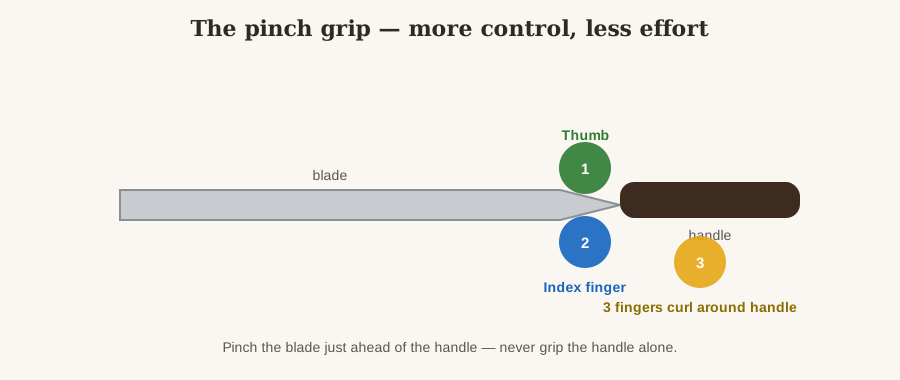
- Pinch the blade, don’t grip the handle. Place your thumb on one side of the blade and your index finger on the other, just ahead of the handle. Your remaining three fingers curl loosely around the handle. This puts your hand closer to the cutting edge, which gives you more control with less effort.
- Let the knife’s weight do the work. A sharp knife cuts with its own weight plus gentle forward pressure. If you’re pressing down hard, the knife is dull — hone it, don’t push harder.
- Keep your guiding hand in a claw. Curl the fingertips of your non-knife hand under, knuckles forward, so the flat of the blade slides against your knuckles.
- Rock, don’t chop. Keep the tip on the board and rock the blade forward through the cut — it needs far less wrist strength than lifting and slamming the knife down.
If the pinch grip still feels awkward after a week, the knife is too big — drop to a 6-inch blade or a lighter knife rather than fighting the grip.
Frequently asked questions
What size chef’s knife is best for small hands?
A 6-inch blade is the best starting point, because the tip stays under your control and the knife weighs less. An 8-inch blade works too if it weighs under about 7 ounces and has a slim handle.
Is a 6-inch chef’s knife too small for everyday cooking?
No — a 6-inch chef’s knife handles about 90% of home prep, including onions, herbs, chicken, and potatoes. It only struggles with very large items like watermelon and wide cabbage.
Are Japanese knives better for small hands than German knives?
Japanese knives are usually lighter and slimmer, which suits small hands, but German knives in 6-inch lengths fit just as well. Pick based on how you cook and maintain knives, not on country of origin alone.
Should I buy a knife set or a single chef’s knife?
Buy a single good chef’s knife first. Most sets include blades you’ll rarely use, and the money is better spent on one knife that fits your hand plus a honing steel.
How often should I sharpen a chef’s knife?
Hone the edge with a honing steel every few uses to keep it aligned, and sharpen it on a whetstone or with a professional service two to four times a year, depending on how often you cook.
The bottom line
The best chef knife for small hands is the one that disappears in your hand: a 6-inch blade or a light 8-inch blade, a slim handle you can close your fingers around, and a weight under 7 ounces. Start with the Mercer Genesis 6-inch for the best fit at the lowest price, or the Victorinox Fibrox Pro 8-inch for the best all-round value. Either way, pair it with a pinch grip and a honing steel — the knife matters, but the grip matters more.