
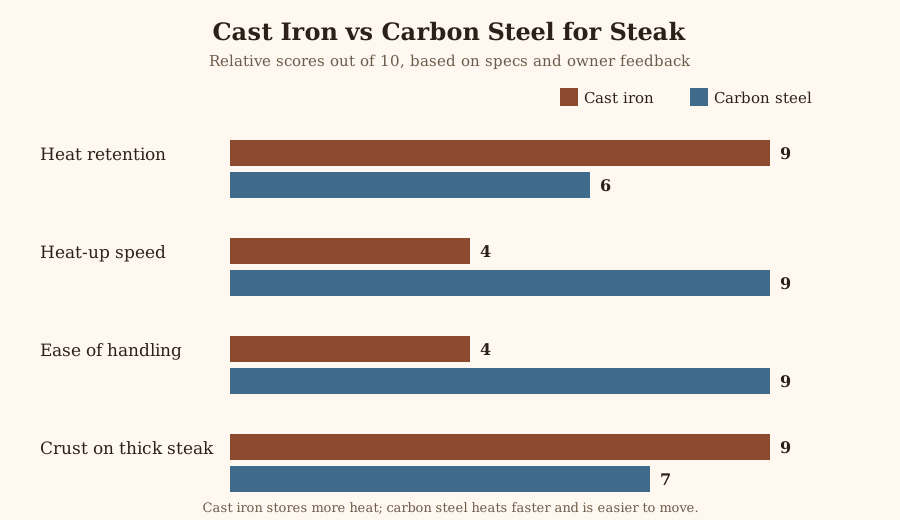
For steak, cast iron wins on heat retention and crust, while carbon steel wins on weight and responsiveness. A 12-inch cast iron skillet holds more heat when a cold steak hits the pan, so the crust browns harder; a carbon steel pan of the same size heats faster, weighs roughly half as much, and is easier to lift and move.
As an Amazon Associate I earn from qualifying purchases.
A great steak sear comes down to one thing: a pan surface hot enough to brown meat fast, before heat creeps into the center and overcooks it. Both pans are made almost entirely of iron — carbon steel is roughly 99 percent iron and 1 percent carbon, cast iron is iron with 2 to 4 percent carbon. The difference is thickness, weight, and how the pan behaves in the 90 seconds after the steak lands.
We compared specs, prices, and verified owner reviews for the best-known pans in both camps. Thick steaks and the deepest crust point to cast iron; frequent cooking and a pan you will actually reach for point to carbon steel.
How do cast iron and carbon steel actually differ?
Cast iron is poured molten into a mold, so cast iron skillets are thick, heavy, and slightly rough. Carbon steel is rolled from sheet steel, so its pans are thinner, smoother, and lighter at the same diameter.
That difference drives everything else. A 12-inch Lodge cast iron skillet weighs about 7.7 pounds; a 12-inch Lodge carbon steel skillet is roughly half that. The cast iron pan’s extra mass stores more heat, while the carbon steel pan’s thinner body heats up faster and responds faster when you turn the burner down.
Both need seasoning — a thin layer of polymerized oil bonded to the iron — and both rust if left wet. Neither has a synthetic nonstick coating, so both handle the high heat steak searing demands.
| Feature | Cast iron | Carbon steel |
|---|---|---|
| Material | Iron with 2–4% carbon, cast in a mold | Iron with ~1% carbon, rolled from sheet steel |
| Typical weight, 12-inch skillet | About 7.7 lb (Lodge L10SK3) | About 4–5 lb (Lodge CRS12) |
| Heat-up time | Slow, 5–8 minutes | Fast, 2–4 minutes |
| Heat retention | Excellent — barely drops when steak is added | Good — drops more, recovers faster |
| Cooking surface | Slightly rough, as-cast texture | Smooth, rolled steel |
| Seasoning needed | Yes, pre-seasoned from the factory | Yes, must be seasoned before first use |
| Best for steak | Thick steaks, deep crust, oven finishing | Weeknight steaks, flipping, one-pan meals |
| Typical price, 12-inch | About $30 (Lodge) | About $42–$45 (Lodge) to about $127 (de Buyer) |
Which pan sears a steak better?
For a thick steak — a ribeye or strip steak 1 to 1.5 inches thick — cast iron sears better. When a cold steak hits a 450-degree pan, the pan surface temperature drops. A heavy cast iron skillet has more thermal mass, so it drops less and recovers faster, which means the surface stays hot enough to keep browning instead of steaming the meat.
Carbon steel still sears well, especially on steaks under an inch thick, where faster heat recovery matters more than total stored heat. On a thick steak cooked to medium-rare, the cast iron crust is usually darker and more even edge to edge.
Heat retention is a function of mass: a 7.7-pound cast iron skillet stores roughly twice the heat energy of a carbon steel pan of the same size. The gap shows up most when you sear two steaks back to back — the cast iron pan is still hot for the second steak, while the carbon steel pan needs a minute on the burner to come back up.
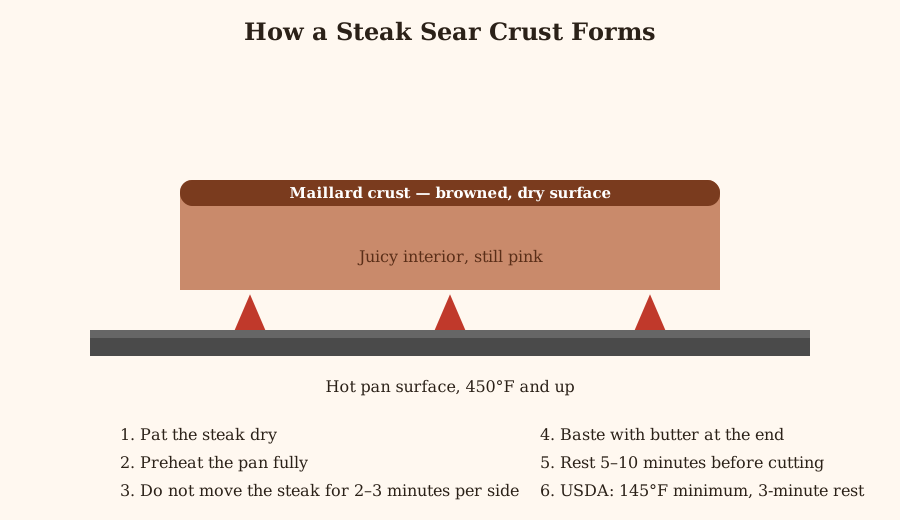
One thing matters more than the pan: the steak must be dry. Pat it completely dry with paper towels, and salt just before cooking or at least 40 minutes ahead — a wet surface steams, and no pan can brown a wet steak.
How much does weight and handling matter for steak?
Weight matters more than most buyers expect, because it decides whether you actually use the pan. A 12-inch cast iron skillet at 7.7 pounds is a two-hand lift for many cooks once a steak, butter, and herbs are in it. Flipping a steak with tongs is fine, but tilting the pan to baste or pouring off fat is a workout.
Carbon steel’s weight advantage is the single biggest reason chefs reach for it daily. At roughly half the weight, a carbon steel pan is easy to lift with one hand and tilt for butter basting. The long, angled handles on de Buyer and Matfer pans are also easier to grip than the short handle on a Lodge cast iron skillet.
If you have wrist or grip issues, or you cook steak more than twice a week, the lighter pan wins on handling alone. If the pan mostly stays on the burner, cast iron’s weight is irrelevant.
What about seasoning, cleaning, and maintenance?
Both pans need seasoning and both punish the same mistakes. Seasoning is a thin layer of oil heated past its smoke point until it bonds to the iron. Lodge cast iron skillets arrive pre-seasoned with soy-based vegetable oil and are ready to cook; de Buyer Mineral B pans arrive coated in beeswax that must be washed off with hot water before the first seasoning; Matfer pans arrive unseasoned. Our step-by-step guide covers the first seasoning in detail: How to Season a Carbon Steel Pan the First Time.
Daily care is identical for both. Wash with hot water and a little dish soap, dry immediately — on the stove over low heat for a minute is the reliable method — and wipe in a drop of oil. Never soak either pan, and never put either in the dishwasher. Both will rust if left wet, and both recover from light rust with a scrub and a fresh seasoning round.
One real difference: carbon steel’s smoother surface builds seasoning faster, so eggs and fish release sooner. Cast iron’s rougher surface takes longer to become truly slick, but its seasoning is more forgiving of mistakes.
What are the best pans for searing steak?
We compared specs, prices, and verified owner reviews across both materials. The five pans below cover every budget and cooking style. Note the price gap: the $30 Lodge cast iron sears as well as — and on thick steaks, better than — carbon steel pans costing four times as much. You pay more in carbon steel for weight and handling, not for a better crust. The premium cast iron option, the Smithey No. 12 at about $220, is sold only through Smithey’s own website, not on Amazon.
| Pan | Material | Size | Weight | Price (Nov 2026) |
|---|---|---|---|---|
| Lodge Cast Iron Skillet L10SK3 | Cast iron | 12 in | About 7.7 lb | About $30 |
| Lodge Cast Iron Skillet L8SK3 | Cast iron | 10.25 in | About 5.7 lb | About $20–$27 |
| Lodge Carbon Steel Skillet CRS12 | Carbon steel | 12 in | Roughly half the cast iron | About $42–$45 |
| de Buyer Mineral B 5610.32 | Carbon steel | 12.5 in | About 6.4 lb | About $127 |
| Matfer Bourgeat 062004 | Carbon steel | 11 in | 4.08 lb | About $107–$113 |
Lodge Cast Iron Skillet, 12-inch (L10SK3) — the best steak pan for most people
The Lodge 12-inch cast iron skillet is the default answer for a reason. At about $30 as of November 2026, it is made in the USA, arrives pre-seasoned, and its 7.7 pounds of iron hold heat better than any other pan at this price. The 12-inch diameter fits two strip steaks side by side. Its only real weakness is weight: moving a loaded pan takes two hands.
Lodge Cast Iron Skillet, 10.25-inch (L8SK3) — the best smaller cast iron for steak
The Lodge 10.25-inch cast iron skillet is the same pan in a smaller, lighter package — about 5.7 pounds and typically $20 to $27 as of November 2026. It fits one large steak or two small ones and heats faster than its 12-inch sibling. If you usually cook steak for one or two people, this is the smarter Lodge to buy.
Lodge Carbon Steel Skillet, 12-inch (CRS12) — the best budget carbon steel for steak
The Lodge 12-inch carbon steel skillet is the cheapest way into carbon steel, at about $42 to $45 as of November 2026. It is made in the USA from 12-gauge carbon steel, arrives pre-seasoned, and weighs roughly half what the same-size Lodge cast iron weighs. The trade-off is a thinner body that drops more temperature when the steak lands, so give it an extra minute on the burner and let it recover between steaks.
de Buyer Mineral B Fry Pan, 12.5-inch (5610.32) — the best premium carbon steel for steak
The de Buyer Mineral B 12.5-inch fry pan is the carbon steel pan most professional kitchens reach for. Made in France from 99 percent iron and 1 percent carbon, it has a 9-inch flat cooking surface — enough for two steaks — and a 3 mm body that balances heat retention with responsiveness. It typically sells for about $127 on Amazon as of November 2026. Note the factory beeswax coating must be washed off before the first seasoning, and the pan is oven-safe only to 400°F for up to 10 minutes.
Matfer Bourgeat Black Carbon Steel Fry Pan, 11-inch (062004) — the chef’s favorite, with one caveat
The Matfer Bourgeat 11-inch black carbon steel pan is the pan French chefs buy for themselves: a welded handle with no rivets to trap grease, a smooth surface that seasons fast, and just 4.08 pounds of weight. It typically sells for about $107 to $113 as of November 2026. One honest caveat: in 2024 French authorities recalled Matfer’s black steel pans, including models 062001 through 062006, over metal release in acidic conditions during lab testing; Matfer disputes the testing method. Season the pan well before first use and avoid long acidic cooks in it — for steak searing, the issue does not apply.
How should you sear a steak in either pan?
The method is the same in both pans.
- Dry the steak completely. Pat all sides with paper towels until no moisture remains. A dry surface is the single biggest factor in a good crust.
- Preheat the pan properly. Cast iron needs 5 to 8 minutes over medium-high heat; carbon steel needs 2 to 4 minutes. Flick a drop of water in: it should sizzle and evaporate instantly.
- Add a high-smoke-point oil. A thin film of avocado oil, refined olive oil, or beef tallow — not butter, which burns at searing temperature.
- Lay the steak away from you and do not move it. Press it down lightly for the first 10 seconds, then leave it alone for 2 to 3 minutes per side.
- Baste at the end. Drop the heat, add butter, crushed garlic, and thyme, and spoon the foaming butter over the steak for the final minute.
- Rest before cutting. Rest 5 minutes for a 1-inch steak and 10 minutes for thicker cuts. The USDA recommends cooking steak to a minimum internal temperature of 145°F followed by a 3-minute rest, and a thermometer is more reliable than timing alone.
Which pan should you buy for steak?
Buy cast iron if you sear thick steaks, cook mostly on weekends, and want the deepest crust for the least money. The Lodge 12-inch at about $30 is the best value in all of cookware, and there is no steak it cannot handle.
Buy carbon steel if you cook steak often, want a pan you can lift with one hand, and value fast heat control over maximum heat storage. The Lodge CRS12 at about $42 is the low-risk way to try carbon steel; the de Buyer Mineral B at about $127 is the buy-once version.
Buy both if you cook steak weekly and have the storage space. Use cast iron for thick ribeyes and oven finishes, and carbon steel for weeknight strips and butter basting. The two pans together cost less than most single premium skillets.
One last note: stainless steel can sear a steak too, but it needs more technique and more fat to release cleanly. If you are weighing a clad stainless pan against these two, our comparison of the two most popular stainless options may help: HexClad vs All-Clad Stainless Steel.
Frequently asked questions
Is cast iron or carbon steel better for steak?
Cast iron is better for thick steaks because its greater mass holds more heat, so the crust browns harder when a cold steak hits the pan. Carbon steel is better for thin steaks and frequent cooking because it heats faster and weighs about half as much.
Can you sear a steak in a carbon steel pan?
Yes, a carbon steel pan sears steak well as long as it is fully preheated and the steak surface is completely dry. Preheat for 2 to 4 minutes over medium-high heat, use a high-smoke-point oil, and do not move the steak until the crust forms.
Does cast iron give steak a better crust than carbon steel?
On thick steaks, yes — cast iron’s heat retention keeps the pan surface hotter after the steak is added, which produces a darker, more even crust. On thin steaks under an inch thick, the crust difference between the two pans is small.
Do you need to season a pan before searing steak?
Yes, both cast iron and carbon steel need a seasoned surface before searing steak. Lodge cast iron and Lodge carbon steel arrive pre-seasoned, while de Buyer and Matfer pans need seasoning before first use — our guide walks through it step by step.