
To clean a burnt stainless steel pan without scratching it, simmer water with a few tablespoons of baking soda for 10 to 15 minutes, let it cool, then lift the residue with a wooden spoon and a non-scratch sponge. For stubborn patches, use a Bar Keepers Friend paste, rubbed with the grain of the steel.
A burnt stainless steel pan looks ruined. The bottom is black, the sides are streaked brown, and the first instinct is to grab the steel wool and attack it. That instinct is exactly what damages the pan: the polished cooking surface scratches more easily than most people expect, and those scratches become the places food sticks to next time.
The good news is that a burnt stainless steel pan is almost always recoverable. The black layer is carbonized food, not damage to the metal, and it comes off with heat, water, and a mild alkali — no brute force required. The methods below follow the published care guidance from All-Clad and Tramontina, the label directions on Bar Keepers Friend, and verified owner feedback.
What actually happens when food burns onto stainless steel?
Stainless steel has no nonstick coating, so food bonds directly to the metal when it overheats. Sugars caramelize, then carbonize; proteins dry out and weld themselves to the surface; fats polymerize into a hard, dark film. The result is a layer of burnt-on carbon on top of the steel — and it is that layer, not the steel, that you need to remove.
Two things make the job harder. First, a dry, empty pan heats far past cooking temperature in under a minute — which is why most burnt pans start with a forgotten pan on a hot burner. Second, water alone will not dissolve carbonized food. That is why soaking rarely finishes the job: you need heat plus a mild alkali to soften the layer before scrubbing. The discoloration left after the black crust is gone — rainbow tints, faint brown shadows — is usually just a thin oxide layer, not damage, and it comes off with a gentler step covered later.
What should you do before you start scrubbing?
Start with the gentlest step and work up. Every burnt pan follows the same escalation: soak, simmer, paste, polish. Skipping ahead to an abrasive pad is how scratches happen.
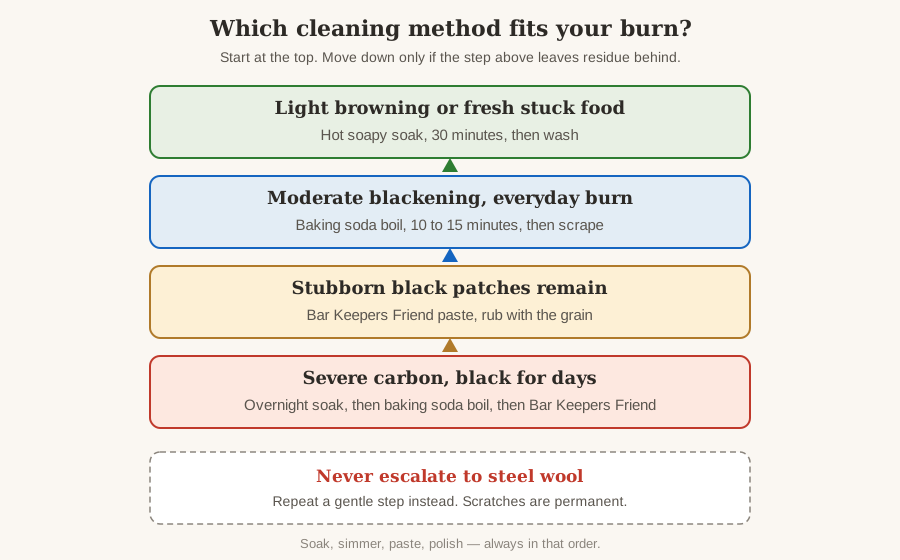
First, let the pan cool. Never plunge a hot stainless steel pan into cold water: the thermal shock can warp a thin pan and loosen the bonded base on a clad pan — All-Clad’s care guidance warns against it, and it is standard advice across the major makers. Next, scrape off whatever comes off easily with a wooden spoon or a plastic scraper, stopping as soon as it stops lifting anything; what resists needs chemistry, not force. Then decide which method fits the burn: light browning needs only a soak and a simmer, a thick black crust needs the baking soda boil, and a pan black for days needs Bar Keepers Friend. The flowchart below maps burn severity to method.
How do you clean a lightly burnt pan with the baking soda boil?
The baking soda boil is the first method to try on any burnt stainless steel pan, and it handles most everyday burns on its own. Baking soda is a mild alkali: heated in water, it softens carbonized food and loosens its grip on the steel without attacking the metal.
- Scrape off the loose bits. Use a wooden spoon or plastic scraper to remove anything flaky.
- Add water and baking soda. Pour in enough water to cover the burnt area by about an inch, then stir in 2 to 3 tablespoons of baking soda per cup of water — about 2 cups of water and 4 to 5 tablespoons for a 12-inch skillet.
- Simmer, don’t boil hard. Set the pan over medium heat and bring the mixture to a gentle simmer for 10 to 15 minutes. You will see dark flakes lifting off the surface.
- Let it cool, then scrape again. Turn off the heat and let the pan cool for 20 to 30 minutes. Scrape the loosened residue with the wooden spoon; most of it should come away in sheets.
- Wash normally. Wash with hot water, a drop of dish soap, and a non-scratch sponge, then dry immediately to prevent water spots.
If a thin brown film remains, repeat the simmer once more rather than reaching for anything abrasive. Two gentle rounds beat one aggressive scrub.
What about the vinegar and baking soda method?
Vinegar and baking soda is the most-searched cleaning combination on the internet, and it is also the most misunderstood. Mixed together in a bowl, the two neutralize each other into mostly salty water — the fizz looks impressive and does almost nothing. Used in sequence, though, they are genuinely useful, because each one does a different job.
Here is the sequence that works: do the baking soda boil first and wash the pan. Then add equal parts white vinegar and water — about a cup of each for a 12-inch skillet — and simmer for 5 minutes. The hot, mildly acidic solution dissolves the chalky white residue and light heat tint the baking soda leaves behind. Rinse and towel dry. Use vinegar as a finishing step, not the main event: it dissolves mineral deposits, but it does not soften thick carbon the way the baking soda boil does.
How do you use Bar Keepers Friend on a burnt pan?
When simmering leaves a stubborn black patch, Bar Keepers Friend is the standard next step — the product most stainless steel makers themselves recommend by name. Its active ingredient is oxalic acid, a mild acid that dissolves burnt-on residue and mineral deposits without the harshness of oven cleaner. The label directions are simple: wet the surface, sprinkle on the powder, rub gently with a non-abrasive cloth or sponge, and rinse thoroughly.
- Wet the burnt area with a little warm water.
- Sprinkle on the powder. Use about a tablespoon for a 12-inch skillet, enough to cover the burnt patch.
- Make a paste and wait. Add a few drops of water and mix it into a thin paste right on the pan. Let it sit for 1 to 2 minutes — no longer, per the label.
- Rub with the grain. Using a soft cloth or a non-scratch sponge, rub in straight lines following the faint brushed grain of the steel, not in circles, which leave visible swirl marks.
- Rinse thoroughly and dry. Rinse with hot water until no white residue remains, then towel dry immediately.
Use it only on stainless steel: the label warns against using it on nonstick coatings, cast iron, and anodized aluminum. As of November 2026, a 12-ounce can of Bar Keepers Friend powder typically sells for around $3 to $5 at US grocery and hardware stores.
What works on a badly carbonized pan?
A pan that has been black for days needs patience more than force. Soak it overnight in hot water with a squirt of dish soap or a few tablespoons of baking soda; the next morning, simmer fresh water and baking soda for 15 to 20 minutes, scrape off the loosened crust, and finish the remaining patches with Bar Keepers Friend. A truly carbonized pan sometimes needs two full cycles — that is normal, and still faster and safer than an hour of hard scrubbing. Never escalate to steel wool: the scratches are permanent, and a scratched surface grabs food more aggressively, so the next burn happens sooner.
Which cleaning method should you use? A quick comparison
| Method | Best for | Time | Risk to the finish |
|---|---|---|---|
| Hot soapy soak | Light browning, fresh stuck food | 30 min to overnight | None |
| Baking soda boil | Most everyday burns, moderate blackening | 20 to 30 minutes | None |
| Vinegar simmer (after baking soda) | White mineral spots, light heat tint | 10 minutes | None |
| Bar Keepers Friend paste | Stubborn black patches, heavy discoloration | 5 to 10 minutes | Very low if rubbed with the grain |
| Dishwasher tablet soak | Severe carbon that resisted simmering | 6 to 8 hours | Low on bare stainless; avoid coated exteriors |
| Steel wool or metal scouring pad | Nothing — it scratches the surface | Fast, and permanently damaging | High — leaves permanent scratches |
What should you never use on stainless steel?
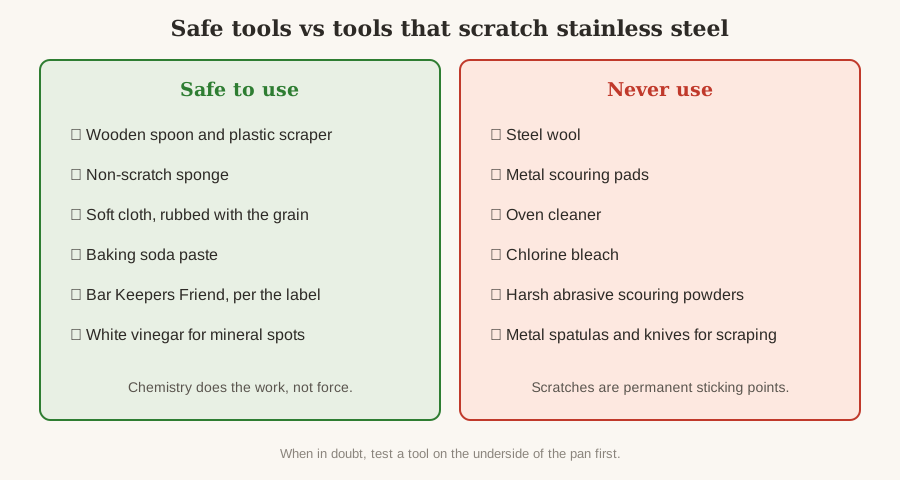
Some cleaning tools are simply wrong for stainless steel, no matter how bad the burn looks. Tramontina’s and All-Clad’s published care guidance both warn against abrasive pads: the polished surface is the nonstick system, and once it is scratched, food sticks more.
- Steel wool and metal scouring pads. The classic mistake. They remove the burn — and a layer of the polished finish with it. The scratches are permanent and become new sticking points.
- Oven cleaner. Formulated for oven enamel, not cookware. It is caustic, it can discolor stainless steel, and it is not meant to contact a food surface.
- Chlorine bleach. Bleach can pit stainless steel, especially if left in contact or used hot. Never mix it with other cleaners.
- Abrasive powdered cleansers other than Bar Keepers Friend. Many scouring powders contain harsh abrasives meant for porcelain or tile. If the label does not say it is safe for stainless steel, do not use it on a pan.
- Metal utensils for scraping. A metal spatula edge or a knife will gouge the surface. Wood, plastic, and silicone are the safe choices.
If you are unsure whether a tool is safe, test it on the underside of the pan first.
How do you remove rainbow stains and white spots?
Once the black crust is gone, two cosmetic problems often remain: rainbow-colored heat tint and chalky white spots. Both are common, both are harmless, and both come off easily.
Rainbow stains are heat tint, a thin oxide layer that forms when stainless steel gets very hot. Bar Keepers Friend removes it in under a minute, and the vinegar simmer above works for light tint. White spots are mineral deposits from hard water: wipe them with undiluted white vinegar, rinse, and dry. Neither affects how the pan cooks. Drying the pan with a towel after every wash prevents both from forming.
How do you keep a stainless steel pan from burning next time?
Cleaning is the rescue; prevention is the habit. Most burnt pans trace back to three mistakes, all easy to fix.
Preheat correctly. Set the empty pan over medium heat for 2 to 3 minutes, then flick in a few drops of water. When the drops bead up and glide across the surface, the pan is ready. Add oil, wait a few seconds for it to shimmer, then add food. Food dropped into a cold pan sticks; food dropped into a properly heated pan releases.
Control the heat. Stainless steel holds heat well, so medium is usually enough. High heat is for searing only, and briefly — an empty pan left on high overshoots cooking temperature in under a minute.
Deglaze while the pan is still warm. After cooking, pour in a splash of water or stock and scrape the bottom with a wooden spoon. The fond — the browned bits stuck to the pan — lifts off in seconds while it is warm, and a pan deglazed right after cooking rarely needs more than a normal wash.
One more habit: if you also cook with carbon steel, do not mix up the cleaning rules — carbon steel needs seasoning and must never be soaked the way stainless steel can. Our guide to seasoning a carbon steel pan the first time covers the differences, and our HexClad vs All-Clad stainless steel comparison looks at how different constructions hold up to daily cooking and cleaning.
Frequently asked questions
Can you use baking soda on a stainless steel pan?
Yes. Baking soda is a mild alkali that is safe for stainless steel, and simmering it in water is the gentlest effective way to loosen burnt-on food without scratching.
Will vinegar damage a stainless steel pan?
No, when used as a short simmer or a wipe-down and rinsed afterward. White vinegar dissolves mineral deposits and light heat tint, but it should not be left in the pan for hours — use it as a finishing step after the baking soda boil.
Why does my stainless steel pan keep burning food?
Usually the pan is too hot or not preheated properly. Food sticks when it meets a cold or unevenly heated surface, and a pan left on high heat overshoots fast. Preheat over medium heat and test with water drops before adding oil.
Is a burnt stainless steel pan safe to use after cleaning?
Yes, once the carbonized food is removed and the pan is washed with soap and water. Stainless steel itself is not damaged by burnt food.
The bottom line
A burnt stainless steel pan is a cleaning problem, not a ruined pan. Start with a wooden scraper and a baking soda boil, escalate to Bar Keepers Friend only if the burn survives that, and never reach for steel wool. The whole job takes 20 to 30 minutes for most burns. As of November 2026, the methods above follow the published care guidance of All-Clad and Tramontina and the label directions on Bar Keepers Friend.
Sources: All-Clad stainless steel care guidance; Tramontina stainless steel care guidance; Bar Keepers Friend Cookware Cleanser label directions; verified owner feedback, as of November 2026.