
CPM MagnaCut is a powder-metallurgy stainless steel designed for knives by metallurgist Dr. Larrin Thomas, combining edge retention comparable to premium Japanese steels with toughness and corrosion resistance no other stainless steel matches at the same hardness. MagnaCut chef knives cost $300–$520 as of November 2026, and they suit serious cooks who want one premium knife — not first-time buyers.
Searches for “magnacut chef knife” broke out in the United States in November 2026. MagnaCut spent its first five years as a pocket-knife and hunting-knife steel, earning a reputation as the first stainless steel with no real compromise. Now kitchen-knife makers are putting it into chef knives.
We compared specs, prices, and verified owner reviews across the MagnaCut chef knives actually on sale, plus the published test data behind the steel. This is an explainer, not a review of a knife we own: no one on our team has cooked with a MagnaCut chef knife long-term, and we do not claim otherwise.
What is CPM MagnaCut steel, and who designed it?
CPM MagnaCut is a stainless knife steel made by powder metallurgy: molten steel is sprayed into fine powder, then pressed and sintered into solid bars. The finer, more even grain structure is what lets MagnaCut be hard, tough, and rust-resistant at the same time.
The steel was designed by Dr. Larrin Thomas, a metallurgist and the author of the Knife Steel Nerds blog and the book Knife Engineering. Thomas set out to solve a specific problem: every stainless knife steel before MagnaCut traded one property for another. Raise the carbon for hardness and wear resistance, and the chromium that made the steel stainless got locked up in chromium carbides. Designers had to pick two of three — hardness, toughness, or corrosion resistance.
MagnaCut was introduced in 2021 and first produced by Crucible Industries in the United States under the CPM (Crucible Particle Metallurgy) process. It is not a Japanese steel, and it was not designed for kitchen knives. Thomas designed it as a knife steel in general, and the first adopters were makers of pocket knives, hunting knives, and fixed blades.
Why does MagnaCut behave differently from other stainless steels?
The difference is in the carbides — the microscopic hard particles that do the cutting work and resist wear. Conventional stainless steels rely on chromium carbides. Those carbides pull chromium out of the surrounding steel, so the matrix around them is less stainless than the overall composition suggests. MagnaCut replaces most of the chromium carbides with vanadium and niobium carbides. The chromium stays dissolved in the matrix, where it keeps doing its corrosion-resisting job.
| Element | Content | What it does |
|---|---|---|
| Carbon (C) | 1.15% | Sets the hardness ceiling; supports carbide formation |
| Chromium (Cr) | 10.7% | Corrosion resistance, kept in the matrix |
| Vanadium (V) | 4.0% | Fine, hard vanadium carbides for wear resistance |
| Niobium (Nb) | ~2.0% | Fine niobium carbides; the break from chromium carbides |
| Nitrogen (N) | ~0.2% | Adds hardness; supplements corrosion resistance |
Three test results explain the steel’s reputation. In CATRA edge-retention testing, MagnaCut at 63 HRC cut 680 mm of card, against 620 mm for S35VN at 61 HRC and 730 mm for S90V at 59 HRC — premium company, slightly below the wear-resistance specialists. In a Charpy toughness test at 62 HRC, MagnaCut absorbed 16 ft-lbs of impact energy, roughly double the 8 ft-lbs of S30V and S35VN at similar hardness, and far ahead of high-vanadium steels like S90V (5 ft-lbs). And for corrosion resistance, MagnaCut survived a 72-hour salt-spray test with no visible corrosion — one of the best results Knife Steel Nerds has measured for any knife steel.
For a kitchen, that means a MagnaCut blade can be ground thin and run hard without chipping the way a thin SG2 blade can, while staying rust-free under the kind of wet, acidic conditions a chef knife actually faces.
One warning: hardness is a range, and the maker controls where a knife lands in it. The Crucible datasheet specifies 60–64 HRC for MagnaCut, and most makers target 62–63 HRC. A knife heat-treated to 59 HRC will hold an edge noticeably worse than one at 63 HRC, even though both are MagnaCut.
How does MagnaCut compare with VG-10, AUS-10, SG2, and 154CM?
These are the steels a MagnaCut buyer is actually choosing against. VG-10 and AUS-10 are the Japanese workhorses of the mid-priced chef knife — Shun and Tojiro use VG-10, and many budget-friendly Japanese knives use AUS-10. SG2 (also sold as R2) is the premium Japanese powder steel in knives from Shun, Miyabi, and Takamura. 154CM is the American classic in Benchmade and other US-made knives.
| Steel | Typical HRC | Edge retention | Toughness | Corrosion resistance | Sharpening effort |
|---|---|---|---|---|---|
| MagnaCut | 60–64 | High | Very high | Excellent | Moderate |
| VG-10 | 59–62 | High | Moderate | High | Moderate |
| AUS-10 | 58–60 | Good | Good | High | Easy |
| SG2 | 61–64 | Excellent | Low | High | Harder |
| 154CM | 58–62 | Good | Moderate | High | Moderate |
MagnaCut’s advantage is not that it wins any single column — SG2 holds an edge longer, and AUS-10 is easier to sharpen — but that it has no weak column. It is the only steel here that scores high or very high on all three of edge retention, toughness, and corrosion resistance. That balance is what the charts below make visible.
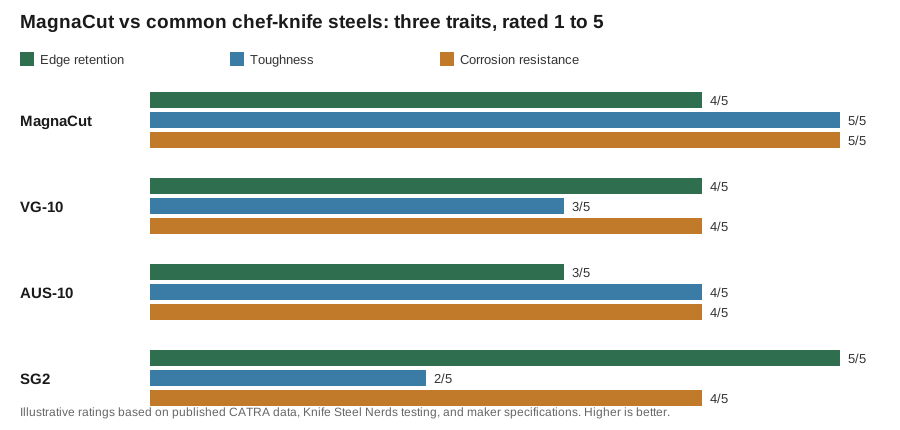
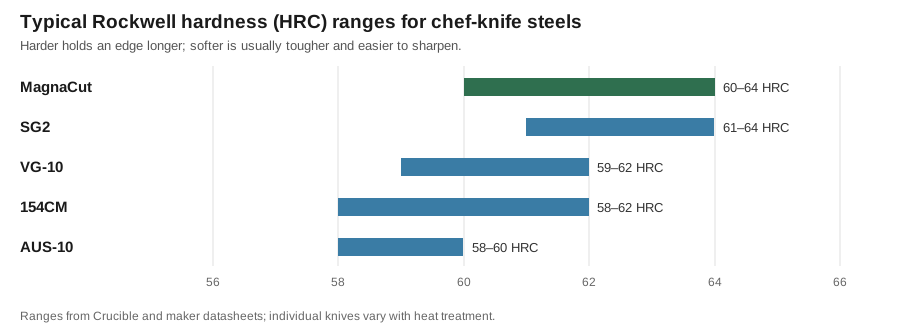
The hardness chart above shows why MagnaCut and SG2 sit in the same hardness band yet behave differently: hardness measures resistance to deformation, not toughness. SG2 is hard and brittle; MagnaCut is hard and tough. The steel comparison chart shows the trade-off differently: where each steel gives something up.
If you already own a good VG-10 or SG2 knife, MagnaCut is an incremental upgrade, not a revelation. You will notice the difference most in toughness — fewer chips on bones and hard vegetables — and in corrosion resistance if you cook with acidic ingredients. If you are coming from a soft German stainless knife, the jump in edge retention will be dramatic.
Which chef knives actually use MagnaCut — and what do they cost?
As of November 2026, MagnaCut chef knives come from a small group of American makers, not from the big Japanese brands. That is the first thing to understand about the market: if you want a MagnaCut chef knife today, you are buying from a US maker, and you are paying for American labor and small-batch production as much as for the steel.
| Maker and knife | Blade | Price as of November 2026 |
|---|---|---|
| New West KnifeWorks — Steph Knife, 8-inch chef | 8 in, CPM MagnaCut, made in USA | $520 ($570 for Ironwood handle) |
| New West KnifeWorks — Tactical Outdoor Chef 2.0, MagnaCut edition | Outdoor chef knife, CPM MagnaCut | $495 |
| White River Knife & Tool — Liong Mah 8-inch Chef’s Knife | 8 in, CPM MagnaCut, Black G-10 handle | $300 |
| Montana Knife Company — Shedhorn Chef | 6 1/2 in, MagnaCut, cryo-treated | $475 |
| Montana Knife Company — Little Bighorn Petty | 5 7/8 in, MagnaCut, Kydex sheath included | $375 |
| Montana Knife Company — MKC Carving Knife | 8 7/8 in, MagnaCut, cryo-treated | $450 |
New West KnifeWorks is the most kitchen-focused of the three. Its Steph Knife is an 8-inch chef knife designed with chef Stephanie Izard, and the MagnaCut version launched in 2025. The blade is ground thin — about 0.08 inches at the spine — and the handle is contoured G-10. Owners report that it holds an edge noticeably longer than the S35VN version of the same knife.
White River Knife & Tool’s entry is the cheapest way into a MagnaCut chef knife. Its Liong Mah 8-inch Chef’s Knife is a collaboration with designer Liong Mah, built in White River’s Michigan shop. At $300 with a Black G-10 handle, it undercuts New West and Montana Knife Company by $150–$220, and it is the only MagnaCut chef knife under $350 we could verify.
Montana Knife Company builds its whole culinary line around MagnaCut, including the Bighorn Chef and the Shedhorn Chef. The company cryo-treats its blades — cooling them to −300°F after quenching — which it says improves edge retention and toughness. The Shedhorn Chef is a 6 1/2-inch knife aimed at hunters and camp cooks who want a chef knife that doubles as a field knife.
Expect to pay $300–$520 for a MagnaCut chef knife, roughly three to five times the price of a good VG-10 chef knife. The steel itself is not the main cost driver: MagnaCut bar stock costs more than VG-10, but the difference is tens of dollars, not hundreds. The price reflects small-batch American production, not the steel alone.
Who should buy a MagnaCut chef knife — and who should skip it?
Buy a MagnaCut chef knife if you cook daily, you already know how to maintain a good knife, and you want one premium knife that will last decades. It makes the most sense as a single-knife purchase — the one chef knife you reach for every day — rather than as part of a set.
Skip it if you are buying your first good chef knife. A $40–$90 VG-10 or AUS-10 knife will teach you what you like in a chef knife — blade length, weight, handle shape — for a fifth of the price. Buy the MagnaCut knife after you know your preferences, not before.
Also skip it if you will not sharpen it. MagnaCut holds an edge longer than VG-10, but no steel stays sharp forever, and a dull $520 knife cuts worse than a sharp $50 knife. If you are not willing to learn to sharpen — or to pay someone who can — buy a cheaper knife and a good sharpener instead.
A final caution: MagnaCut is a steel, not a maker. A badly ground MagnaCut knife will cut worse than a well-ground VG-10 knife, whatever the spec sheet says. Judge the knife — its grind, its geometry, its handle — not just the steel name stamped on the blade.
How do you sharpen and care for a MagnaCut chef knife?
Sharpening MagnaCut does not require a fundamentally different technique from sharpening other quality stainless steels, but it does reward the right abrasives. The vanadium carbides in MagnaCut are harder than aluminium oxide, so a standard aluminium-oxide water stone will cut the steel matrix but skate over the carbides. Diamond plates, CBN (cubic boron nitride) stones, or silicon carbide stones cut the carbides properly.
Use a 15–20 degree angle per side, and preserve the factory angle if the knife already cuts well. Most MagnaCut chef knives ship with a 15-degree-per-side edge, and re-profiling to a more acute angle risks chipping on hard vegetables.
For grits, follow the condition of the edge rather than the steel name. A 1000-grit water stone restores a dulled edge; a 3000–6000-grit stone refines it. Stropping on leather with a fine compound — 1-micron diamond paste, for instance — gives the final polish. Avoid pull-through sharpeners: they remove too much steel and leave a coarse, short-lived edge.
Daily care is the same as for any premium stainless knife. Hand wash and dry immediately — MagnaCut is highly corrosion resistant, not corrosion-proof — and store it on a magnetic strip or in a saya, not loose in a drawer. Never put it in the dishwasher: the detergent and the rattling will damage the edge and the handle long before the steel itself is affected.
Is a MagnaCut chef knife worth the money?
MagnaCut is the best-balanced knife steel available as of November 2026 — that much the test data supports. No other stainless steel combines its edge retention, toughness, and corrosion resistance at the same hardness. For a knife you will use every day for decades, that balance is genuinely valuable.
Whether it is worth $300–$520 depends entirely on who you are. For a cook who already owns a good knife and wants the best steel available in a chef knife, yes: the White River Liong Mah at $300 is a defensible buy, and the New West Steph Knife at $520 is the most kitchen-focused option. For a first-time buyer, or someone who will not sharpen, the money is better spent on a $60–$90 VG-10 knife and a sharpening stone.
The steel will get cheaper and more common as more makers adopt it. If $300-plus feels steep today, a good VG-10 or SG2 knife will serve you well while you wait — and the MagnaCut knives will still be there when you are ready.
Frequently asked questions
What is MagnaCut steel?
MagnaCut — formally CPM MagnaCut — is a powder-metallurgy stainless steel designed by metallurgist Dr. Larrin Thomas and produced by Crucible Industries since 2021. It is notable for combining high edge retention, high toughness, and excellent corrosion resistance — a combination no earlier stainless knife steel achieved.
Is MagnaCut better than VG-10?
MagnaCut is tougher and more corrosion-resistant than VG-10 at similar hardness, with comparable edge retention. For a chef knife that may hit bones or hard vegetables, the toughness advantage is the most meaningful difference.
Is MagnaCut better than SG2?
MagnaCut holds an edge slightly less long than SG2 but is much tougher and less prone to chipping. If you prioritise edge retention above all else, SG2 wins; if you want a knife you can use hard without worrying about chips, MagnaCut wins.
How hard is MagnaCut steel?
MagnaCut can be heat-treated to 59–65 HRC, with the Crucible datasheet specifying 60–64 HRC and 62–63 HRC as the typical target for knives. The exact hardness depends on the maker’s heat treatment.
Is MagnaCut hard to sharpen?
No — MagnaCut is not exceptionally difficult to sharpen when suitable abrasives are used. Diamond or CBN stones cut its vanadium carbides efficiently; standard aluminium-oxide stones work more slowly because the carbides are harder than the abrasive.
Does MagnaCut rust?
MagnaCut is highly corrosion-resistant — testing found no visible corrosion after 72 hours in a 15% salt-spray test — but no steel is rust-proof. Hand wash and dry your knife after use, especially after contact with acidic foods.
How much does a MagnaCut chef knife cost?
As of November 2026, verified MagnaCut chef knives cost $300–$520: the White River Liong Mah 8-inch Chef’s Knife at $300, Montana Knife Company knives at $375–$475, and New West KnifeWorks knives at $495–$520.