
Yes — hard anodized cookware is considered safe for everyday cooking when used as directed. The anodized layer is sealed aluminum oxide, and modern nonstick coatings are made without PFOA, which was phased out of US nonstick manufacturing in 2013. The real safety rule is heat: keep the pan below about 500°F (260°C) and replace it once the coating flakes.
Hard anodized cookware sits in millions of American kitchens — the dark grey pans from Calphalon, Anolon, T-fal, and Circulon that promise easy food release and a tougher surface than plain aluminum. Yet the same pans raise a persistent question: is that dark coating actually safe to cook on, day after day?
The answer is reassuring, but the detail matters. Hard anodized cookware is not one material but two: a hardened aluminum body and a nonstick coating on top of it. Each layer has its own safety story, limits, and failure mode — and understanding the difference tells you how to use these pans confidently and when to throw one away.
We compared specs, prices, and verified owner reviews across the major hard-anodized lines, and checked manufacturer guidance from Calphalon, Anolon, and T-fal.
What exactly is hard-anodized cookware?
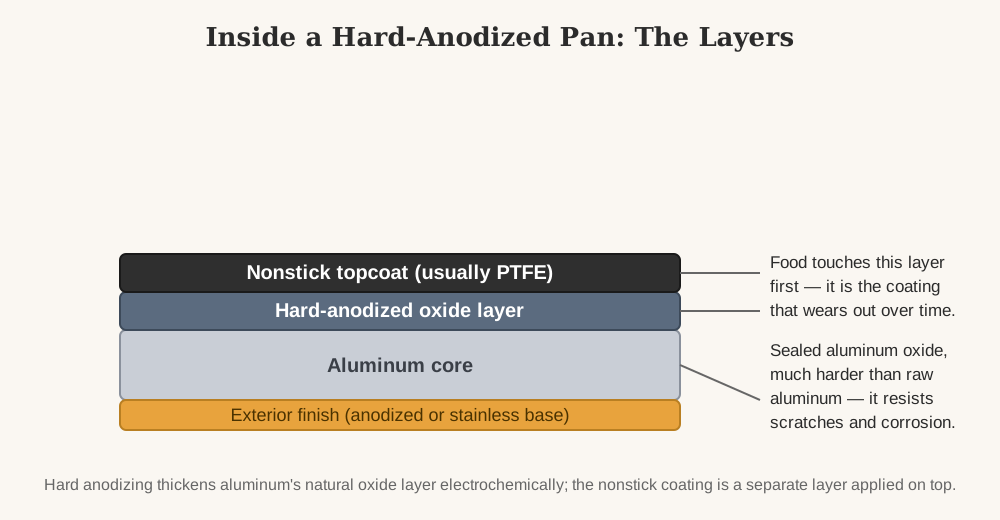
Hard anodizing is an electrochemical process that thickens aluminum’s natural oxide layer. The aluminum is submerged in an acid bath and charged with electricity, growing a dense layer of aluminum oxide far thicker and harder than the thin film that forms on raw aluminum in air. The result is a dark grey, scratch-resistant shell bonded to the metal itself.
That hardened shell is why these pans feel different from plain aluminum. Hard-anodized aluminum resists corrosion, does not react with acidic foods such as tomatoes or vinegar the way bare aluminum can, and distributes heat more evenly than thin stainless steel — which is why these pans are popular for frying and sautéing.
Most hard-anodized pans sold today add a second layer: a nonstick topcoat, usually PTFE (the polymer known by the brand name Teflon), sometimes reinforced with ceramic particles. This is the layer your food actually touches, and the layer that wears out. When people ask whether hard anodized cookware is safe, they are usually asking about this topcoat — not the anodized aluminum underneath it.
One practical consequence: hard-anodized aluminum is not magnetic, so a plain hard-anodized pan will not work on an induction cooktop. Induction-compatible versions add a stainless steel base plate, advertised clearly — check the base before you buy if you cook on induction.
Is hard-anodized cookware safe to cook with?
Yes, for normal home cooking — and the evidence comes from three separate facts, one for each layer of the pan.
First, the anodized layer itself. The hard-anodized surface is sealed aluminum oxide, a stable material that keeps food from contacting the raw aluminum beneath it. US regulators have not flagged hard-anodized cookware as a health risk when used as directed, and manufacturers describe the anodized surface as non-reactive with food.
Second, the nonstick topcoat. Modern PTFE coatings are chemically inert at normal cooking temperatures, meaning they do not react with food or release substances into it during ordinary use. The chemical that once worried people — PFOA, a processing aid used in making some nonstick coatings — was phased out of US nonstick manufacturing by 2013 under the EPA’s stewardship program, and major brands now state their coatings are PFOA-free. A pan bought today from a mainstream brand does not contain PFOA.
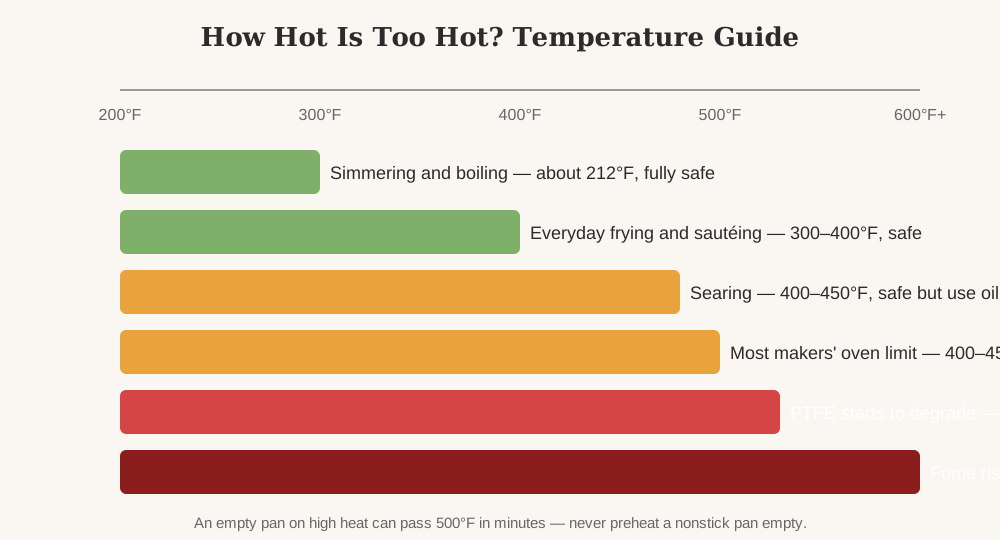
Third, the temperature limit. PTFE begins to break down above about 500°F (260°C), and around 600°F (315°C) it can release fumes that irritate lungs and are dangerous to pet birds. This is the one genuine safety boundary for hard-anodized nonstick cookware, and it is entirely avoidable: water boils at 212°F, most frying happens between 300°F and 400°F, and even a hard sear rarely needs more than 450°F. The risk appears only when a pan is heated empty on high — something no manufacturer recommends for any nonstick pan.
The bottom line: hard anodized cookware is safe when used the way its makers intend — medium heat, food or oil in the pan, no empty preheating on high. The safety question is really a heat-management question.
What is the difference between the anodized layer and the nonstick coating?
Confusing the two layers causes most of the misunderstanding about this cookware. The anodized layer is part of the pan’s body — aluminum oxide grown from the aluminum itself. The nonstick coating is a separate material applied on top of it. They fail differently, last different lengths of time, and raise different questions.
| Feature | Hard-anodized layer | Nonstick topcoat |
|---|---|---|
| What it is | Aluminum oxide grown from the pan’s own aluminum | PTFE applied over the anodized surface |
| What food touches | Never, while the topcoat is intact | Always — this is the cooking surface |
| Typical lifespan | Lasts the life of the pan unless deeply gouged | 3–5 years of regular use |
| Heat limit | Aluminum oxide tolerates high heat | Begins to degrade above about 500°F (260°C) |
| What damages it | Deep gouges from sharp metal, harsh abrasives | High heat, metal utensils, abrasives, sprays |
| If it fails | Exposes raw aluminum underneath | Food sticks, surface flakes, pan should be replaced |
Some hard-anodized pans have no nonstick topcoat at all — just a bare anodized cooking surface. These behave more like stainless steel: food sticks more, but there is no coating to wear out and no PTFE temperature ceiling. If a nonstick coating bothers you, a bare hard-anodized pan or stainless steel may suit you better — our guide to the best non-toxic cookware for a gas stove covers those alternatives in detail.
How hot is too hot for hard-anodized cookware?
The number to remember is 500°F (260°C). Below it, a PTFE nonstick surface is stable; above it, the polymer begins to degrade, and the higher the temperature goes, the faster that happens. Around 600°F (315°C), fumes can become a real concern, particularly for pet birds, whose lungs are far more sensitive than ours.
In practice, staying under the limit is easy because ordinary cooking rarely approaches it: simmering and boiling sit at 212°F, pan-frying runs about 325–375°F, and a good sear needs 400–450°F. All are comfortably inside the safe range — provided food or oil is in the pan to absorb the heat.
The danger scenario is specific and avoidable: an empty pan left on a burner set to high can pass 500°F in a few minutes, because nothing is absorbing the heat. Manufacturers’ oven-safe ratings tell the same story — most hard-anodized lines are rated oven-safe to 400–450°F, with some T-fal lines rated to 350°F — sitting safely below the temperature where the coating begins to suffer.
Stay inside the limit with simple habits: medium or medium-high heat for nearly everything, oil or food in the pan before it gets hot, and let the pan cool before running cold water over it — thermal shock can warp the base. If you sear at very high heat regularly, use stainless steel or cast iron instead. Our comparison of HexClad vs All-Clad stainless steel covers pans built for high-heat searing.
What happens if the coating gets scratched or starts flaking?
Minor scratches are the most common worry, and the least dangerous. A light scratch from a fork or spatula does not make a pan unsafe: it exposes a tiny patch of the anodized surface underneath, which is itself a stable, sealed material. Manufacturers including Calphalon state that minor scratches do not affect safety or performance. What a scratch does affect is performance — food begins to stick in the scratched area, and the scratch becomes a starting point for further wear.
Deep scratches and flaking are a different matter. When the coating starts to peel, chip, or flake into food, the pan’s cooking surface is failing, and that is the point to replace it. There is no reliable evidence that swallowing a small flake of PTFE is harmful — the material is inert and passes through the body — but a flaking pan cooks badly, sticks constantly, and only gets worse.
The practical rule is straightforward: light surface marks are cosmetic, so keep using the pan. Visible flaking, large bare patches, or a surface that has gone rough and no longer releases food means the pan is done. Most owners reach that point after three to five years of daily use — the normal lifespan of a PTFE coating, not a defect.
Does dishwasher use or metal utensils damage the coating?
Yes — both shorten a coating’s life, and this is where most hard-anodized pans actually die: the coating rarely fails from one event, but wears down gradually from heat, utensils, and cleaning.
Dishwasher use is the slower killer. Most major brands label their hard-anodized pans dishwasher-safe, and the pan will survive the cycle — but harsh detergents and jostling wear the nonstick surface faster than hand washing does. Calphalon and Anolon both recommend hand washing to preserve the coating, even on lines they call dishwasher-safe. A minute with a soft sponge can add a year or more to a pan’s useful life.
Metal utensils are the faster killer. A metal spatula or fork can score the coating, and each score is a place where food sticks and further wear starts. Wood, silicone, and nylon tools cannot scratch the surface — a small habit change with an outsized effect on how long the pan lasts.
Two other habits matter. Aerosol cooking sprays leave a sticky residue that builds up on nonstick surfaces and is hard to remove; manufacturers recommend a teaspoon of oil or butter instead. Abrasive scrubbers, steel wool, and scouring powders should never touch the cooking surface — they strip the coating directly. A soft sponge and hot soapy water handle almost all cleaning, and a paste of baking soda and water removes stubborn residue without abrasion.
When should you replace hard-anodized cookware?
Replace a hard-anodized pan when any of these signs appear: the coating flakes or peels into food; large bare patches of metal show through; food sticks across the whole surface even with oil; the pan has warped and no longer sits flat on the burner; or the handle is loose. Any one of these is enough.
With normal care, expect three to five years from a nonstick hard-anodized pan used daily; pans used a few times a week can last longer, and cheap thin pans often less. The anodized body may still be sound when the coating gives out — but without its nonstick layer, the pan no longer performs as a nonstick pan.
There is no need to replace a pan on a schedule. Inspect the cooking surface every few months: run your fingers across it when cool and look for rough patches, flaking edges, or discoloration that will not wash off. A pan that still releases an egg cleanly and shows no flaking is still a good pan, whatever its age.
How does hard-anodized cookware compare with stainless steel and cast iron?
Hard-anodized nonstick is a convenience choice: it wins on easy food release and cleanup, and loses on heat tolerance and lifespan. Stainless steel tolerates any heat a home burner can produce and lasts decades, but eggs and fish stick without technique and oil. Cast iron holds heat better than either and lasts generations with seasoning, but it is heavy and needs maintenance.
| Cookware type | Heat tolerance | Food release | Lifespan | Maintenance |
|---|---|---|---|---|
| Hard-anodized nonstick | Up to about 500°F | Excellent when new | 3–5 years (coating) | Hand wash, no metal utensils |
| Stainless steel | No practical limit | Poor without oil and technique | Decades | Dishwasher-safe, any utensils |
| Cast iron | No practical limit | Good when seasoned | Generations | Seasoning, hand wash, dry promptly |
| Bare hard-anodized aluminum | High (no PTFE ceiling) | Moderate — sticks more | Decades (body) | Hand wash preferred |
Which hard-anodized sets are worth considering?
The established lines are easy to compare. The T-fal Professional 12-piece set, about $65–$85 as of November 2026, is the budget standard: PTFE nonstick with the brand’s Thermo-Spot heat indicator, oven-safe to 350°F. The Anolon Advanced 11-piece set, about $180–$250 as of November 2026, sits in the middle: a thicker anodized body, a three-layer nonstick surface, and oven safety to 400°F. The Calphalon Premier 10-piece set, about $200–$300 as of November 2026, is the premium pick: a three-layer nonstick interior, stay-cool handles, and oven safety to 450°F.
Price tracks thickness and coating quality more than brand name: a heavier pan holds heat more evenly and resists warping, so compare weights rather than counting pieces.
Frequently asked questions
Is hard anodized cookware safe for everyday cooking?
Yes, when used as directed — medium heat, food or oil in the pan, and no empty preheating on high. Modern coatings are PFOA-free.
Does hard anodized cookware contain PFOA or Teflon?
Hard-anodized pans often use a PTFE (Teflon) nonstick topcoat, but PFOA — once used to manufacture PTFE — was phased out of US nonstick production in 2013, and current pans from major brands are labelled PFOA-free.
At what temperature does hard anodized cookware become unsafe?
The nonstick coating begins to degrade above about 500°F (260°C), with fume risks around 600°F (315°C). Normal cooking stays well below this: frying runs 300–400°F and a hard sear reaches about 450°F.
Is it safe to use a scratched hard anodized pan?
Light scratches are safe to cook on — they expose a small patch of sealed anodized aluminum — but they reduce nonstick performance. Replace the pan when the coating flakes, peels, or shows large bare patches.
Can hard anodized cookware go in the dishwasher?
Most lines are labelled dishwasher-safe, but manufacturers recommend hand washing — harsh detergents wear the nonstick coating faster, and a soft sponge can add a year or more to the pan’s life.