
Scrub the rust off with steel wool or a chainmail scrubber, wash the skillet with hot water, dry it completely, then re-season it with a thin coat of oil baked at 450–500°F. Light rust takes about 30 minutes; heavy rust may need a 1–3 hour vinegar soak first. A skillet is only ruined if it is cracked or deeply
A rusty cast iron skillet looks like a lost cause. It is not. Cast iron is one of the few pieces of cookware that can be stripped back to bare metal and brought back to full use, even after months in a damp garage or a sink full of water. The fix is simple, cheap, and takes about an hour of active work.
The process has two parts: remove the rust, then rebuild the seasoning — the thin layer of polymerized oil that protects the iron from moisture. Skip the second part and the rust comes straight back.
We based this guide on manufacturer care guidance from Lodge, the largest cast iron maker in the US, plus specs, prices, and verified owner reviews of the tools involved.
Is a rusty cast iron skillet ruined?
Almost never. Rust on cast iron is iron oxide forming where water and air reached bare metal. In most cases it is a thin surface layer that scrubs off in minutes. The skillet is only beyond saving if it is cracked, or the rust has eaten deep pits into the cooking surface.
Check the damage before you start. Run your fingers across the rusted area. If it feels like rough sandpaper but the metal underneath is solid, you are dealing with surface rust — the easy case. If your fingertip catches in small craters, the rust has pitted the iron. Light pitting is still usable once cleaned and seasoned, though food may stick a little more in those spots. Deep pitting, flaking chunks, or a visible crack means the pan is done — replace it rather than restore it.
| Rust level | What it looks like | What to do | Time needed |
|---|---|---|---|
| Light surface rust | Orange dust or spots, mostly on the cooking surface | Scrub with steel wool, wash, dry, re-season | About 30 minutes |
| Moderate rust | Orange-brown patches over most of the pan, rough to the touch | Scrub hard, or use a vinegar soak, then re-season | 1–2 hours |
| Heavy rust | Thick, flaking crust on the inside and outside, dark staining | Vinegar soak 1–3 hours, heavy scrubbing, then re-season | 2–4 hours |
| Beyond saving | Deep pits, crumbling metal, or a crack in the wall or handle | Recycle it and buy a replacement | — |
One reassuring fact: a skillet that has been fully cleaned and re-seasoned is safe to cook in again. Lodge’s own care guidance treats rust removal as routine maintenance, not a reason to throw the pan away.
What do you need to remove rust from cast iron?
You probably own most of this already. The whole kit costs roughly $15–$25 if you buy everything new, and the tools last for years.
| Tool or supply | What it is for | Typical price as of November 2026 |
|---|---|---|
| Steel wool, fine grade (#000 or #00) | Scrubbing surface rust off the iron | About $4–$6 for a pack |
| Chainmail scrubber | Scrubbing rust and stuck food without removing good seasoning | About $10–$15 |
| White vinegar (1 gallon) | A 50/50 vinegar-water soak for heavy rust | About $3–$4 |
| Dish soap | Washing the pan after scrubbing | Already in your kitchen |
| Paper towels or a clean rag | Drying the pan and applying oil | Already in your kitchen |
| Neutral cooking oil or shortening | Re-seasoning (vegetable oil, canola oil, or Crisco) | About $4–$6 |
Two notes on the shopping list. First, do not use a wire wheel or an angle grinder on a skillet you plan to cook in — power tools can gouge the surface. Hand scrubbing is slower, but it is the method every manufacturer recommends. Second, plain vegetable oil or canola oil works well for re-seasoning and costs the least. Flaxseed oil is often recommended online, but it is expensive (about $10–$12 a bottle) and prone to flaking off — Lodge’s own guidance uses ordinary vegetable oil or melted shortening.
How do you get rust off a cast iron skillet?
Work through these steps in order. The method below handles light to moderate rust; if your skillet is heavily crusted, do the vinegar soak in the next section first, then come back to step 1.
Step 1: Scrub the rust off. Take the dry skillet to the sink and scrub every rusted area with steel wool or a chainmail scrubber, using firm circular pressure — cooking surface, outside walls, handle, and pour spouts. Aim for dull grey bare metal with no orange left. Light rust takes 5–10 minutes; moderate rust takes 15–20. Rinse away the orange dust as you go so you can see what is left.
Step 2: Wash with hot water and a little soap. Once the rust is gone, wash the pan with hot water and a small amount of dish soap, scrubbing with a stiff brush. The old rule that soap ruins cast iron is a myth — Lodge states that a small amount of soap is fine, because modern dish soap does not contain the lye that once stripped seasoning.
Step 3: Dry it immediately and completely. This is the step people skip, and it is the one that causes rust to return overnight. Towel-dry the skillet, then set it on a burner over low heat for 3–5 minutes until every drop of water has evaporated. Cast iron rusts fast — a wet pan left on the drying rack can show orange spots by morning.
Step 4: Apply a very thin coat of oil. Pour about a teaspoon of vegetable oil or melted shortening into the warm pan and rub it over every surface with a paper towel. Then wipe almost all of it off with a clean towel — the surface should look dry, not shiny. Too much oil is the most common seasoning mistake: thick oil turns sticky and bakes into a gummy layer instead of a hard one.
Step 5: Bake it upside down. Place the skillet upside down on the middle rack, with foil on the rack below to catch drips. Heat the oven to 450–500°F — the range Lodge recommends for seasoning — and bake for 60 minutes. The heat bonds the thin oil layer to the iron in a process called polymerization, turning liquid oil into a hard, dry coating.
Step 6: Let it cool in the oven. Turn the oven off and leave the skillet inside until it is cool enough to handle, about 30–45 minutes. Do not rush this with cold water; a hot pan plunged into cold water can warp or crack.
Step 7: Repeat the oil-and-bake cycle twice more. One layer of seasoning is thin protection. Three thin layers, each baked for an hour, give a noticeably tougher, more even coating. The pan will look dark brown rather than jet black after three rounds — that is normal. The deep black finish builds 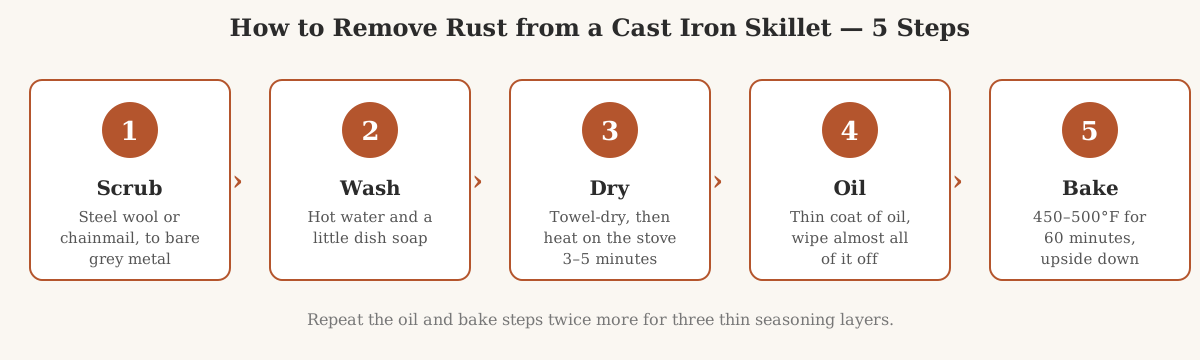
Should you use vinegar to remove rust from cast iron?
Yes, but only for heavy rust — and only for a limited time. A 50/50 mix of white vinegar and water dissolves rust chemically, reaching into crevices that steel wool cannot. It is the right tool when the skillet is covered in thick, flaking rust that would take an hour of scrubbing to remove by hand.
Mix equal parts white vinegar and water in a container large enough to submerge the skillet, or plug the sink and fill it. Soak the pan for 1–3 hours, checking it every hour. As soon as the rust has loosened, pull the pan out, scrub it with steel wool, and wash it immediately. The soak must be short: vinegar is an acid, and if cast iron sits in it too long — overnight, for example — the acid starts eating the good iron underneath the rust. Never leave a skillet in vinegar overnight.
For light or moderate rust, skip the vinegar entirely. Steel wool is faster, cheaper, and carries no risk of over-soaking.
| Method | Best for | Time | Risk |
|---|---|---|---|
| Steel wool or chainmail scrubbing | Light to moderate rust | 10–20 minutes | None — the manufacturer-recommended method |
| Vinegar soak (50/50, 1–3 hours) | Heavy, flaking rust | 1–3 hours plus scrubbing | Over-soaking pits the iron; never soak overnight |
How do you re-season a cast iron skillet after removing rust?
Re-seasoning is the step that turns a clean but vulnerable pan back into a cooking tool. Seasoning is not a coat of oil sitting on the metal — it is a layer of oil heated past its smoke point until it bonds to the iron as a hard polymer. That layer is what keeps water off the metal and food from sticking.
The method is the same one described in steps 4–7 above, and it is worth understanding why each detail matters:
- Thin coats, not thick ones. Each layer should be so thin the pan looks almost dry. Thick oil cannot polymerize evenly; it stays tacky and peels.
- High heat, long enough. At 450–500°F for a full hour, the oil passes its smoke point and bonds to the iron. Lower temperatures leave a soft, sticky film.
- Upside down, with foil below. Any excess oil drips off instead of pooling in the cooking surface and baking into bumps.
- Three layers minimum. One layer protects the pan, but three give a durable base that survives the first few cooks.
The oil you choose matters less than the technique. Lodge recommends vegetable oil or shortening, and both are cheap and widely available. Canola oil works the same way. Avoid olive oil for seasoning — its smoke point of about 375–405°F is below the baking temperature, so it smokes heavily and can leave a sticky residue.
If you also own carbon steel pans, the seasoning method is nearly identical — the same thin coats and high heat apply. Our guide to how to season a carbon steel pan the first time walks through the same process for carbon steel.
Once the skillet is seasoned, cook something fatty in it first: bacon, fried chicken, or shallow-fried vegetables. Fatty cooking builds the seasoning faster than any amount of oven baking. Avoid simmering acidic 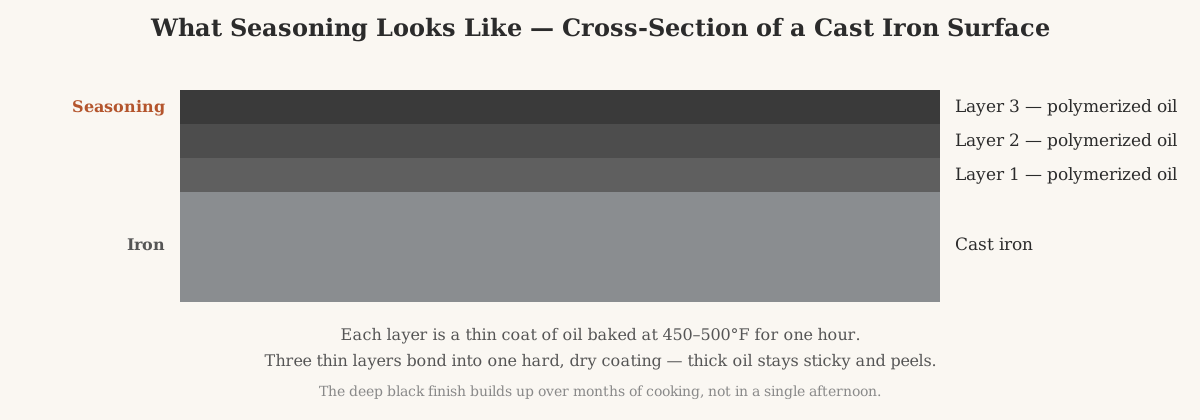
What mistakes should you avoid when restoring cast iron?
Most restoration failures come from rushing one step. These are the mistakes we see most often in owner reviews and forum posts.
Leaving the pan wet after washing. Cast iron begins rusting within hours of contact with water. Towel-dry it, then heat it on the stove until the water evaporates — every time, not just during restoration.
Using too much oil when seasoning. A pan that comes out of the oven sticky had too much oil on it. Wipe the oil off until the pan looks dry before baking.
Soaking in vinegar overnight. A short vinegar soak dissolves rust; a long one dissolves iron. Check the pan every hour and pull it out as soon as the rust is loose.
Seasoning at too low a temperature. Oil baked at 350°F does not polymerize — it just sits on the surface and stays greasy. The oven needs to reach 450–500°F for a full hour.
Cooking acidic food in a freshly seasoned pan. Tomato sauce and wine reductions are fine in a well-seasoned skillet, but a brand-new seasoning layer is thin and vulnerable. Give the pan a few weeks of regular cooking first.
How do you keep a cast iron skillet from rusting again?
Rust is a storage problem, not a cooking problem. A skillet that is used regularly and stored dry almost never rusts, because each cook adds a little more oil to the seasoning.
After every cook, wash the pan with hot water, dry it on the stove over low heat, and rub in a few drops of oil while it is still warm. That 60-second routine is the entire maintenance program. If you live in a humid climate, store the pan with a paper towel inside it to absorb moisture.
Use the skillet often. Cast iron improves with cooking — the seasoning layer gets tougher and more non-stick the more you fry, sear, and bake in it. If you want to compare what cast iron does best against its closest rival, our cast iron vs carbon steel steak comparison breaks down searing, heat retention, and handling side by side.
A restored skillet is not a compromise — it is the same pan it always was, with a fresh layer of protection. Lodge sells its classic 10.25-inch skillet for about $20–$30 as of November 2026, so restoration is rarely about saving money. It is about keeping a tool that gets better with age instead of sending it to the scrap pile.
Frequently asked questions
Can you cook with a rusty cast iron skillet?
No — scrub the rust off, wash the pan, and re-season it before cooking. Once cleaned and re-seasoned, it is safe to cook in again.
How long does it take to remove rust from a cast iron skillet?
Light surface rust takes about 30 minutes of scrubbing, washing, drying, and one seasoning round. Heavy rust takes 2–4 hours including a 1–3 hour vinegar soak and three seasoning rounds.
Will vinegar damage my cast iron skillet?
A short vinegar soak of 1–3 hours is safe and effective for heavy rust, but leaving cast iron in vinegar overnight can pit the iron. Check the pan every hour and remove it as soon as the rust has loosened.
How many times should I season a cast iron skillet after removing rust?
Season it three times, with a thin coat of oil baked at 450–500°F for one hour per round. Three thin layers give a durable base; the deep black finish builds up over months of regular cooking.
Can I use soap on a cast iron skillet?
Yes — Lodge states that a small amount of modern dish soap is fine, because it no longer contains the lye that once stripped seasoning. Wash with hot water and soap, dry immediately on the stove, and rub in a few drops of oil.