
The best stand mixer for bread dough is the Bosch Universal Plus: it kneads up to 15 pounds of dough per batch with a belt drive that absorbs the shock of stiff dough instead of passing it to the gears. The Ankarsrum Assistent Original is the better pure bread machine, and the KitchenAid Professional 600 is the best bowl-lift pick.
As an Amazon Associate I earn from qualifying purchases.
TL;DR — our verdict: Buy dough capacity first and wattage second. The Bosch Universal Plus (around $385–$500 as of November 2026) wins on batch size, the Ankarsrum Assistent Original (around $750–$800) on kneading action, and the KitchenAid Professional 600 (around $350–$550) is the strongest bowl-lift mixer. The Cuisinart SM-50 (around $200–$290) is the value pick for one- or two-loaf batches; the Hamilton Beach 63240 (around $200–$260) is the budget pick.
Bread dough is the hardest job a stand mixer does: a stiff sourdough fights back, climbing the hook and heating the motor. We compared specs, prices, and verified owner reviews rather than running lab tests. Prices are as of November 2026.
How did we rank these mixers for bread dough?
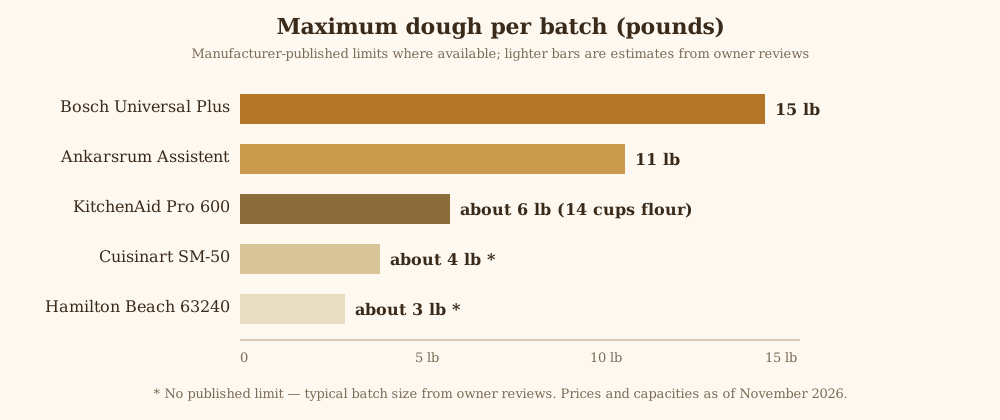
Three numbers matter more than the wattage on the box: published dough capacity per batch, drive type — bowl-lift versus tilt-head, gear versus belt — and bowl size. Brands measure capacity differently, so we converted everything to dough weight per batch where the manufacturer gave us a number (Bosch in pounds, Ankarsrum in kilograms, KitchenAid in cups of flour) and marked the rest as estimates from owner reviews; Cuisinart and Hamilton Beach publish no dough limit at all.
Which stand mixers handle bread dough best at a glance?
| Mixer | Dough capacity per batch | Bowl | Motor and drive | Price as of Nov 2026 |
|---|---|---|---|---|
| Bosch Universal Plus | Up to 15 lb | 6.5 qt | 500 W, belt drive | Around $385–$500 |
| Ankarsrum Assistent Original | Up to 11 lb (5 kg) | 7.4 qt (7 L) | 600 W continuous, rotating bowl | Around $750–$800 |
| KitchenAid Professional 600 | 14 cups flour (about 6 lb dough) | 6 qt | 575 W, all-metal gears, bowl-lift | Around $350–$550 |
| Cuisinart Precision Master SM-50 | No published limit; about 4 lb dough (estimate) | 5.5 qt | 500 W, tilt-head | Around $200–$290 |
| Hamilton Beach Professional 63240 | No published limit; about 3 lb dough (estimate) | 5 qt | 450 W, tilt-head | Around $200–$260 |
Is the Bosch Universal Plus the best mixer for big bread batches?
Yes, if batch size is the deciding factor. The Bosch Universal Plus kneads up to 15 pounds of dough at a time — fourteen loaves — the largest published capacity we compared. Its belt drive is a genuine advantage: the belt absorbs the pulsing load of stiff dough instead of hammering the gears, which is why owners report these machines lasting decades.
The design is unusual: the bowl sits on the base and the motor drives from below, so there is no heavy head to flex or bounce. The trade-off is the footprint — the mixer is wide, the bowl locks in with a twist, and it has only four speeds.
At around $385–$500 as of November 2026, the Bosch costs less than the Ankarsrum and about the same as a KitchenAid Professional 600, while handling more than twice the dough. If you bake four or more loaves a week, this is the pick.
Bosch Universal Plus Stand Mixer, 500 Watt, 6.5 Quarts (MUM6N10UC)
Is the Ankarsrum Assistent Original the best mixer for serious bread bakers?
For the kneading itself, yes. The Ankarsrum works nothing like a planetary mixer: the bowl rotates while a dough roller and scraper work the dough the way hands do, pressing and folding it instead of dragging a hook through it. It is rated for up to 11 pounds (5 kilograms) of dough — enough for a serious weekly bake, including heavy rye and whole-wheat doughs that stall other mixers.
The 7.4-quart (7-liter) stainless bowl is the largest here, the 600-watt motor is a continuous rating rather than a peak number, and the machine carries a 7-year warranty on the base — the longest in this roundup by a wide margin.
The price is the honest obstacle: around $750–$800 as of November 2026, roughly double the KitchenAid Professional 600. It is also a specialist — superb for dough, but slower for whipping than a planetary mixer, with a smaller accessory ecosystem. Buy it if bread is the reason you own a mixer; buy something else if bread is an occasional weekend project.
Ankarsrum Assistent Original AKM 6230 Electric Stand Mixer, 7.4 Quart (Red)
Is the KitchenAid Professional 600 the best bowl-lift mixer for dough?
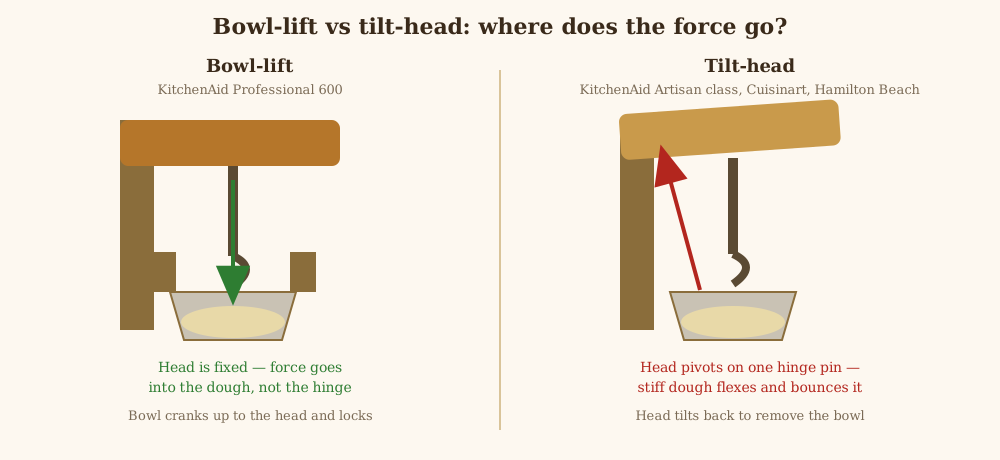
It is the best conventional planetary mixer for bread dough here. The Professional 600 pairs a 575-watt motor with all-metal gears and a bowl-lift design: the bowl locks onto arms and cranks up to the head, so the head cannot flex or bounce under a heavy load. KitchenAid rates it for 14 cups of flour per batch — about 6 pounds of finished dough, or roughly eight loaves.
With the bowl locked in place and the head fixed, the motor’s force goes into the dough instead of into the hinge. The 6-quart bowl is generous, and the machine stands about 16.5 inches tall — measure your upper cabinets before buying.
Two honest caveats: the price range is wide — around $350–$550 as of November 2026 depending on color and seller — and some colors go out of stock for months. And at about 29 pounds, it lives on the counter or in the cabinet. If you want the KitchenAid attachment ecosystem and you bake weekly, this is the model to get — not the smaller tilt-head Artisan. Our KitchenAid vs Cuisinart stand mixer comparison breaks down the two brands head to head.
KitchenAid Pro 600 Series 6-Quart Bowl-Lift Stand Mixer, White (KP26M1XWH)
Is the Cuisinart Precision Master SM-50 good enough for bread dough?
For one- or two-loaf batches, yes — and it is the best value here. The Cuisinart Precision Master SM-50 gives you a 5.5-quart bowl, a published 500-watt motor, 12 speeds, and a 3-year limited warranty for around $200–$290 as of November 2026. On paper it out-specs every tilt-head KitchenAid near its price.
The catch is the tilt-head design and the missing number: Cuisinart publishes no dough-weight limit, so the SM-50 is not rated for heavy dough work the way the Bosch, Ankarsrum, and KitchenAid Pro 600 are. Based on owner reviews, it handles a standard double-loaf batch — around 6 cups of flour — but stiff whole-wheat dough at that size is its ceiling.
Buy the SM-50 if you bake a loaf or two a week. Skip it if you regularly double a recipe or bake dense whole-grain doughs — the Bosch costs about $150 more and handles nearly four times the dough.
Cuisinart Precision Master 5.5-Quart Stand Mixer, White Linen (SM-50NAS)
Is the Hamilton Beach Professional 63240 a good budget mixer for bread?
It is the cheapest way into a capable dough mixer, with a clear ceiling. The Hamilton Beach Professional 63240 is a 5-quart, 450-watt, all-metal tilt-head mixer with 12 speeds and a 5-year warranty, usually around $200–$260 as of November 2026. The all-metal body and long warranty are unusual at this price, and owner reviews report it handling single-loaf batches without strain.
The ceiling is the same as the Cuisinart’s, lower down: Hamilton Beach publishes no dough-weight limit, the 450-watt motor is the weakest here, and the head takes the load. A single loaf is comfortable; a double batch of stiff sourdough is not. Availability is uneven — the Amazon listing has shown no featured offers at times, so check the live price before buying.
Buy it if your budget is firm and you bake occasionally rather than weekly. If you bake every week, the Cuisinart SM-50 costs about the same and gives you a bigger bowl and a stronger motor.
Hamilton Beach Professional All-Metal Stand Mixer, 5 Quart, 12 Speeds (63240)
Why do tilt-head 4.5-quart mixers struggle with stiff dough?
Every part of the design works against a heavy load. A tilt-head mixer — the KitchenAid Artisan class and most budget mixers — hangs the motor in a head that pivots on a single hinge pin. Stiff dough pulls the hook down and sideways, levering against the hinge, so the head flexes and bounces instead of driving the dough. The 4.5-quart bowl makes it worse: the dough climbs the hook instead of kneading.
The motor is the third problem. Artisan-class mixers typically run a 325-watt motor, and KitchenAid’s own guidance says to knead dough only on speed 2 and to keep batches small. Ignore that and the motor overheats, the thermal cut-off trips, and repeated overloads wear the gears. None of this makes a tilt-head mixer a bad mixer — a 4.5-quart Artisan is fine for cakes, cookies, and the occasional single loaf — but it is the wrong tool for a weekly double batch of sourdough. If your kitchen is small, our guide to the best stand mixer for small kitchens covers the trade-offs.
What size mixer do you actually need for bread?
Match the mixer to your weekly loaf count. One loaf a week fits any mixer here, including the Hamilton Beach. Two loaves a week — a standard double batch, about 6 cups of flour — is the Cuisinart’s ceiling and the KitchenAid Professional 600’s easy middle. Four or more loaves a week, or regular whole-wheat and rye baking, is Bosch and Ankarsrum territory.
A useful rule: if your recipe uses more than 6 cups of flour, you need a bowl-lift mixer or a Bosch or Ankarsrum. A 5-quart bowl can hold the dough, but the motor and the head are what fail, not the bowl. Dough also doubles as it develops — a bowl that looks half-full at the start is full by the time the gluten is developed.
How should you knead bread dough in a stand mixer?
Knead on speed 2 and no higher — every manufacturer here specifies low speed for dough, because higher speeds whip air in and overheat the motor. Add flour gradually, and let the dough rest a few minutes halfway through if the motor sounds strained; a short rest lets the flour hydrate and the dough relax.
Watch the dough, not the clock. It is kneaded enough when it pulls away from the bowl in a single mass and passes the windowpane test — a small piece stretched thin enough to see light through without tearing. Most white doughs reach that point in 6 to 10 minutes on speed 2. If the head is bouncing, the batch is too big — split it in half and knead the halves separately.
Frequently asked questions
Can a KitchenAid Artisan knead bread dough?
Yes, for a single loaf at a time — but not for weekly double batches. The Artisan’s 325-watt motor and tilt-head design mean stiff dough flexes the head and heats the motor, so keep to one loaf and knead only on speed 2.
How many watts do you need for bread dough?
Watts alone do not decide it — torque and drive type matter more. A 500-watt belt-drive Bosch handles 15 pounds of dough, while a 500-watt tilt-head mixer handles a fraction of that, because the belt absorbs shock and the drive puts the force into the dough instead of the hinge.
Is a bowl-lift mixer better than a tilt-head mixer for bread?
Yes, for bread specifically. A bowl-lift mixer locks the bowl to the arms and keeps the head fixed, so the motor’s force goes into stiff dough instead of flexing a hinge.
Can you knead sourdough in a stand mixer?
Yes, on speed 2 for 6 to 10 minutes, stopping when the dough pulls away from the bowl and passes the windowpane test. Sourdough’s long fermentation does most of the gluten development, so the mixer does less work than with a fast yeast dough.
How much dough can a 5-quart mixer handle?
About one double-loaf batch, or roughly 6 cups of flour, in a sturdy tilt-head like the Cuisinart SM-50. Stiff whole-wheat or bagel dough at that size is the ceiling — for bigger batches, step up to a 6-quart bowl-lift mixer or a Bosch or Ankarsrum.
The bottom line
Buy dough capacity first. The Bosch Universal Plus is the best stand mixer for bread dough for most weekly bakers, the Ankarsrum is the best for the finest knead and a machine that lasts decades, and the KitchenAid Professional 600 is the best conventional bowl-lift pick. The Cuisinart SM-50 and Hamilton Beach 63240 are honest budget choices for one- or two-loaf weeks — just respect their ceilings and knead on speed 2.