
The KitchenAid Artisan Series 5 (KSM150PS) is the better stand mixer for most home bakers, thanks to its larger attachment ecosystem, wider color range, and decades of proven durability. The Cuisinart Precision Master SM-50 is the better value, offering a stronger 500-watt motor, a larger 5.5-quart bowl, and a 3-year warranty for roughly $135 less as of November 2026.
As an Amazon Associate I earn from qualifying purchases.
Searches for “kitchenaid vs cuisinart stand mixer” surged in the United States in November 2026, and the comparison is closer than the price gap suggests. On paper, the Cuisinart wins the spec sheet: more watts, a bigger bowl, more speeds, a longer warranty, and a lower price. In a real kitchen, the KitchenAid wins on attachments and resale value.
We compared specs, prices, and verified owner reviews for both flagship tilt-head models, plus their budget siblings. This is a comparison of published specifications, current prices, and owner feedback — not a hands-on test.
Which stand mixer wins overall — KitchenAid or Cuisinart?
The KitchenAid Artisan Series 5 wins for most buyers. Its 5-quart bowl handles up to 9 dozen cookies in a single batch, its 59-point planetary action reaches the edges of the bowl, and its power hub accepts more than 10 optional attachments, from pasta makers to food grinders.
The Cuisinart Precision Master SM-50 wins on value. Its 500-watt motor out-rates the KitchenAid’s 325 watts, its 5.5-quart bowl holds half a quart more, its 12 speeds give finer control than the KitchenAid’s 10, and its limited 3-year warranty is three times as long as KitchenAid’s 1-year warranty. As of November 2026 it sells for about $215 on Amazon, while the KitchenAid Artisan lists at $499.99 and typically sells for $350–$500 depending on color.
The deciding factor is what you plan to do with the mixer after the first year. If you want a mixer that can become a pasta maker, a meat grinder, and an ice cream maker over time, buy the KitchenAid. If you want the most mixing capacity per dollar and you will mainly bake bread, cookies, and cakes, buy the Cuisinart and keep the savings.
How do the KitchenAid Artisan and Cuisinart SM-50 compare side by side?
| Feature | KitchenAid Artisan Series 5 (KSM150PS) | Cuisinart Precision Master (SM-50) |
|---|---|---|
| Motor power | 325 watts | 500 watts |
| Bowl capacity | 5 quarts, polished stainless steel with handle | 5.5 quarts, polished stainless steel with handle |
| Speeds | 10 | 12 |
| Planetary mixing action | 59 touchpoints around the bowl | 59-point planetary mixing action |
| Dimensions | 14.1 in D x 8.7 in W x 13.9 in H | 14.17 in D x 7.87 in W x 14.13 in H |
| Weight | 22.8 lb | About 15–18 lb (listings vary) |
| Included attachments | Coated flat beater, coated dough hook, 6-wire whip, pouring shield | Chef’s whisk, flat mixing paddle, dough hook, splash guard with pour spout |
| Optional hub attachments | 10+ (pasta, grinder, ice cream, and more) | 5 types (pasta extruder, pasta roller and cutters, ice cream maker, meat grinder, spiralizer) |
| Warranty | 1-year hassle-free replacement | Limited 3-year warranty |
| List price | $499.99 | $319.95 |
| Typical street price, as of November 2026 | $349–$500 depending on color | About $215 |
| Colors | 20+ | Silver, white linen, black, red, and a few more |
The two mixers are almost the same size on the counter, and both are tilt-head designs. The real differences are in the motor, the attachment port, and the warranty card.
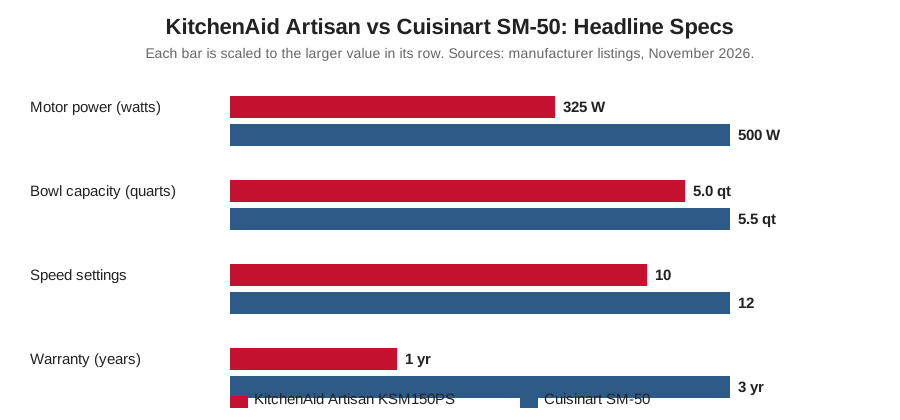
Does the Cuisinart’s 500-watt motor actually beat the KitchenAid’s 325 watts?
On the spec sheet, yes — 500 watts is 54% more than 325 watts. In the bowl, the gap is smaller than the numbers suggest, because wattage is an input rating, not a measure of mixing torque. KitchenAid’s direct-drive, all-metal gears have moved stiff dough for decades on 325 watts, and owner reviews report that the Artisan handles pizza dough, double cookie batches, and bread dough without stalling.
The Cuisinart’s extra watts show up in heavy doughs and large batches: the 500-watt motor holds its speed better when a dense whole-grain dough starts to resist. For a baker who makes bread weekly or doubles every cookie recipe, the Cuisinart’s motor is a genuine advantage, not just a bigger number.
For everyday baking — a single batch of cookies, a cake, a loaf of sandwich bread — both motors are more than enough. Start heavy doughs on a low speed and let the dough hook do the work; high speed on a stiff dough strains any home mixer, whatever the wattage on the box.
Which bowl is better for real baking — 5 quarts or 5.5 quarts?
The Cuisinart’s 5.5-quart bowl holds about 10% more than the KitchenAid’s 5-quart bowl, and that half quart matters most for bread bakers and big-batch bakers. A double batch of bread dough fits with more headroom, which means less flour on the counter and less risk of dough climbing over the rim.
The KitchenAid’s 5-quart bowl is the more proven size. KitchenAid states it handles up to 9 dozen cookies, 8 cups of all-purpose flour for bread dough, or 4 pounds of mashed potatoes in one batch. Both bowls are polished stainless steel with a handle.
Both mixers are about 14 inches tall and 14 inches deep, so neither one fits under a standard 18-inch upper cabinet with the head tilted back. If your kitchen is tight, our guide to the best stand mixer for small kitchens covers the footprint question in more detail.
How do the attachments compare?
Both mixers ship with the same three tools: a flat beater for batters and cookie dough, a dough hook for yeast dough, and a wire whisk for cream and egg whites. The Cuisinart adds a splash guard with a pour spout in the box; KitchenAid includes a pouring shield with the Artisan as well, so the out-of-box kits are effectively tied.
The difference opens up at the front power hub. KitchenAid’s hub accepts more than 10 optional attachments — pasta rollers and cutters, a pasta extruder, a food grinder, a grain mill, a vegetable slicer, and an ice cream maker, plus a large third-party market. Cuisinart’s hub accepts five attachment types — pasta extruder, pasta roller and cutters, ice cream maker, meat grinder, and spiralizer.
That gap matters only if you will actually buy attachments. A pasta roller is the most common add-on for either brand, and both brands offer one. But if you can picture your mixer becoming a grain mill or a sausage stuffer in two years, the KitchenAid’s ecosystem is the reason to pay more now. Attachments are brand-specific, so the choice locks in your future accessory spending.
One more practical detail: the Cuisinart’s bowl, whisk, paddle, dough hook, and splash guard are all dishwasher-safe according to its manual.
Which mixer is better built — and which is quieter?
The KitchenAid Artisan weighs 22.8 lb, and most of that weight is metal. Its all-metal gears and die-cast body are the reason twenty-year-old Artisans still show up in working kitchens, and the weight keeps the mixer planted on the counter when a stiff dough tries to walk it across the surface. The trade-off is that moving it in and out of a cabinet is a two-handed job.
The Cuisinart is lighter — Cuisinart’s own spec sheet lists 15 lb, while retailer listings show up to 18.35 lb — and it is also die-cast metal, but with more plastic in the trim and the speed dial. Owner reviews describe it as solid for the price, not as overbuilt as the KitchenAid. The lighter body is easier to lift and store, but more likely to shift during a heavy knead, so a damp cloth or silicone mat underneath helps.
Neither brand publishes a decibel rating, so there is no objective noise figure to compare. In owner feedback, both machines are typical countertop-mixer loud at high speed, and neither is marketed as a quiet mixer.
The warranty tells the durability story in the brands’ own words. KitchenAid covers the Artisan for 1 year with a hassle-free replacement warranty; Cuisinart covers the SM-50 for 3 years under a limited warranty. A longer warranty is not a guarantee of a longer life, but Cuisinart is putting three times as much coverage behind its machine.
How much do they cost as of November 2026 — and which is the better value?
| Model | List price | Street price, as of November 2026 |
|---|---|---|
| KitchenAid Artisan Series 5 (KSM150PS) | $499.99 | $349 in Juniper and Milkshake; $380–$500 in other colors |
| KitchenAid Classic (K45SS) | $379.95 | About $330 |
| Cuisinart Precision Master (SM-50) | $319.95 | About $215 |
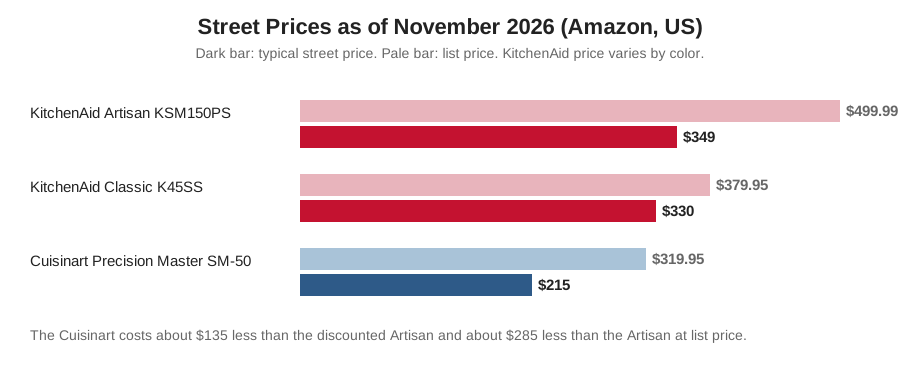
The KitchenAid’s price depends heavily on color. As of November 2026, the Juniper and Milkshake finishes were selling for $349 at Amazon — $150.99 under the $499.99 list price — while popular colors such as Empire Red and Pistachio were listed at $439–$500. KitchenAid runs these discounts regularly, especially around Black Friday, so the patient buyer rarely pays list price.
The Cuisinart’s price is steadier and lower. At about $215 on Amazon against a $319.95 list price, it costs roughly $135 less than the discounted KitchenAid and roughly $285 less than the KitchenAid at list price.
Value depends on how long you keep the mixer. Spread over ten years, the KitchenAid at $349 costs about $35 a year, and the Cuisinart at $215 costs about $22 a year — a difference of roughly $1 a month.
What about the budget versions — KitchenAid Classic vs Cuisinart SM-50BC?
Both brands sell a cheaper sibling, and the comparison flips at the budget level.
The KitchenAid Classic Series 4.5-Quart Tilt-Head Stand Mixer (K45SS) is the Artisan’s smaller, simpler relative: a 4.5-quart bowl, a 275-watt motor, and 10 speeds, at a list price of $379.95 and a street price of about $330. It uses the same attachment hub and the same 59-point planetary action — but at $330 it saves only about $20 against a discounted Artisan, which makes it hard to recommend unless the smaller bowl suits a small kitchen.
The Cuisinart Precision Master 5.5-Quart Stand Mixer (SM-50BC) is not a smaller mixer at all — it is the same SM-50 in the Silver Lining finish, at the same $214.99 Amazon price. The white-linen version, the Cuisinart SM-50NAS, lists at the same $319.95 and sells in the same range. There is no budget penalty for choosing the Cuisinart: the cheapest Cuisinart is the full Cuisinart.
The practical takeaway is simple. If you choose KitchenAid, skip the Classic and buy the Artisan on sale — the price gap is too small to give up half a quart and 50 watts. If you choose Cuisinart, pick whichever SM-50 color is cheapest that week.
Who should buy the KitchenAid Artisan — and who should buy the Cuisinart SM-50?
Buy the KitchenAid Artisan Series 5 (KSM150PS) in White if you bake several times a week, you want the deepest attachment ecosystem, you care about color choice, or you want the mixer with the best resale value. The Milkshake finish is the same mixer, and it was the cheapest color at $349 as of November 2026.
Buy the Cuisinart Precision Master SM-50 if your budget is under $250, you bake bread or double batches regularly, you want the longest warranty, or you want the most mixer for the money. It gives up the KitchenAid’s attachment depth and color range, but it wins on motor power, bowl size, speed control, warranty length, and price.
Either mixer will handle a decade of home baking. Choose by budget and by attachments, and you will not regret either one.
Frequently asked questions
Is KitchenAid or Cuisinart better for stand mixers?
KitchenAid is the better overall choice for most buyers because of its larger attachment ecosystem, wider color range, and stronger resale value. Cuisinart is the better value, with a stronger motor, a larger bowl, more speeds, and a longer warranty.
Is 500 watts better than 325 watts in a stand mixer?
A 500-watt motor holds its speed better under heavy dough, but wattage is an input rating, not a direct measure of mixing torque. KitchenAid’s 325-watt Artisan handles normal bread and cookie dough without stalling.
What is the difference between the KitchenAid Artisan and the KitchenAid Classic?
The Artisan (KSM150PS) has a 5-quart bowl and a 325-watt motor, while the Classic (K45SS) has a 4.5-quart bowl and a 275-watt motor. Both have 10 speeds and the same hub, but the Artisan is often only about $20 more on sale.
Does the Cuisinart SM-50 have the same attachments as KitchenAid?
No. Both include a flat beater, a dough hook, and a whisk, but their hub attachments are brand-specific and do not interchange. KitchenAid offers more than 10 optional attachments, while Cuisinart offers five types.
How long is the warranty on a Cuisinart stand mixer vs a KitchenAid?
Cuisinart covers the Precision Master SM-50 with a limited 3-year warranty; KitchenAid covers the Artisan Series 5 with a 1-year hassle-free replacement warranty.
Which stand mixer is best for bread dough?
The Cuisinart SM-50 has the edge for frequent bread baking, thanks to its 500-watt motor, larger 5.5-quart bowl, and 12 speeds. The KitchenAid Artisan also kneads bread dough well, and its heavier body stays planted on the counter during a long knead.