
Quick answer: Yes, a KitchenAid stand mixer makes smooth, fluffy mashed potatoes with almost no arm work — if you use the flat beater, keep the speed low, and stop the moment the potatoes look smooth. Start on Speed 2 for about a minute, add warm butter and milk, then finish with a short whip for a lighter texture. Mix too long or too fast and the potatoes turn gluey.
A stand mixer earns its counter space when the potatoes have to be ready at the same time as everything else. This guide is for anyone who owns a KitchenAid and wants a big batch of mash without standing over a pot with a hand masher. We compared KitchenAid’s own manual instructions with verified owner reviews; we did not test mixers in our own kitchen.
Photo: MashedPotatoes by Renee Comet, Public domain via Wikimedia Commons.
Can you make mashed potatoes in a KitchenAid stand mixer?
Yes — KitchenAid says so itself. Its owner’s manual lists mashed potatoes under the flat beater’s jobs and prints a full recipe: 5 large potatoes, about 2½ pounds, with half a cup of heated milk, 2 tablespoons of butter, a teaspoon of salt, and an eighth of a teaspoon of pepper. That recipe serves 9, about three-quarters of a cup each. Read KitchenAid’s own stand mixer owner’s manual for the full recipe and speed guide.
The mixer breaks up a large batch evenly and leaves your hands free for the butter and milk. If you do not own a stand mixer yet, our guide to the best affordable stand mixer covers cheaper models that handle this job. One caution: the mixer is faster and stronger than your arm, so keep runs short and stop early.
How to make mashed potatoes in a KitchenAid
Keep the mixer on low until the last step.
- Peel 5 large potatoes, about 2½ pounds, and cut them into even chunks so they cook at the same rate.
- Cover with cold salted water, bring to a boil, then simmer 15 to 25 minutes, until a fork slides in easily.
- Drain well, then let them sit in the hot pot for a minute or two so the steam escapes.
- Warm the bowl and flat beater with hot water, then dry them, as KitchenAid’s manual instructs.
- Tip the hot potatoes into the bowl, fit the flat beater, and mix on Speed 2 for about a minute, until smooth.
- Add the warm milk, butter, salt, and pepper a little at a time. Turn to Speed 4 and beat about 30 seconds, until the milk is absorbed.
- Turn to Speed 6 and beat about a minute, until fluffy. Stop and scrape the bowl down once.
- Optional finish: swap the flat beater for the wire whip and whip at Speed 10 for 2 to 3 minutes. KitchenAid’s garlic potato recipe uses Speed 6 with the whip for 3 to 4 minutes instead — see KitchenAid’s Garlic Gruyere Potatoes recipe.
Serve right away. The mixing stage takes about 2 to 3 minutes — stop sooner if the batch looks done.
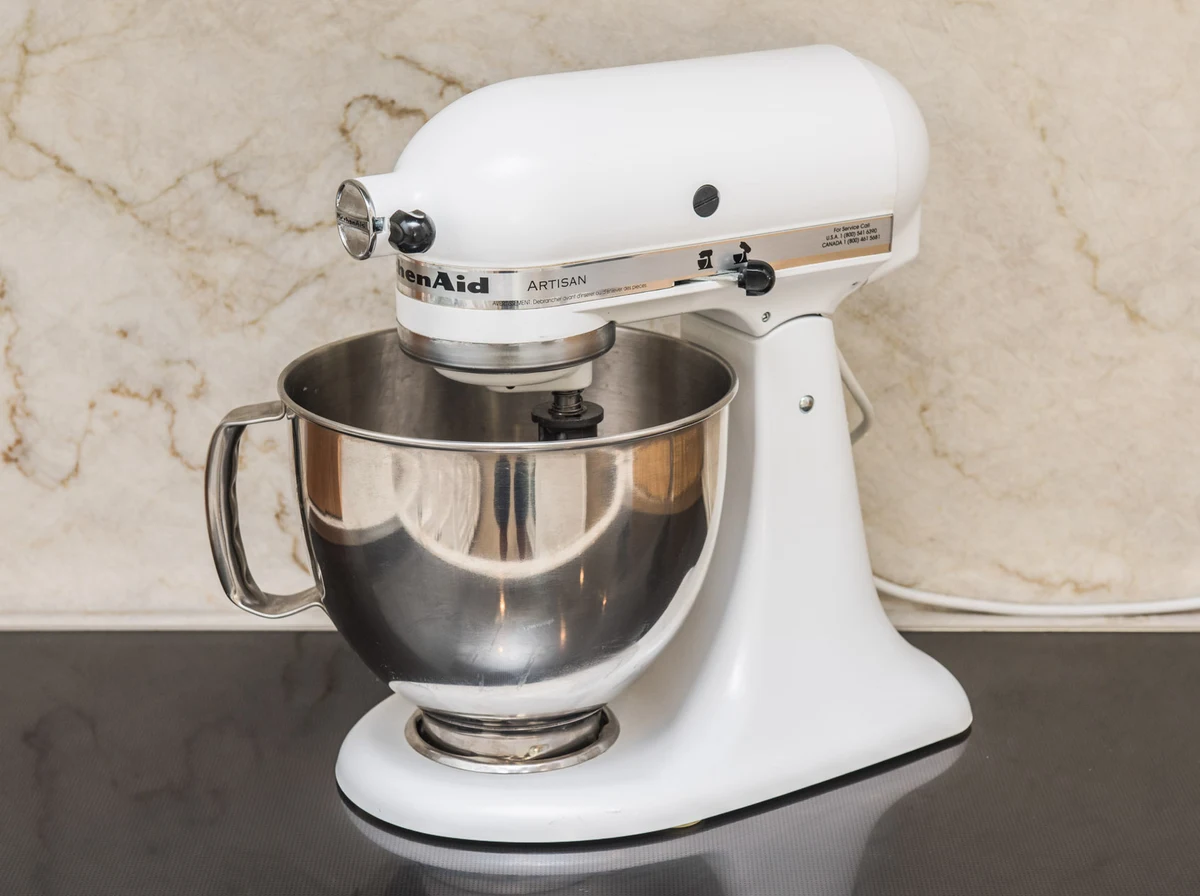
Photo: White KitchenAid mixer (KSM150PSWH) by Your Best Digs, CC BY 2.0 via Wikimedia Commons.
What matters most: potatoes, attachment, speed, and warm dairy
Potato type. Starchy potatoes mash the fluffiest, so russets and Yukon Golds are the usual picks. Waxy potatoes, such as red potatoes, hold their shape better in salads but turn pasty when beaten hard.
Attachment. Use the flat beater, also called the paddle, for the mashing itself. KitchenAid’s manual lists mashed potatoes under the flat beater and reserves the wire whip for mixtures that need air beaten in — which is why the whip only appears at the end, for the optional fluffing step. The dough hook has no place here: it is built for kneading bread dough. If you are still choosing between brands, our KitchenAid vs Cuisinart stand mixer comparison covers which attachments each one ships with.
Speed. Stay low: KitchenAid’s speed guide names Speed 2 for “starting mashing potatoes,” and its recipe never goes above Speed 6 with the flat beater. Speed 10 appears only with the wire whip, for the final fluffing. High speed does not mash faster; it just releases more starch.
Warm dairy. Heat the milk and let the butter soften before they go in. KitchenAid’s recipe calls for heated milk, and its garlic potato recipe melts the butter, cream, and milk together first. Warm dairy blends into hot potatoes in seconds, while cold milk cools the batch and forces you to mix longer.
What not to do
Most gluey mash comes from one of these mistakes.
- Do not start on high speed. Starting at Speed 6 or above throws hot potato around the bowl and overworks it before you can react. Always start on Stir or Speed 2.
- Do not use the wire whip to mash, and never use the dough hook. The whip beats air in and shreds the potatoes, which releases starch fast. Mash with the flat beater; whip only at the end. The dough hook just pushes potatoes around the bowl.
- Do not add cold milk or butter. Cold dairy cools the potatoes and makes you mix longer. Warm both first.
- Do not try to fix lumpy potatoes by mixing longer. Lumps usually mean the potatoes were undercooked, not undermixed. Cook the mash gently on the stove with a little more warm butter and milk first, then return it to the mixer briefly.
- Do not re-beat leftovers in the mixer to reheat them. Reheat gently on the stove or in the microwave with a splash of milk instead. The USDA says to refrigerate leftovers within 2 hours, keep them 3 to 4 days in the fridge, and reheat them to 165°F. Read the USDA’s own Leftovers and Food Safety guide.
When should you use the mixer — and when should you not?
Use the mixer for a big batch. A holiday dinner for 8 or 9 people is the classic case: KitchenAid’s own recipe is written for 5 large potatoes, and that is a lot of mashing by hand. Use it too when your hands tire easily, or when you want a very smooth result. A full-size mixer does take counter space, though, so if your kitchen is tight, see our guide to the best stand mixer for small kitchens before you buy one.
Skip the mixer for a small batch. Mashing potatoes for one or two people takes about a minute with a hand masher, and washing the bowl and beater takes longer. Skip it as well if you like a rustic, chunky texture: a hand masher leaves small pieces intact, while the mixer smooths everything out. And if the potatoes are still firm in the middle, do not reach for the mixer to save them — put them back on the heat until a fork goes through easily. Our stand mixer storage ideas will help you put the machine away afterwards.
Flat beater vs wire whip vs ricer
| Tool | Best for | Watch out for |
|---|---|---|
| Flat beater | Mashing and blending in butter and milk | Stop as soon as the potatoes look smooth |
| Wire whip | Final fluffing only, for 2 to 3 minutes | Using it to mash overworks the potatoes |
| Potato ricer | The smoothest texture with no mixer | Slow for big batches, and one more tool to wash |
| Hand masher | Small batches and a rustic, chunky texture | Lumps if the potatoes are undercooked |
A ricer is the quiet winner for smoothness: it never overworks the potatoes, so gluey mash is almost impossible. The mixer is faster for a crowd; the hand masher fastest for a small batch.
FAQ
What KitchenAid attachment is best for mashed potatoes?
The flat beater, also called the paddle. KitchenAid’s own manual lists mashed potatoes under the flat beater, and its recipe mashes with the beater at Speed 2 before switching to the wire whip for the final fluffing. Use the whip only at the end, for 2 to 3 minutes.
Why did my mashed potatoes turn gluey in the stand mixer?
Overmixing is the usual cause: the more you work cooked potatoes, the more starch they release, and that starch is what makes the texture sticky and gluey. The fix is prevention — low speed, short runs, warm dairy, and stopping the moment the potatoes look smooth. Once potatoes have gone gluey, no amount of extra mixing will save them.
How long do leftover mashed potatoes last?
Refrigerate them within 2 hours of cooking, in a covered container, and eat them within 3 to 4 days. That is the USDA’s rule for leftovers. Reheat them to 165°F, adding a splash of milk to loosen them back up.