
A santoku knife is a Japanese knife used for slicing, dicing, and mincing vegetables, fish, and boneless meat. Its name means “three virtues,” referring to those three tasks. With a flat edge, a sheepsfoot tip, and a blade usually 5 to 7 inches long, it cuts with a straight push-cut instead of the rocking motion of a Western chef’s knife.
If you have ever watched someone prep dinner with fast, quiet, straight-down chops — an onion diced in seconds, a tomato sliced paper-thin — the knife in their hand was probably a santoku. It is the most common all-purpose knife in Japanese home kitchens. This guide explains what it is for, where it beats a chef’s knife, and how to pick, hold, and care for one. We compared published specs, current prices, and verified owner reviews; we did not test knives in our own kitchen for this article.
What does “santoku” mean?
“Santoku” comes from the Japanese santoku bōchō, “knife of three virtues.” The three virtues are the cutting tasks it was designed for: slicing, dicing, and mincing. Some sources read them as the three foods it handles best — meat, fish, and vegetables.
The santoku is a young design, appearing in Japan after World War II, when cooks wanted one general-purpose knife instead of separate blades for fish and vegetables. Makers reshaped the Western chef’s knife for Japanese cutting habits: a straighter edge, a shorter and thinner blade, and a tip that curves down. The result is a knife built for the push-cut — a straight, downward stroke — rather than the rocking motion Western cooks use.
What is a santoku knife used for?
A santoku does its three named jobs best on food soft enough to cut cleanly with a thin, sharp edge. The flat edge is the key: most of it sits flat on the board, so the whole blade makes contact at once and each cut lands cleanly.
Slicing. The thin blade glides through food with little resistance, making thin, even slices easy — tomatoes without crushing, raw fish in clean slices. The wide blade also works as a scoop for carrying cut food to the pan.
Dicing. Dicing onions, carrots, and potatoes is where the santoku earns its keep: the flat edge gives direct downward control, so cubes come out even — and even cubes cook evenly.
Mincing. Garlic, ginger, and herbs mince cleanly, because the straight-down push-cut chops rather than smears. One note: the flat edge suits the rocking mince poorly, so mincing herbs means a series of short push-cuts, not a rock.
| Food | How a santoku handles it | Why it works |
|---|---|---|
| Onions | Dices cleanly with push-cuts | Flat edge contacts the board along its full length |
| Tomatoes | Slices thin without crushing | Thin blade needs little downward force |
| Raw fish | Cuts clean, even slices | Thin blade glides with minimal drag |
A santoku is a prep knife. Its job is done before the food hits the pan, and for most weeknight cooking that covers nearly all of the cutting.
What is a Granton edge, and do the dimples actually help?
Many santoku knives have small oval hollows ground into the blade sides, just above the edge. This is a Granton edge, also called hollow-ground or kullenschliff. The dimples create tiny air pockets between blade and food, so thin slices of potato, cucumber, or cheese are less likely to cling to the steel.
The effect is real but modest. The dimples help most with starchy, wet foods — potato slices, cucumber rounds, raw salmon — where suction makes slices stick. They do nothing for the cutting itself; a dull Granton-edge knife cuts no better than a dull plain-edge knife.
Not every santoku has a Granton edge. Shun sells its standard 7-inch santoku (DM0702) with a plain edge and a hollow-ground version (DM0718) at the same price. If you slice a lot of potatoes and raw fish, the dimpled version is worth having; if you mostly dice onions, a plain edge performs the same.
How is a santoku different from a chef’s knife?
The santoku and the chef’s knife are both all-purpose knives that overlap on most tasks. The differences are in shape, size, and motion — and those decide which one feels better in your hand.
A chef’s knife has a curved belly and a pointed tip. The curve lets the blade rock on the board, so the tip stays planted while the heel rises and falls — fast for mincing herbs and big piles of food. A chef’s knife is usually 8 inches long, sometimes 10, and thicker and heavier.
A santoku has a flat edge and a sheepsfoot tip that curves down to meet it. With almost no belly to rock on, the motion is a straight push forward and down. The blade is thinner and lighter, usually 5 to 7 inches long, and the wide blade doubles as a scoop.
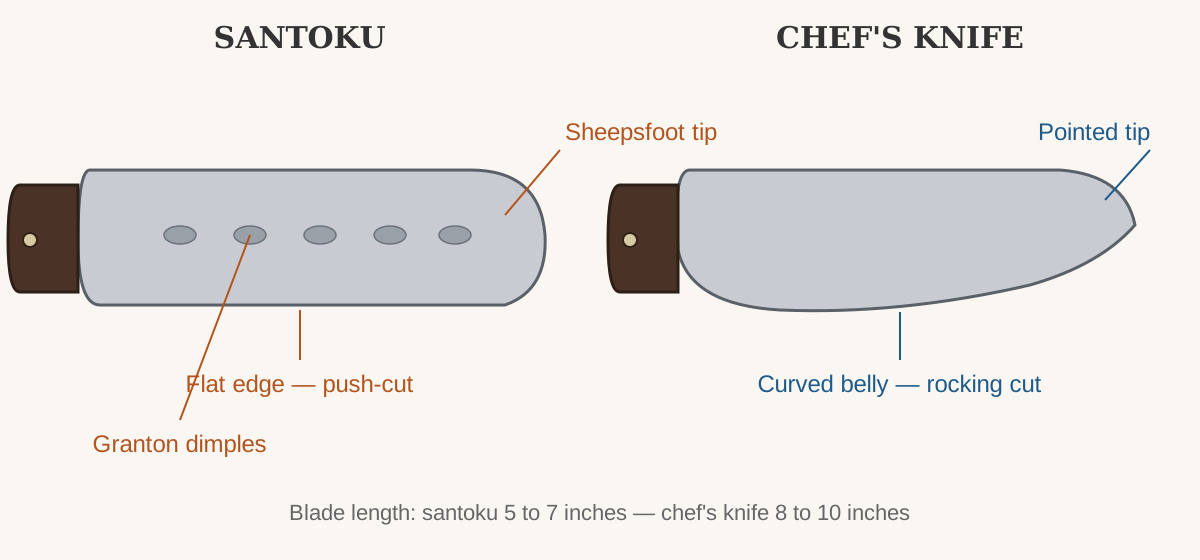
| Feature | Santoku knife | Chef’s knife |
|---|---|---|
| Blade length | Usually 5 to 7 inches | Usually 8 to 10 inches |
| Edge shape | Flat, with almost no curve | Curved belly along the edge |
| Tip shape | Sheepsfoot tip curving down | Pointed tip curving up |
| Cutting motion | Straight push-cut | Rocking motion, tip planted |
| Best at | Vegetables, fish, boneless meat | Rocking mince, large roasts |
Neither knife is objectively better. Cooks with smaller hands or boards often prefer the santoku; cooks who mince large bunches of herbs or break down big cuts of meat often prefer the chef’s knife. Many kitchens keep both. Our guide to choosing a chef’s knife by blade steel and handle covers the same decision from the chef’s-knife side.
What is a santoku knife NOT for?
A santoku is a precision tool, not a cleaver. Keep it away from bones, frozen food, hard squash rinds, and coconuts — the thin blade cannot take the force, and hard Japanese steel can chip badly. It can cut bread, but a serrated bread knife does it far better.
Do not pry with the tip or scrape food off the board with the edge — use the spine or a bench scraper instead. Never cut on glass, granite, marble, or ceramic; those surfaces dull and chip the edge fast. Use a wood or plastic board.
The rule is simple: if the food resists instead of parting under the knife, you are using the wrong tool. A santoku should glide — if you are forcing it, stop.
Should you get a 5-inch or a 7-inch santoku?
The 7-inch blade is the standard size and the one most buyers should start with: long enough to slice a large onion or a salmon fillet in one stroke. The 5-inch blade is a compact version for smaller hands, smaller boards, and tighter kitchens.
Choose the 7-inch if you cook for two or more people and your board is at least 12 by 18 inches. Choose the 5-inch if you have small hands, a small board, or a small kitchen — less length to control, less weight to manage. Our guide to the best chef’s knife for small hands covers that sizing question in more depth.
A 7-inch santoku typically weighs 5 to 7 ounces; a 5-inch, closer to 4. Hold the knife before you buy: the balance point should sit just in front of the handle, and the handle should fill your palm.
What steel is a santoku made from?
Santoku blades come in two steel families, trading sharpness against forgiveness. German-style santokus use softer stainless steel, around 55 to 58 on the Rockwell hardness scale (HRC): keen edge, hard to chip, easy to sharpen at home. Japanese-style santokus use harder steel, around 60 to 62 HRC, often a VG-10 or VG-MAX core in Damascus cladding: they hold an edge longer and cut thinner, but can chip if twisted against something hard.
As of November 2026, three examples show the range: the Mercer Culinary Genesis 7-inch santoku (M20707), forged German steel with a Santoprene handle, sells for roughly $35 to $45 and weighs 3.2 ounces; the Victorinox Fibrox Pro 7-inch Granton santoku sells for around $50; and the Shun Classic 7-inch santoku (DM0702), handcrafted in Seki, Japan, with a VG-MAX core and 68-layer Damascus cladding, lists for about $190 to $238, with the hollow-ground DM0718 at the same price. A mid-range Japanese option is the Tojiro DP santoku, a 6.7-inch (17 cm) VG-10 blade, usually $60 to $80.
For a first santoku, $35 to $50 is the sensible experiment: enough for a properly made blade that holds an edge, and little enough to learn whether you like the flat profile before spending more. Our roundup of the best Japanese knives under $100 for beginners covers several of these options in detail.
How do you hold and use a santoku knife?
Good technique is mostly grip and motion: the knife does the work; you guide it and keep your fingers safe.
Hold it with a pinch grip. Pinch the blade between your thumb and index finger, just in front of the handle, and wrap your remaining three fingers around the handle. This puts your hand close to the blade, giving you control and keeping the knife from twisting.
Protect your guiding hand with a claw. Curl the fingertips of your guiding hand under, so your knuckles face the blade and your fingertips tuck safely behind them. Cut slowly until the motion feels automatic; speed comes from repetition, not from forcing it.
Cut with a push-cut, not a rock. Set the blade on the food near the heel, and push down and slightly forward in one smooth stroke. Lift, slide back, and repeat. The whole edge should meet the board at the end of each cut.
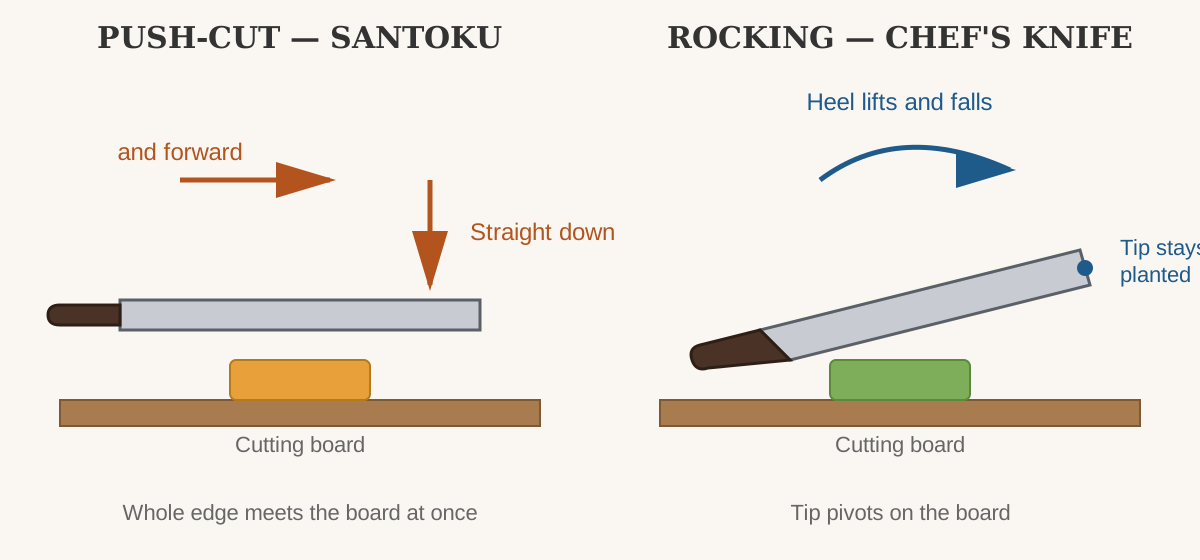
Let the blade do the work. A sharp santoku needs very little downward force. If you are pressing hard, the knife is dull — and pressing harder is how fingers get cut.
Use the wide blade as a scoop. After dicing, turn the blade flat, slide it under the cut food, and lift it to the pan — faster than gathering food with your hands, and it keeps the edge off the board.
How do you care for a santoku knife?
Hand wash and dry immediately. Wash with warm water and mild dish soap, then dry right away. Never put a santoku in the dishwasher: the detergent dulls the edge, the rattling chips it, and the damp heat can damage wooden handles.
Hone often, sharpen when needed. Honing with a ceramic rod or honing steel realigns the edge; it does not remove metal. Hone a German-steel santoku every few uses, and a Japanese-steel santoku lightly, because hard steel is more brittle and aggressive honing can chip it. When honing no longer restores the edge, the knife needs a whetstone or a professional. Our guide on how to sharpen a kitchen knife at home walks through the whetstone method for both steel types.
Store it safely. A knife block, magnetic strip, or blade guard protects the edge. Do not toss a santoku loose into a drawer; the edge will chip and the tip will dull.
Frequently asked questions
Can a santoku knife replace a chef’s knife?
Yes, for most home cooks. A santoku covers the bulk of daily prep, though a chef’s knife is still better for rocking mince and large roasts.
Is a santoku good for beginners?
Yes, it is one of the best first knives: shorter and lighter than an 8-inch chef’s knife, with a flat edge that makes the push-cut simple to learn.
What size santoku should I buy?
Buy a 7-inch unless you have small hands or a small board, in which case a 5-inch fits better.
Can you cut meat with a santoku knife?
Yes, it cuts boneless meat well, including chicken breasts and beef for stir-fry — but not bones, and not whole poultry.
Is a Granton edge worth it on a santoku?
Yes, if you slice a lot of potatoes, cucumbers, or raw fish — the dimples reduce sticking. If you mostly dice onions, a plain edge performs the same.
Should you buy a santoku knife?
A santoku is worth buying if your cooking revolves around vegetables, fish, and boneless meat. It is the right first knife for cooks with smaller hands or kitchens, and the right second knife for cooks who own a chef’s knife and want a lighter tool for vegetables.
It is not the right knife if you regularly break down whole chickens, cut through bones, or mince large bunches of herbs by rocking — a chef’s knife or a cleaver will serve you better.
The best way to decide is to hold one: a 7-inch santoku in the $35 to $50 range costs less than a week of takeout, and a month of cooking with it will tell you more than any guide can.