
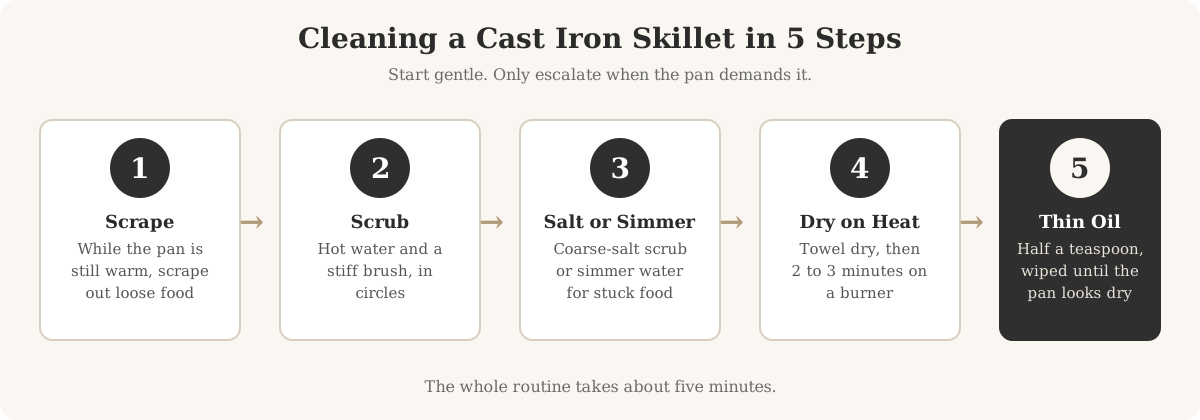
To clean a cast iron skillet with burnt-on food, scrape out the loose bits while the pan is still warm, scrub it under hot water with a stiff brush, and dry it on the stove before wiping on a thin layer of oil. For food that will not budge, simmer a little water in the pan for a few minutes or scrub with coarse salt. A well-built seasoning layer survives all of this, because it is oil bonded to the iron, not a coating sitting on top of it.
Burnt-on food is what most people fear with cast iron: you seared a steak, the fond turned to carbon, and the pan looks like a lost cause. It is not — a skillet can be scrubbed, simmered, and scraped back to clean, as long as you skip the few habits that actually strip seasoning.
What is seasoning, and why does it survive cleaning?
Seasoning is not a coat of oil sitting on the surface of the pan. It is a layer of oil heated past its smoke point until it polymerizes — bonds chemically — with the iron underneath. That bond creates the hard, slick surface cast iron is known for — and it is why a normal wash does not undo it.
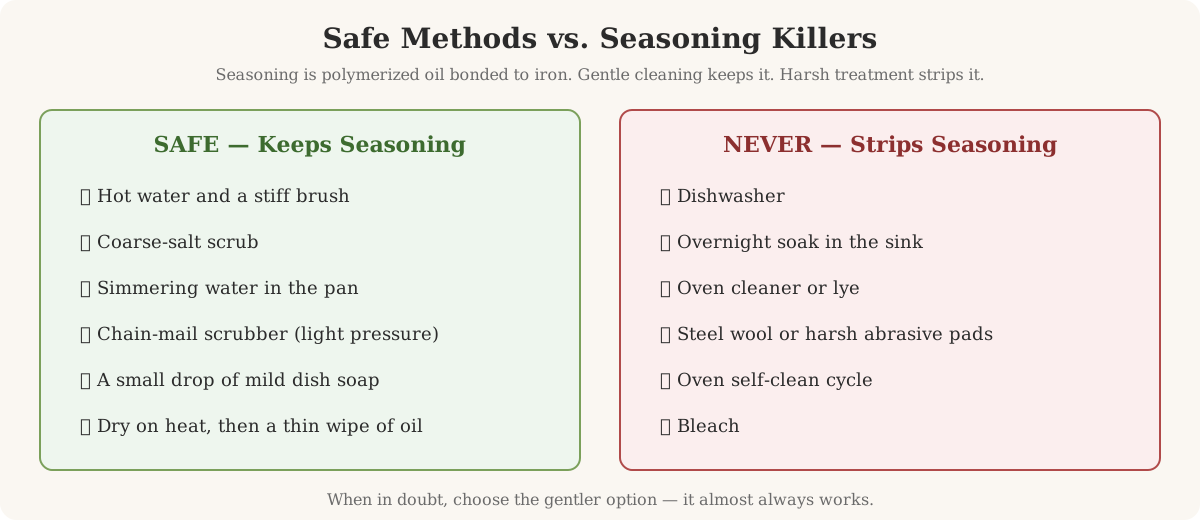
Seasoning is tougher than its reputation: hot water, a stiff brush, coarse salt, and even a small amount of mild dish soap do not break a polymerized bond. What damages it is sustained abuse — hours of soaking, dishwasher detergent, oven cleaner, and grinding abrasives.
Which method should you use for burnt-on food?
Match the method to the mess, and always begin with the gentlest option that fits.
| Method | Best for | Time | Seasoning risk |
|---|---|---|---|
| Hot water and stiff brush | Light sticking, fresh burnt bits | 2–3 minutes | Very low |
| Coarse-salt scrub | Stuck-on crust, greasy residue | 3–5 minutes | Very low |
| Simmering water in the pan | Hard, dried-on food, thick crust | 5–10 minutes | Very low |
| Chain-mail scrubber | Stubborn food on a well-seasoned pan | 2–4 minutes | Low |
| Baking-soda paste (last resort) | Carbonized food that survived the rest | 10–15 minutes | Low to moderate |
Work down the list in order.
How do you clean burnt-on food with hot water and a brush?
This default method handles most burnt-on food if you catch the pan while it is still warm.
- Let the skillet cool until you can hold the handle comfortably, about 5–10 minutes after cooking.
- Scrape out the loose food with a wooden spatula or pan scraper.
- Hold the skillet under hot running water and scrub in circles with a stiff nylon brush or a non-metal scrub pad, working the whole cooking surface including the sloped sides.
- If the pan still feels gritty, add a small drop of mild dish soap — Lodge’s care guidance says a small amount will not damage good seasoning. Rinse thoroughly.
- Dry the pan immediately — towel first, then a minute or two on a burner over medium-low heat — and wipe on a thin layer of oil. The layer should look almost dry, not wet or pooled.
That is the whole routine, and it takes about five minutes. Cooking a steak in cast iron is the classic way to end up with a burnt-on crust.
How does the coarse-salt scrub method work?
When hot water and a brush leave a crust behind, coarse salt is the next step up. Its crystals are hard enough to grind stuck food off but too soft to cut through polymerized seasoning, and Lodge recommends the method.
- Start with a warm pan and pour out any standing water or grease.
- Pour about 2–3 tablespoons of coarse kosher salt into the skillet, enough to cover the stuck area.
- Add just a teaspoon or two of water — enough to make a damp paste, not a puddle.
- Fold a paper towel into a pad and scrub the salt paste over the stuck food in firm circles.
- Scrape the dirty salt into the trash, then rinse under hot water and scrub once more to clear any grit.
- Dry on the stove and wipe on a thin coat of oil.
The salt scrub shines on greasy, crusty messes — bacon residue, fused cheese, the ring from a fried egg — and works as a spot treatment. Rinse well afterward: salt left on bare iron invites rust.
How do you loosen burnt-on food by simmering water?
Simmering is the heavy lifter, for food dried into a hard sheet. Instead of fighting the crust, you let heat and water dissolve the bond between food and pan — Lodge recommends this approach for stubborn residue.
- Pour about an inch of water into the skillet — enough to cover the burnt area.
- Bring the water to a gentle simmer over medium heat, not a rolling boil.
- Simmer 3–5 minutes, scraping the bottom gently with a wooden spatula as the crust lifts.
- Pour the dirty water out, then rinse under hot water.
- Scrub the now-softened surface with a stiff brush.
- Dry on the burner and finish with a thin wipe of oil.
Never leave a skillet sitting in a sink full of water: a long soak lets moisture seep into weak spots in the seasoning and invites rust. If one round does not finish the job, repeat it — two short simmers beat one long soak.
How do you use a chain-mail scrubber without damaging seasoning?
A chain-mail scrubber is a pad of interlinked stainless-steel rings. It sounds aggressive, but on a well-seasoned pan it is safe: the smooth rings glide over the slick seasoning and knock food off without gouging it.
- Use it only on a well-seasoned pan — on a new pan, stick to salt and simmering.
- Wet the pan with hot water first.
- Scrub in small circles with light pressure — pressing hard does not clean faster and is how people damage seasoning.
- Rinse and check: if the food is gone and the pan still looks dark and slick, you are done.
Chain mail is for one job: stubborn stuck-on food on a mature pan, after salt and simmering have done most of the work.
What do you do when food is really, really stuck?
Sometimes a pan defeats every method above — work through this ladder and stop at the first step that works.
- Simmer again for 8–10 minutes — a second round loosens food the first only softened.
- Make a thick salt paste. Use more salt and less water than the standard scrub, and let it sit on the worst spots for 5 minutes.
- Try a baking-soda paste as a last resort: mix 3 tablespoons of baking soda with a little water, coat the burnt area, and let it sit 10–15 minutes. Scrub, rinse, and dry immediately.
- Accept the limit: a thin dark film may be stained seasoning, not food.
Oven cleaner, lye, and self-clean cycles are stripping methods, not cleaning methods. If you spot rust, our guide to getting rust off a cast iron skillet covers restoration.
What should you never do to a cast iron skillet?
These habits actively destroy seasoning.
- Never put it in the dishwasher. Harsh detergent plus long, hot, wet exposure strips seasoning and invites rust — cast iron is hand-wash only.
- Never soak it overnight. A sink full of water gives moisture hours to find weak spots in the seasoning. A few minutes of simmering loosens food better.
- Never use oven cleaner or lye. Caustic strippers dissolve baked-on grease — and seasoning is baked-on grease. They take the pan back to bare iron.
- Never use steel wool or harsh abrasive pads on a seasoned pan. On cast iron, the material steel wool removes is your seasoning. Save it for rust removal on a pan you intend to re-season.
- Never run it through the oven’s self-cleaning cycle. A Lodge representative told Consumer Reports that the extreme heat of a self-clean cycle “melts the seasoning off the pan.”
- Never plunge a hot pan into cold water. A screaming-hot skillet hitting cold water can warp or crack.
- Never use bleach. Bleach does not help with stuck food, and it can pit the iron.
Can you use dish soap on cast iron?
Yes — a small amount of mild dish soap is fine on a well-seasoned pan. Lodge’s care guidance says so, and America’s Test Kitchen confirms it. The old warning dates from when soap contained lye; modern soap is gentler, and mature seasoning is polymerized oil, not loose grease.
Use a small squeeze for greasy or sticky residue only. Rinse it all off, dry the pan, and finish with a thin wipe of oil. Soap loosens grease — it does not lift carbonized food.
How do you dry a cast iron skillet properly?
Drying prevents rust, and it is the step most often skipped. A pan that looks dry can still hold moisture in its pores, so towel-drying alone is not enough.
- Wipe the pan dry with a clean towel right after rinsing — surface, sides, handle, and underside.
- Set the skillet on a burner over medium-low heat for 2–3 minutes, until no steam rises and the surface looks uniformly matte.
- Let the pan cool for a minute before oiling — oiling a screaming-hot pan wastes oil and can smoke.
Never air-dry: a skillet left to drip-dry develops rust spots, sometimes within an hour. Heat-drying takes two minutes.
How do you finish with a light coat of oil?
The final step after every wash is a thin wipe of oil — and thin does all the work. Too much oil is the most common beginner mistake: a thick layer stays tacky and goes rancid. A proper coat is nearly invisible.
- While the pan is still warm, pour about half a teaspoon of a neutral, high-smoke-point oil — vegetable, canola, or grapeseed — into the center. Lodge’s test kitchen reaches for vegetable or canola oil most often, as of November 2026.
- Spread it over the cooking surface with a folded paper towel, then wipe it out as if removing it all. The surface should look dry with a faint sheen, not wet.
- Store the pan dry; if you stack pans, slip a paper towel between them.
That is the whole loop: wash, dry, oil — five minutes after every cook, and each cycle adds to the seasoning.
Does enameled cast iron clean the same way?
No. Everything here applies to raw, bare cast iron — the black, uncoated pans from Lodge and similar makers. Enameled cast iron has a glass-like coating fired onto the iron: no seasoning, no metal tools, no chain mail, and no salt scrub, all of which can chip the enamel. Our comparison of enameled cast iron vs raw cast iron explains how to tell them apart. For enameled pieces, hot water, a soft sponge, and a little dish soap are the whole routine.
The same methods also work on carbon steel pans — see our cast iron vs carbon steel steak comparison.
Frequently asked questions
Can you put a cast iron skillet in the dishwasher?
No. Dishwasher detergent and long hot wet cycles strip seasoning and cause rust — hand-wash instead.
How do you clean a cast iron skillet after cooking steak?
Let the pan cool, scrape out the loose bits, then scrub under hot water with a stiff brush. If a crust remains, simmer an inch of water for 3–5 minutes and scrape with a wooden spatula.
Does coarse salt damage cast iron seasoning?
No. Coarse salt is softer than polymerized seasoning, so it grinds stuck food off without cutting into the seasoning. Scrub with a salt paste, rinse, and dry on the stove.
Can you use a chain-mail scrubber on cast iron?
Yes, on a well-seasoned pan — the smooth steel rings glide over the slick seasoning without gouging it. Use light pressure on a wet pan, and stick to salt and simmering on new pans.
What is the fastest way to clean burnt-on food from cast iron?
Simmer an inch of water for 3–5 minutes, scrape with a wooden spatula, then scrub under hot water — under 10 minutes total.
The bottom line
Burnt-on food is a cleaning problem, not a seasoning emergency. Start with hot water and a brush while the pan is still warm, step up to a salt scrub or a few minutes of simmering when the food resists, and keep the chain-mail scrubber for stubborn patches. Dry on the stove every time, finish with a coat of oil so thin it looks dry, and skip the dishwasher, the overnight soak, and the oven cleaner.