
A nakiri knife is a Japanese vegetable knife with a thin, rectangular blade and a perfectly flat cutting edge. It push-cuts vegetables into clean, even slices, julienne strips, and fine mince. Unlike a chef’s knife it does not rock, and unlike a santoku it has no curve at all.
In a Japanese home kitchen, one knife does most of the vegetable work: a short, wide rectangle of steel with a squared-off tip. That is the nakiri — it looks like a small cleaver, but it is far lighter and thinner, and it cuts nothing like one. A typical nakiri weighs 150 to 200 grams. We compared specs, prices, and verified owner reviews, and every price here is as of November 2026.
What is a nakiri knife?
A nakiri is a traditional Japanese vegetable knife — nakiri bocho, roughly “knife for cutting greens.”
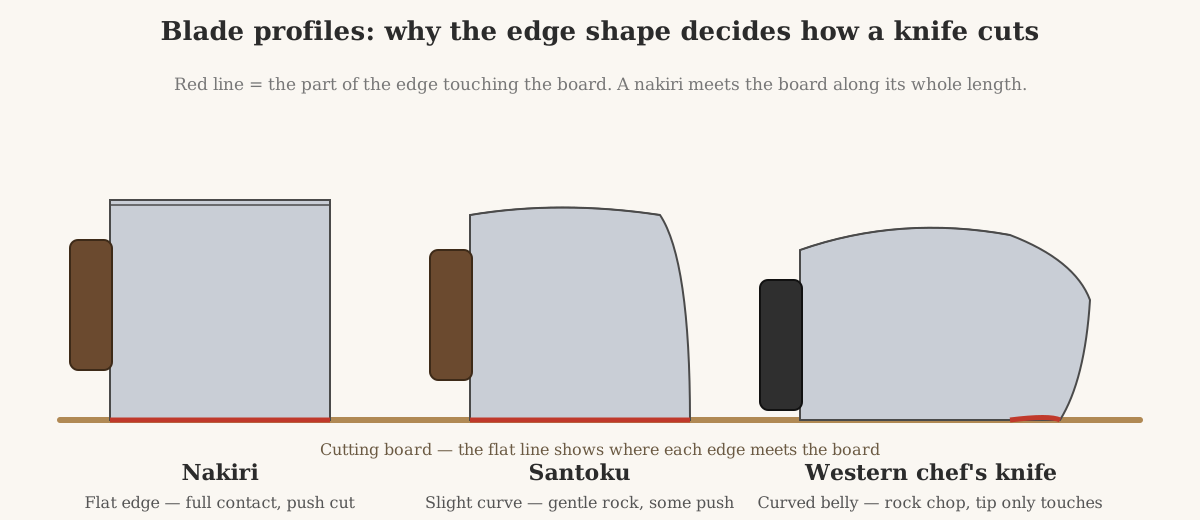
The defining feature is the edge: straight from heel to tip, with almost no curve. When you press it down, the whole edge meets the cutting board at once, so a slice comes off in a single clean motion. The blade is thin, usually 1.5 to 2 millimeters at the spine, and tall, about 45 to 55 millimeters from edge to spine. That height keeps your knuckles clear and stops cut food sticking to the blade. Most run 165 to 180 millimeters (6.5 to 7 inches), with a double-bevel edge for right- and left-handed cooks alike.
Two tip styles exist, squared (Tokyo) and slightly rounded (Osaka), but both cut the same way. Traditional knives use a wa handle, a light octagonal wooden handle that shifts balance toward the blade. Western-style knives use a heavier riveted handle. The wa handle feels quicker; the Western handle feels familiar to anyone coming from a German or American set.
What is a nakiri knife used for?
A nakiri is built for vegetables, and its flat edge and thin blade make it the best knife in the kitchen for four jobs.
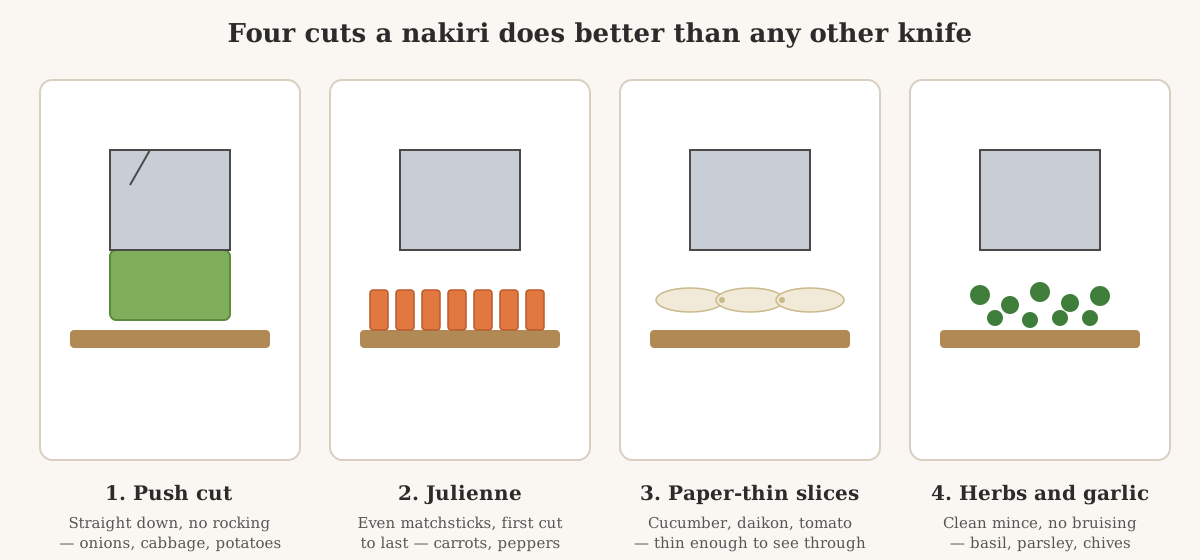
Push-cutting and straight chopping. This is the nakiri’s home territory. You lift the blade and press straight down, and the full edge meets the board at once. Onions, cabbage, potatoes, and carrots come off in even pieces, with no accordion effect at the bottom of each slice.
Julienne and fine strips. Because the edge is straight and the blade is tall, you can cut long, even matchsticks of carrot, bell pepper, or zucchini in one pass. The tall blade guides against your knuckles, keeping cuts parallel.
Paper-thin slices. A thin nakiri glides through a cucumber or a tomato with almost no wedging, so slices come out translucent and even.
Herbs and aromatics. Chopping parsley, basil, chives, or garlic with a nakiri produces a clean mince instead of a bruised paste. The straight edge shears the leaves instead of dragging across them, keeping herbs green and fragrant rather than dark and bitter.
What is a nakiri knife NOT good for?
A specialist has limits worth knowing before you buy one: the thin blade that makes it so good on vegetables is exactly what makes it wrong for hard jobs.
Do not rock-chop with it. A nakiri has no curved belly, so rocking it leaves the tip and heel untouched and produces uneven cuts.
Do not cut bones, frozen food, or hard squash. The thin edge can chip on bone, frozen meat, or a rock-hard butternut squash. A nakiri is not a cleaver. Warm hard squash in the microwave for a minute first.
Do not use it as a general-purpose knife. A nakiri is a poor choice for slicing raw meat, trimming fat, or carving a roast: it has no point for detail work, and the wide blade is clumsy around a whole chicken. Never use it to pry, scrape a board with the edge, or cut on glass or granite.
Do not buy it as your only knife. A nakiri is a second knife, not a first one. If you own one good knife, it should be a chef’s knife or a santoku. A nakiri earns its place once you have an all-rounder.
How is a nakiri different from a santoku?
The santoku is the knife most people confuse with a nakiri: both are Japanese, roughly the same length, and both handle vegetables well. Our guide to what a santoku knife is used for covers that blade in detail, but the short version is that the santoku is a generalist and the nakiri is a specialist.
| Feature | Nakiri | Santoku |
|---|---|---|
| Edge | Completely flat, no curve | Slight curve toward the tip |
| Tip | Squared off, no point | Sheep’s-foot tip |
| Motion | Push cut, straight down | Push cut or gentle rock |
| Blade height | Tall, about 50 mm | Shorter, about 40 to 45 mm |
| Best at | Vegetables, thin slicing | Vegetables, meat, fish |
| Worst at | Meat, bones, rock-chopping | Very thin slicing |
A santoku’s slight curve lets it rock a little and slice meat, making it a better single knife for a small kitchen. A nakiri’s dead-flat edge cuts vegetables more evenly, because the whole edge meets the board on every stroke. If you cook mostly vegetables and already own a chef’s knife, the nakiri is the better second knife; if you want one Japanese knife to do almost everything, the santoku is the safer pick.
How is a nakiri different from a Western chef’s knife?
The gap is wider, because the two knives are built around opposite ideas about how cutting works. A chef’s knife is designed around the rocking motion: the curved belly lets the tip stay on the board while the heel rises and falls. A nakiri is designed around the push cut: the flat edge goes straight down and comes straight back up.
| Feature | Nakiri | Western chef’s knife |
|---|---|---|
| Blade length | 165 to 180 mm (6.5 to 7 in) | 200 to 250 mm (8 to 10 in) |
| Edge | Flat, no curve | Curved belly for rocking |
| Thickness | Thin, about 1.5 to 2 mm | Thicker, about 2 to 2.5 mm |
| Weight | Light, about 150 to 200 g | Heavier, about 200 to 280 g |
| Best for | Vegetables, precision slicing | All-purpose: meat, vegetables, herbs |
| Motion | Push cut, straight down | Rock chop, slicing, draw cut |
A chef’s knife is the better all-rounder and should come first in any kitchen. A nakiri is the better vegetable knife, full stop. Many cooks use both: the chef’s knife for breaking down ingredients, the nakiri for the vegetable prep that follows.
How do you use a nakiri knife?
Using a nakiri is simple once you stop trying to rock it: the technique is the push cut, and it takes about ten minutes to learn.
- Hold it with a pinch grip. Pinch the blade just above the handle between thumb and index finger, and wrap your other fingers around the handle. The pinch grip gives you control over the thin blade.
- Curl your guide hand into a claw. Tuck your fingertips back and let your knuckles lead. The flat side of the blade slides against them, setting each slice’s thickness and keeping your fingers safe.
- Push forward and down, not down alone. Start with the heel on the board, then push forward and down in one smooth motion. The edge travels forward as it cuts, producing a clean slice instead of a crushed one.
- Lift straight up and repeat. Raise the blade, slide it back, and push again. There is no rocking and no sawing. The rhythm is lift, push, lift, push.
- Let the knife do the work. A sharp nakiri needs very little pressure. If you are forcing it, the edge is dull and needs honing or sharpening, not more muscle.
Two habits protect the blade: cut on wood or soft plastic, never glass, stone, or ceramic, and move chopped food with the spine or the flat of the blade, never the edge.
How do you choose a nakiri knife?
A first nakiri need not be expensive, but a few choices decide whether you will love it or leave it in the drawer. Our guide on how to choose a chef’s knife covers blade steel and handles in depth, and the same principles apply here.
Blade length: 165 mm or 180 mm. The 165 mm (6.5-inch) nakiri is the standard size for most home cooks: long enough to cross a head of cabbage, short enough to feel nimble. The 180 mm version suits larger hands and bigger boards. If unsure, buy the 165 mm.
Steel: VG-10, AUS-10, or White #2. VG-10 is the most common stainless steel in Japanese nakiri knives, hardened to about 60 to 61 HRC, so it holds an edge well and resists rust. AUS-10 is similar but softer, tougher, and cheaper. White #2 is a traditional carbon steel that takes the sharpest edge but rusts if left wet. For a first nakiri, stainless VG-10 or AUS-10 is the practical choice.
Handle: wa or Western. A wa handle is light and octagonal, and makes the knife feel blade-forward and quick. A Western handle is heavier and riveted. Small hands usually prefer wa; a Western handle is the safer buy if you want a knife that feels like the rest of your set.
Three entry-level nakiri knives worth knowing
You do not need to spend a fortune to get a good nakiri. The three knives below come up most often in owner reviews and buying guides, and they cover the three price tiers that make sense for a first purchase. Prices are as of November 2026 and will move with sales.
| Knife | Blade | Steel | Handle | Price |
|---|---|---|---|---|
| Mercer Culinary Genesis 7-inch Nakiri (M20907) | 178 mm (7 in) | German stainless, 56 to 58 HRC | Santoprene, Western | About $45 |
| Tojiro DP Nakiri 165 mm (F-502) | 165 mm (6.5 in) | VG-10 core, 60 HRC | Western, riveted | About $65 to $75 |
| Shun Classic 6.5-inch Nakiri (DM0728) | 165 mm (6.5 in) | VG-MAX, 68-layer Damascus | PakkaWood, D-shaped | About $190 |
The Mercer Genesis is the budget pick: a forged, full-tang knife for about $45, with a grippy Santoprene handle, though its softer German steel needs honing more often. The Tojiro DP is the value sweet spot, with real VG-10 steel for about $65 to $75. The Shun Classic is the step-up option, with a VG-MAX core in 68 layers of Damascus steel, at about $190. If you are still deciding between Japanese knives, our roundup of the best Japanese knives under $100 for beginners is a useful next read.
How do you care for a nakiri knife?
A nakiri is easy to care for, but it rewards the same habits as any good Japanese knife. Hand wash it with warm water and mild soap, then dry it immediately with a towel. Never put it in the dishwasher, where it bangs against other utensils and the edge chips. Never leave a carbon-steel nakiri wet on the board, because rust can start within minutes.
Store it in a block, on a magnetic strip, or in a blade guard, never loose with other utensils. A honing rod realigns a slightly dull edge between uses, but it does not replace sharpening. For a real edge, use a whetstone at about 15 degrees per side, or a professional sharpener once or twice a year. Skip pull-through sharpeners: they can chip a hard Japanese edge. A good wood cutting board also matters: end-grain wood is the kindest surface for a thin edge and will keep it sharp noticeably longer than a hard plastic board.
Frequently asked questions about nakiri knives
Is a nakiri knife worth it?
Yes, if you cook vegetables most days and already own a chef’s knife or santoku. It makes prep faster and more precise, but it is a poor choice as your only knife.
What is the difference between a nakiri and an usuba?
A nakiri is double-bevel, sharpened on both sides, while an usuba is single-bevel, sharpened on one side only. The usuba cuts thinner slices but is harder to sharpen and steer, so the nakiri suits almost every home cook.
What size nakiri should I buy?
A 165 mm (6.5-inch) nakiri suits most home cooks: it handles everything from garlic to cabbage and feels nimble on a standard board. Choose 180 mm only for large hands or a very large board.
Do you need a nakiri if you already have a santoku?
No, not if you already own a santoku and are happy with it. A nakiri only earns its place if you want cleaner, thinner, more even vegetable cuts than a santoku can produce.