
Hard maple is the best all-around wood for a cutting board, because its Janka hardness of around 1,450 lbf resists deep cuts while staying gentle on knife edges, and its tight, closed grain resists moisture. Hinoki is the kindest wood to thin Japanese knives, acacia is the best-looking budget pick, and white oak is the most water-resistant — but the right wood depends on how you cook.
As an Amazon Associate I earn from qualifying purchases.
A cutting board is the kitchen tool your knives touch every day, so the wood it is made from matters. The wrong wood dulls a good edge in weeks, warps after a few washes, or soaks up moisture and odors. We compared specs, prices, and verified owner reviews for the seven woods cooks ask about most. We did not test boards in our own kitchen; every claim below comes from published specifications, manufacturer guidance, and owner feedback.What makes a wood good for a cutting board?
A good cutting-board wood has to pass four tests at once. Hardness comes first: the wood must resist deep scoring without chipping or rolling a knife edge. Woodworkers generally put the sweet spot at a Janka hardness between roughly 900 and 1,500 lbf.
Grain structure is the second test. Closed-grain woods have small, tight pores that shed water and food; open-grain woods have wide pores that trap moisture and debris. That is why red oak — with its wide, open pores — should never become a cutting board. The third test is water resistance: a board gets wet every time you use it, and wood that absorbs water swells, warps, and eventually cracks. White oak fights this naturally, because its pores are plugged by cell growths called tyloses, and teak carries natural oils that repel water. The fourth test is maintenance — every wooden board needs regular oiling, but some demand it monthly while others forgive a skipped season.
Is end grain better than edge grain for a cutting board?
End grain is the better cutting surface, but it is not the better board for everyone. On an end-grain board, the fibers stand vertically, like the bristles of a brush, so a knife edge slips between them instead of severing them — and they close back up after the cut, hiding knife marks. On an edge-grain board, the fibers run horizontally, so each cut severs fibers and leaves a visible mark.
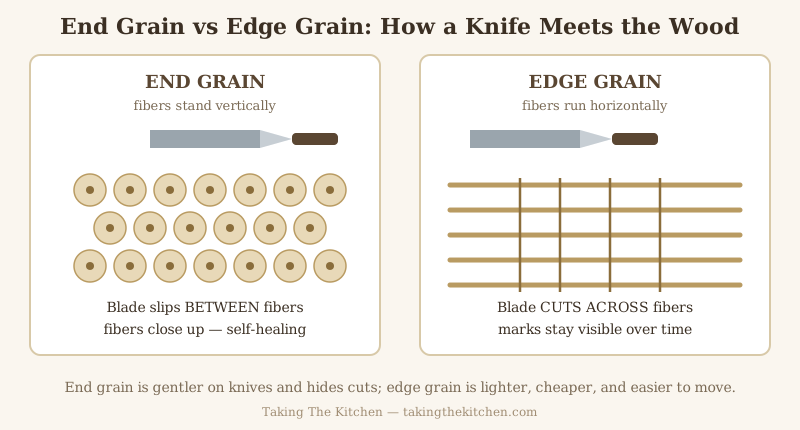
That self-healing comes at a price. End-grain boards are thicker, heavier, and more expensive: a 20-by-15-inch end-grain maple block can weigh 21 pounds, which is a piece of furniture, not something you lift to scrape scraps into the bin. Edge-grain boards are lighter, cheaper, and easier to wash and store, and entirely adequate for everyday vegetable prep. Face grain — the wide, flat surface of a plank — shows off the wood’s figure best, which is why it is the usual choice for serving boards, but it scars the fastest. Buy end grain if you chop daily and want a board that lasts decades, buy edge grain if you want a lighter board you can actually move, and save face grain for serving.
How do hinoki, maple, walnut, acacia, white oak, cherry, and teak compare?
No single wood wins every category. Here is how the seven woods stack up on published Janka hardness ratings.
| Wood | Janka hardness (lbf) | Grain | Knife wear | Maintenance | Best for |
|---|---|---|---|---|---|
| Hinoki (Japanese cypress) | ~400–500 | Fine, closed | Gentlest on edges | High — oil often, dry upright | Thin Japanese knives |
| Hard maple | ~1,450 | Tight, closed | Very gentle | Moderate — oil monthly | Everyday all-purpose use |
| Black walnut | ~1,010 | Closed, medium | Gentle | Moderate — oil monthly | Dark, handsome daily board |
| Acacia | ~1,700 | Open to medium | Moderate — harder on edges | Low to moderate | Budget serving and light prep |
| White oak | ~1,360 | Closed (tyloses seal pores) | Moderate | Moderate — oil monthly | Wet prep, carving, BBQ |
| Cherry | ~950 | Fine, closed | Very gentle | Moderate — oil monthly | Light daily use, looks |
| Teak | ~1,155 | Closed, oily | Moderate | Low — natural oils help | Humid kitchens, outdoor use |
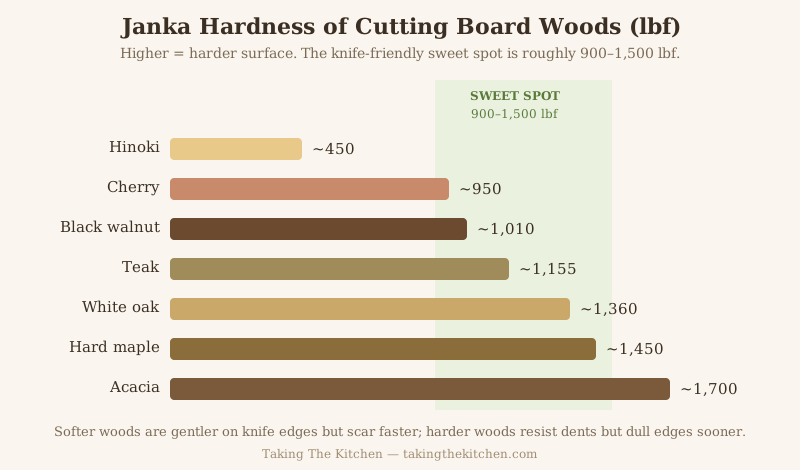
Hinoki and cherry are the softest woods here — kindest to a knife edge, quickest to show cut marks. Hard maple sits mid-range, which is why it is the default recommendation. Acacia is the hardest wood on the list: it resists dents beautifully but is toughest on knives. White oak and teak earn their places through water resistance.
Is hinoki the best wood for Japanese knives?
Hinoki is the best wood for thin, hard Japanese knives, and it is not close. Hinoki is Japanese cypress, a pale, fine-grained softwood with a Janka hardness of only around 400 to 500 lbf — roughly a third as hard as maple. That softness is the whole point: a hard, thin Japanese edge meets a surface that yields instead of fighting back, so the edge stays sharp far longer. Japanese knife makers have paired their blades with hinoki for generations, and specialist reviewers consistently call it the gentlest cutting surface available.
The trade-off is that hinoki shows its work: the board scars, dents, and stains more easily than any hardwood on this list, and a thin hinoki board can warp if left wet or dried flat. It needs more care: oil it regularly, wash it promptly, and dry it standing on edge.
Most cooks buy the Shun Hinoki Cutting Board in medium — 15.75 by 10.75 inches, half an inch thick, FSC-certified. It sells for around $55 to $65 as of November 2026 — one of the cheapest ways to protect an expensive Japanese knife. Buy hinoki if you own Japanese knives; skip it if you want a board you can abuse.
Shun Hinoki Cutting Board, Medium (15.75″ x 10.75″)
Is hard maple still the best all-around cutting board wood?
Hard maple is still the best all-around cutting board wood. At around 1,450 lbf, northern hard rock maple is hard enough to resist deep cuts, yet it sits right at the top of the knife-friendly range. Its tight, closed grain resists moisture, and its pale, even color shows stains honestly.
The reference board is the John Boos CCB Series end-grain block, model CCB2015-225: 20 by 15 inches, 2.25 inches thick, 21 pounds of American hard maple. It lists for around $296 as of November 2026, and owners report using the same block for decades. If the 21-pound block is more than you want to lift, the same maple in edge grain gives you most of the performance at roughly half the weight and price.
John Boos CCB Series Maple End Grain Cutting Board, 20″ x 15″ x 2.25″
Is walnut a good cutting board wood?
Walnut is a very good cutting board wood, and the best-looking one on this list. Black walnut rates around 1,010 lbf, softer than maple and gentler on knife edges, with a rich chocolate-brown grain that darkens with oiling. It is closed-grain, so it resists moisture well, and it needs the same monthly oiling as maple. It shows cut marks sooner than maple and usually costs more in the same size. Choose walnut if you want a board that looks like furniture; choose maple for maximum durability per dollar.
Is acacia wood good for cutting boards?
Acacia is good for cutting boards with one caveat: it is the hardest wood in this comparison. At around 1,700 lbf, an acacia board resists dents, scratches, and warping better than almost anything else you can buy. It is also strikingly beautiful, with dramatic golden-brown grain, and it is usually the cheapest hardwood board on the shelf.
The caveat is knife wear: a surface that hard is tougher on a knife edge than maple or walnut, so if you own expensive knives, acacia will send you to the whetstone more often. Acacia’s grain is more open than maple’s, so it needs regular oiling and should not be left soaking.
A solid entry point is the Ziruma acacia board, 16 by 11 inches, FSC-certified acacia pre-conditioned with beeswax, flaxseed oil, and lemon oil. It sells for around $35 as of November 2026. Buy acacia for looks and value; buy maple if knife care is your top priority.
Ziruma Acacia Wood Cutting Board, 16″ x 11″
Is white oak good for cutting boards?
White oak is an excellent cutting board wood, and the most misunderstood one. The confusion comes from red oak, its close cousin, which has wide, open pores that trap food and moisture and should never be used for a cutting board. White oak is different. Its pores are naturally plugged by cell growths called tyloses, which seal the wood from the inside. That gives white oak a closed-grain surface and the best natural water resistance of any wood here.
At around 1,360 lbf, white oak is nearly as hard as maple and resists dents well, but it is a little tougher on knife edges than maple or walnut. Its water resistance makes it the best pick for wet work like carving roasts or prepping barbecue. The catch is availability: white oak boards mostly come from small workshops and artisan makers, so prices vary widely by size and maker. If you do a lot of wet prep, white oak is worth seeking out; otherwise maple is easier to buy.
What about cherry and teak?
Cherry and teak are the two specialists here, each excellent in a narrow role. Cherry rates around 950 lbf, making it one of the gentlest woods on a knife edge, with a fine, closed grain and a warm reddish color that deepens as it ages. It is a lovely daily board for light prep — vegetables, fruit, bread — but it marks sooner than maple. Teak rates around 1,155 lbf and earns its place through natural oils that repel water better than any other wood here, making it the best choice for a humid kitchen or outdoor cooking. Buy teak from a maker that states its sourcing, since much of it is plantation-grown and quality varies.
What is the best wood for a cutting board if you only buy one?
The best wood for a cutting board depends on how you cook, not on a single winner. If you want one board that does everything well, buy hard maple — the best balance of hardness, knife-friendliness, and price. If you own thin Japanese knives, buy hinoki. If you want the best-looking board for the least money, buy acacia, and accept that your knives will need sharpening a little more often. If you carve roasts or prep barbecue, seek out white oak. And if you want a board that looks like furniture, walnut is the answer.
One honest warning applies to every wood on this list: a wooden board is a commitment, not a purchase-and-forget item. If you will not oil it and dry it properly, a plastic or composite board will serve you better than a neglected wooden one. If you are comparing wood with other materials, our comparison of stainless steel cutting board pros and cons covers when steel makes sense, and our look at whether Epicurean cutting boards are safe covers the leading composite alternative.
How do you care for a wooden cutting board?
Wooden board care is simple, but it is not optional. The full routine is in our guide to how to care for wooden cutting boards; the pointers below are the short version. Wash the board with hot, soapy water right after use, never soak it, and never put it in the dishwasher — the fastest way to warp and crack any wooden board. Dry it standing on edge so air reaches both faces. Oil it with food-grade mineral oil or board cream when the surface looks pale and dry — roughly monthly for a daily-use board.
Frequently asked questions
Is acacia wood good for cutting boards?
Yes, acacia is good for cutting boards, especially for light prep and serving: it is hard, resists dents and warping, and is usually the cheapest hardwood board available — but at around 1,700 lbf it is tougher on knife edges than maple.
Is white oak safe for cutting boards?
Yes, white oak is safe for cutting boards: its pores are naturally sealed by cell growths called tyloses, giving it a closed grain and strong water resistance — but red oak is not, because its open pores trap food and moisture.
Is hinoki too soft for a cutting board?
No, but it is the softest wood here at around 400 to 500 lbf, so it scars faster than maple and needs more careful oiling and upright drying in return for being the gentlest wood on knife edges.
What is the best wood for a cutting board for Japanese knives?
Hinoki, because its soft, fine-grained surface yields under a hard, thin edge instead of chipping it, which is why Japanese knife makers have paired their blades with hinoki for generations.
How often should I oil a wooden cutting board?
About once a month if you use it daily, or whenever the surface looks pale and dry, using food-grade mineral oil or a board cream — let it soak overnight before wiping off the excess.