
Epicurean cutting boards are safe for everyday food contact when used as the manufacturer directs. They are made from Richlite, a paper composite of kraft paper and fully cured phenolic resin, and they are NSF certified for food contact. The formaldehyde question has a real answer, but it is about tiny, measured emissions — not about a board leaching chemicals into your food.
Searches for “epicurean cutting board toxic” jumped more than 650% in the United States in November 2026, according to Google Trends data for the week of this article. The spike makes sense: Epicurean boards look like neither wood nor plastic, and anything unfamiliar that touches food invites a safety question. We compared specs, manufacturer documentation, NSF listings, and verified owner reviews to answer it honestly.
What are Epicurean cutting boards made of?
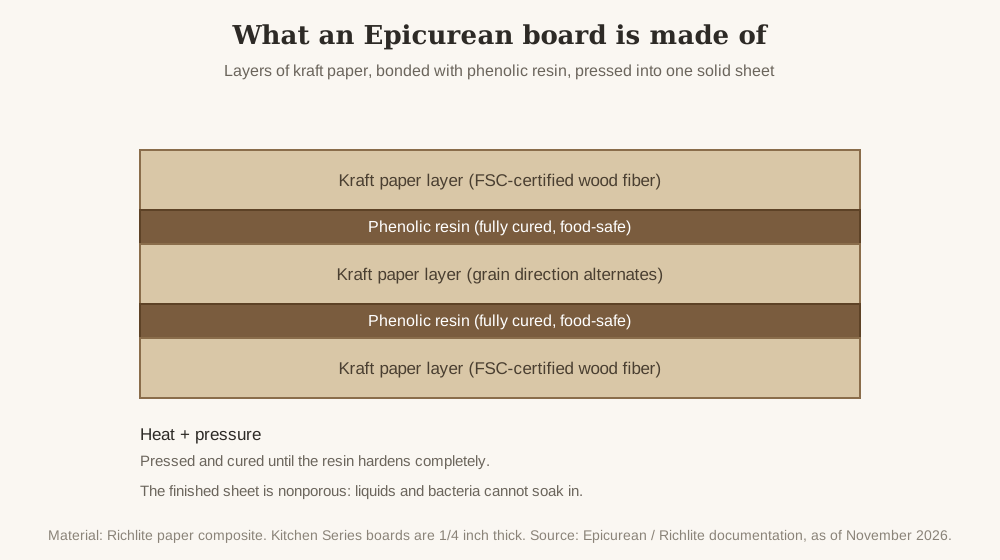
An Epicurean board is not wood, and it is not plastic. It is Richlite, a paper composite. Epicurean’s own FAQ describes the process: rolls of high-quality custom craft paper are infused with a thermosetting resin, stacked with the grain direction alternating, then pressed under even heat and pressure and cured into a solid sheet.
The resin is a phenolic resin. Richlite’s FDA food-contact statement, which Epicurean links from its FAQ, describes the material as cellulose-based kraft paper plus fully cured resole phenolic resin, with no coatings or pigments intentionally added. The paper comes from FSC-certified sources and/or recycled paper, according to Epicurean’s product documentation, and the mix varies by color: Natural and Slate use virgin pulp, while Nutmeg blends virgin paper with recycled cardboard.
The finished sheet is thin, hard, and nonporous. Kitchen Series boards are 1/4 inch thick, two-sided, with a hang hole, in Natural, Slate, and Nutmeg. The most popular size, 14.5 x 11.25 inches, is large enough to dice an onion and a pepper side by side. Epicurean backs its boards with a lifetime warranty against defects in material and workmanship, and every board is made in the USA, at the company’s facility in Superior, Wisconsin.
Is the phenolic resin in Epicurean boards toxic?
This is the question behind the search spike, and it deserves a straight answer. Phenolic resin is made from phenol and formaldehyde — two chemicals nobody wants in their food. The safety case for Epicurean boards rests on what happens during manufacturing: the resin is fully cured under heat and pressure, which cross-links it into a hard, stable solid. Once cured, the resin does not behave like its raw ingredients.
The evidence for that claim comes from several directions. Richlite’s formaldehyde statement reports emissions under 0.001 ppm in GREENGUARD Gold testing, and the material contains no urea-formaldehyde resins — the type used in cheap particleboard and the one most associated with indoor formaldehyde problems. Epicurean boards are also GREENGUARD Gold certified for low chemical emissions, and Richlite states the material meets EU REACH standards, with no substances of very high concern above 0.1% by weight. Independent testing tells a similar story: lab tests commissioned on scratched board samples leached in purified water found no traces of phenolic resin and no microplastic particles in the leachate.
None of this means the concern is imaginary. Some owners report that a new Epicurean board smells faintly of formaldehyde when it first arrives, and that the smell can take weeks to fade. A small number of highly chemically sensitive people say they cannot use one at all. If you are very sensitive to formaldehyde, that owner feedback matters more than any certification — a solid hardwood board with no resin at all is the safer choice for you.
What does NSF certification actually mean for an Epicurean board?
NSF certification is the strongest third-party check on an Epicurean board, and it is worth understanding what it covers. NSF is the National Sanitation Foundation, an independent body that tests food equipment for cleanability, material safety, and resistance to bacteria.
Two separate NSF listings back Epicurean boards. The board itself is listed under NSF/ANSI 2, the food equipment standard, with a “700 Kitchen Series Cutting Board” line covering all four sizes. The material is listed separately under NSF/ANSI 51: Richlite’s “Phenolic Wood Fibre Sheet for Food Zone” is listed for all food contact types, up to 350°F.
What NSF certification does not mean is equally important. It is not a guarantee that a board is the healthiest possible choice, and it is not a test of long-term chemical migration over a decade of daily use. It means the product passed defined tests for food-contact safety and cleanability.
How does formaldehyde from an Epicurean board compare to everyday exposure?
Numbers help here, because “contains formaldehyde” sounds alarming without context. Formaldehyde is naturally present in outdoor air, in wood, and even in some foods. The table below puts the board’s reported emissions next to ordinary background levels.
| Source | Formaldehyde level |
|---|---|
| Epicurean board, GREENGUARD Gold testing (per Richlite) | Under 0.001 ppm |
| Rural and suburban outdoor air | 0.0002–0.006 ppm |
| Urban outdoor air | 0.0015–0.047 ppm |
| Solid wood, typical emissions | About 0.00675 ppm |
| GREENGUARD Gold room limit for a product | 0.0073 ppm |
The takeaway is narrow but useful: the board’s reported formaldehyde emissions sit at or below the background formaldehyde already present in ordinary outdoor air, and well below the limit GREENGUARD Gold allows for a product in a room. That does not prove zero risk for the most sensitive people, but it does put the “toxic board” framing in perspective. A new board’s smell, when owners notice one, is the one real-world signal worth paying attention to — letting a new board air out for a few days before first use is a reasonable, low-cost precaution.
How do Epicurean boards compare to wood, plastic, and stainless steel?
No cutting board material is best at everything. The comparison below weighs the main options on the factors that matter most for safety and daily use, as of November 2026.
| Factor | Epicurean (Richlite) | Solid hardwood | Polyethylene plastic | Stainless steel |
|---|---|---|---|---|
| Dishwasher safe | Yes, including high-heat cycles | No — warps and cracks | Yes | Yes |
| Nonporous surface | Yes | No — needs oiling | Yes when new, scored over time | Yes |
| Heat resistance | Up to 350°F (177°C) | Low — scorches | Low — melts and warps | Very high |
| Knife friendliness | Good, slightly hard | Excellent | Good | Poor — dulls edges fast |
| Maintenance | None — no oiling | Regular oiling | None | None |
| Microplastic shedding | None reported in lab leach tests | None (wood particles only) | Yes — knife cuts shed particles | None |
| Resin or glue involved | Yes — phenolic resin | Minimal — food-safe glue in joints | No | No |
| Typical price, everyday size | About $40 for the 14.5-inch All-in-One (MSRP, as of November 2026) | $40–$90 for maple | $10–$25 | $30–$60 |
Epicurean’s real advantage is convenience: it is the only wood-like board you can put in the dishwasher. Its real trade-off is the resin — a small, measurable chemical question that solid wood avoids entirely. Plastic’s trade-off is different and better documented: knife cuts shed microplastic particles into food, which is why many cooks are moving away from heavily scored plastic boards.
How do you care for an Epicurean cutting board?
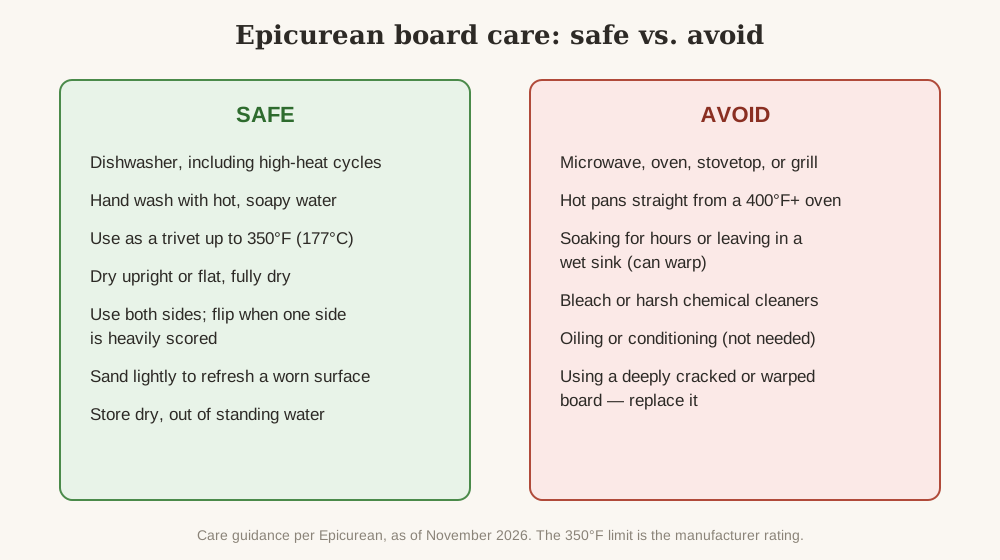
Care is where most Epicurean boards fail early, and the rules are simple. The board is dishwasher safe, including high-heat cycles, and it can also be washed by hand with hot, soapy water. It needs no oiling, no conditioning, and no bleach. A light sanding can refresh a worn surface.
The two mistakes to avoid are heat above 350°F and standing water. Epicurean says the material is heat resistant up to 350°F and can be used as a trivet, but it is not cookware: never put it in the microwave or oven, on the stovetop, or on the grill, and never set a pan straight from a 400°F oven on it. Epicurean’s care guidance warns the board can warp if left in wet or damp conditions for long periods — so do not soak it for hours or leave it sitting in a wet sink. Wash it, dry it, and store it dry.
When should you replace an Epicurean cutting board?
An Epicurean board lasts years, but it is not immortal. Replace it when any of these are true:
- Deep grooves that trap food. Shallow knife marks are normal and harmless on a nonporous surface. Deep, darkened grooves that stay stained after washing are where bacteria can shelter.
- Warping. A board that rocks on the counter is a safety problem, not a cosmetic one — it moves under the knife. Warping usually follows long soaking or damp storage.
- Cracks or chips at the edges. A cracked board can harbor moisture and bacteria in the break, and chips can flake into food.
- A smell that never fades. Most new-board smell dissipates within weeks. A board that still smells strongly chemical after months of use and washing is worth replacing.
As a rule of thumb, a daily-use Epicurean board in a home kitchen should be inspected yearly and replaced when it shows any of the signs above — not on a fixed schedule.
What are the best alternatives if you are still worried?
If the resin question bothers you even after the numbers, the honest answer is to choose a material with no resin at all. Three options cover most kitchens:
Solid hardwood (maple, walnut, teak). The safest-feeling choice for most people: no resin, no plastic, and decades of use behind it. The cost is maintenance — regular oiling, hand washing only, and no dishwasher. A good maple board costs $40–$90 as of November 2026.
Stainless steel. The most hygienic option on paper: fully nonporous, dishwasher safe, and heatproof. The cost is your knives — steel dulls edges faster than any other board material. If you cook mostly with a knife you are willing to sharpen often, it is a strong pick. Our breakdown of stainless steel cutting board pros and cons weighs the trade-offs in detail, and our guide to how to sharpen a kitchen knife at home covers the technique.
Natural rubber. A newer option that is knife-friendly, nonporous, and resin-free. It is heavier and more expensive than Epicurean, and less widely available.
What we would not recommend as a “safer” swap is a cheap plastic board: it trades a small, measured resin question for a documented microplastic one.
Who should buy one, and who should skip it?
Buy an Epicurean board if you want a low-maintenance everyday board, you like the idea of a dishwasher-safe board that is not plastic, and the resin question does not worry you after reading the numbers. It is a good fit for busy home cooks, small kitchens where a thin board matters, and anyone replacing a scored plastic board.
Skip it if you are highly sensitive to formaldehyde, if you want a board with zero synthetic binder, or if you regularly need a trivet for pans hotter than 350°F. In those cases, solid hardwood or stainless steel will serve you better, and you will not spend your time wondering about the material.
The bottom line is unglamorous but reassuring: an Epicurean board is a well-tested, certified food-contact product with a small, honest caveat. The resin is real, the emissions are measured and low, and the board is safe to use as directed — as long as you respect the 350°F limit, keep it dry between uses, and replace it when it is worn out.
Frequently asked questions
Are Epicurean cutting boards toxic?
No, not in normal use. Epicurean boards are made from Richlite — kraft paper bonded with fully cured phenolic resin — and they are NSF certified for food contact. Richlite reports formaldehyde emissions under 0.001 ppm, at or below ordinary outdoor air levels.
Do Epicurean cutting boards contain formaldehyde?
The resin is made with formaldehyde, but the finished board contains no urea-formaldehyde resin, and the cured phenolic resin is stable. Reported emissions are under 0.001 ppm in GREENGUARD Gold testing, and some owners notice a faint smell on a brand-new board that fades over a few weeks.
Are Epicurean cutting boards dishwasher safe?
Yes, including high-heat cycles, according to Epicurean. The risk is not the dishwasher but drying: the board can warp if left in wet or damp conditions for long periods, so dry it fully and store it dry.
Can you use an Epicurean board as a trivet?
Yes, up to 350°F (177°C). Epicurean says the board can be used as a trivet, but it is not cookware — never use it in the microwave, oven, on the stovetop, or on the grill.
Do Epicurean cutting boards release microplastics?
Lab leach tests on scratched board samples found no phenolic resin and no microplastic particles in the water. Richlite is a paper composite, not a plastic, so it does not shed plastic particles the way scored polyethylene boards do.
How long do Epicurean cutting boards last?
Years of daily use, with no oiling or special care. Replace the board when it has deep grooves that trap food, warping, cracks, or a chemical smell that never fades — not on a fixed schedule.