
A stainless steel cutting board is the most hygienic and durable option: it is non-porous, dishwasher-safe, and will not stain, absorb odors, or warp. The trade-off is your knives — steel is unyielding, so edges roll and dull faster than on wood or plastic. It is best for raw meat and heavy-duty prep, not for your best knives.
As an Amazon Associate I earn from qualifying purchases.
Stainless steel cutting boards have gone from commercial kitchens to home kitchens in the last few years, and Google Trends shows US searches for their pros and cons rising 350% in the past 24 hours. The pitch is simple: a board that cannot absorb bacteria, cannot be stained by beets or turmeric, and will never crack, warp, or need oiling. The catch is equally simple: the same hardness that makes steel so durable is what dulls your knives.
We compared the stainless steel boards actually selling now against the two materials they compete with — wood and plastic. No single board wins everything: steel wins on hygiene and durability, wood on knife care, plastic on price. Which one belongs in your kitchen depends on what you cut most.
What are the pros of a stainless steel cutting board?
The case for steel starts with hygiene. Stainless steel is non-porous, which means liquids have nowhere to soak in. Raw chicken juices, beet stains, garlic and onion odors — all of it rinses off the surface instead of sinking into fibers or knife grooves. That is the single biggest advantage over wood and plastic, and the reason commercial kitchens and butcher shops have used stainless work surfaces for decades.
Sanitizing is just as easy: hot soapy water, a wipe-down, and the dishwasher, whose high heat helps sanitize it. Unlike wood it will not warp, crack, or split from water exposure, and there is no oiling schedule or special soap. The same habits that keep stainless steel pans looking new — hot soapy water, soft sponge, no harsh abrasives — work here too.
Durability is the second win. A steel board does not crack, chip, warp, or wear thin. A 1.2–2 mm sheet of 304 stainless steel will outlast several wood and plastic boards bought in the same period, and it will look nearly the same in five years as it did on day one — aside from fine surface scuffs, which are cosmetic. It tolerates boiling water, hot food straight from the pan, and even dough work: the cool, non-stick surface is genuinely good for pastry and bread, where wood can grip and plastic can flex.
Stability is the quieter advantage: a steel board in the common 15 x 11-inch size weighs around 2–2.5 lbs, so it stays put while you chop, and some models add a counter lip or silicone mat that solves sliding completely.
What are the cons of a stainless steel cutting board?
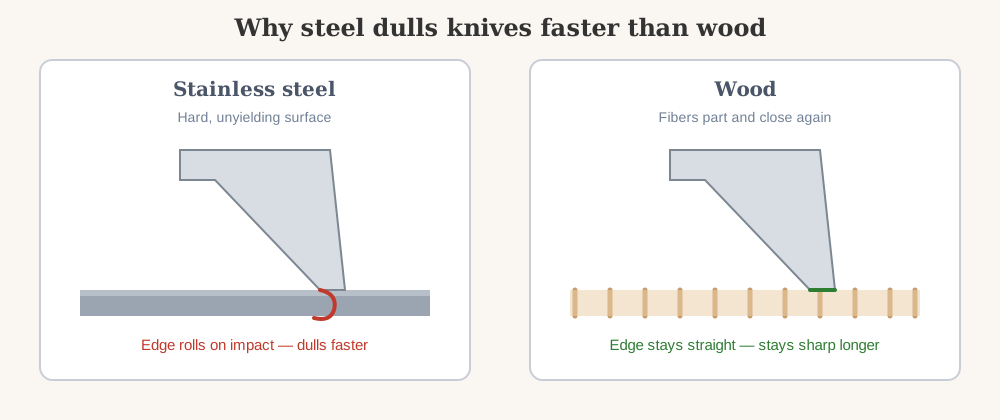
The main drawback is knife wear, and it is not a small one. Steel does not yield under a blade the way wood fibers or plastic do, so the knife’s fine edge rolls microscopically with every cut. The result is a blade that needs honing far more often — and over time, more frequent sharpening. If you own good knives, this is the reason to think twice before making steel your everyday board.
Noise is the second complaint. Chopping on steel is loud: every cut rings and clatters in a way wood never does. In an open-plan kitchen or a household with light sleepers, that matters more than it sounds like it should.
The surface itself is slippery. Smooth steel offers little grip, so round foods like onions and tomatoes can roll, and the board can skate on a wet counter unless it has a lip, a mat, or a damp towel underneath. Thin, cheap boards make this worse — a flimsy sheet can flex and bow under pressure, which is why thickness matters when you buy (more on that below).
Finally, steel shows its use: fine scratches appear quickly and never come out, so a mirror-bright board soon looks worked-in. That is purely cosmetic, but unlike wood, a scuffed steel board cannot be sanded back to a fresh surface.
How does stainless steel compare to a wood cutting board?
Wood — usually end-grain maple, beech, or walnut — is the classic rival, and it wins on the one thing steel loses: knife care. Wood fibers part under the blade and close again, so the edge stays true far longer. A good wood board is also quieter, grippier, and more pleasant to cut on, and a thick end-grain board can be sanded and re-oiled back to a fresh surface when it gets worn.
Steel wins the other columns: no oiling, dishwasher-safe, cannot crack from soaking, will not absorb odors. Wood needs hand washing, regular oiling, and prompt drying. On hygiene the gap is smaller than steel fans claim — a University of California, Davis study found wood boards can be just as hygienic as plastic when both are washed properly. Washed well, wood is safe; washed poorly, steel is more forgiving.
| Feature | Stainless steel | Wood (end-grain) |
|---|---|---|
| Hygiene | Non-porous; easiest to sanitize | Safe when washed well; fibers trap moisture below the surface |
| Kind to knives | Poor — edges roll and dull faster | Best — fibers yield and protect the edge |
| Durability | Will not crack, warp, or split | Can crack if soaked; sandable and re-oilable |
| Maintenance | None — dishwasher-safe, no oiling | Hand wash, oil regularly, dry promptly |
| Noise | Loud, rings with every cut | Quiet |
| Lifespan | Decades | Decades with care |
| Cost | Budget boards are inexpensive | A quality end-grain board costs several times more |
How does stainless steel compare to a plastic cutting board?
Plastic — usually high-density polyethylene (HDPE) — is the budget option, and it competes with steel on convenience rather than quality. Plastic boards are light, cheap, dishwasher-safe, and come in colors you can assign to different foods. For many households that is enough.
The problem is grooves: every cut scores the plastic, and those scores trap moisture and bacteria where a sponge cannot reach. US food-safety guidance recommends replacing a plastic board once it develops deep knife grooves. That replacement cycle is plastic’s hidden cost — a cheap board needs replacing every year or two with daily use. Plastic also warps in a hot dishwasher and stains from turmeric and tomato.
Steel has none of those failure modes — no grooves, no warping, no staining, nothing to replace. The trade is knife wear and noise, and a higher up-front price for a thick board. If you already replace plastic boards regularly, a single steel board is often cheaper over five years.
| Feature | Stainless steel | Plastic (HDPE) |
|---|---|---|
| Hygiene | Non-porous; fully sanitizable | Grooves trap bacteria; replace when deeply scored |
| Kind to knives | Poor — edges roll faster | Good — softer surface protects the edge |
| Durability | Will not warp, crack, or stain | Warps in heat; stains; grooves wear in |
| Maintenance | None — dishwasher-safe | Dishwasher-safe; replace when grooved |
| Noise | Loud | Quiet |
| Lifespan | Decades | 1–2 years of daily use |
| Cost | More up front, nothing to replace | Cheapest up front, recurring replacement |
Is a stainless steel cutting board safe for food?
Yes — provided you buy the right grade. Look for food-grade 304 stainless steel, also sold as 18/8 (18% chromium, 8% nickel), or 316, which adds molybdenum and resists corrosion slightly better. Both are standard food-contact grades used in commercial kitchens. Avoid boards that do not state a grade at all: unmarked steel may be a lower alloy that rusts or pits.
There is no coating to flake and no plasticizer to leach — part of steel’s appeal for buyers who want a low-toxicity kitchen, the same thinking behind our guide to the best non-toxic cookware for a gas stove. The safety rules are ordinary: wash with hot soapy water between raw meat and produce, and use separate boards for raw meat and ready-to-eat food. Steel makes those rules easier to follow, not optional.
Will a stainless steel cutting board ruin your knives?
It will not ruin them, but it will dull them faster than wood or plastic — and the reason is physics, not hardness. A knife’s edge is only a few microns wide, and on an unyielding surface that fine edge folds and rolls microscopically with each cut. Wood and plastic give slightly under the blade, so the edge stays straight longer. The knife steel is actually harder than the board steel; the damage comes from the board refusing to yield, not from the board being harder.
The practical answer is to match the knife to the board: use a beater knife on steel and keep your best knives — especially thin, hard Japanese blades — on wood. Hone the edge before each use, which straightens the rolled edge in seconds, and learn how to sharpen a kitchen knife at home so the extra wear costs minutes, not a new knife. Our guide to choosing a chef’s knife explains which blade steels hold up best.
Which stainless steel cutting boards are worth buying?
Three boards cover the useful range, and they differ mainly in thickness — thicker boards resist warping and feel more stable under the knife.
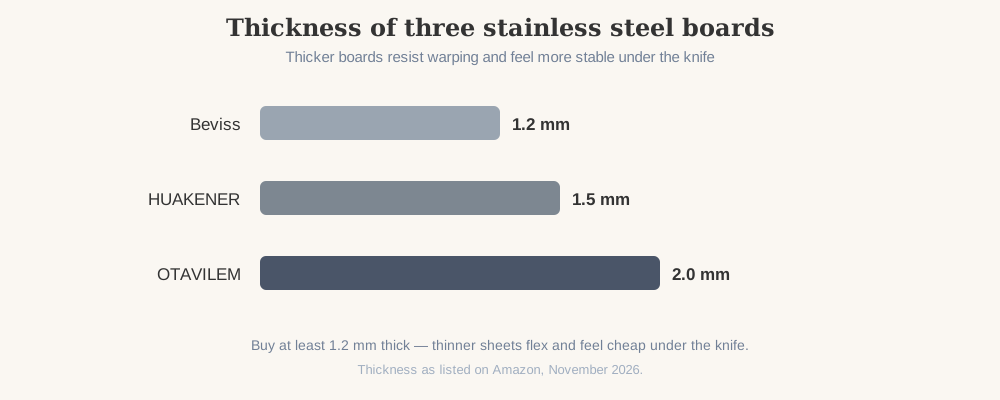
The HUAKENER Large Stainless Steel Cutting Board, 15.7 x 11.8 inches is the best all-rounder: food-grade 304 steel, a counter lip that stops it sliding off the edge, and a silicone mat underneath for grip — the two features that fix steel’s slipperiness. At 0.06 inches (about 1.5 mm) thick it is sturdy without being heavy. [Check the HUAKENER board on Amazon]
The OTAVILEM Stainless Steel Cutting Board, 15.7 x 11.8 inches is the heavy-duty pick: 2 mm (0.08 inches) thick, the sturdiest of the three, and sold since February 2025 as a kneading and meat-prep board. If you cut bone-in meat or frozen food, the extra thickness is worth it. [Check the OTAVILEM board on Amazon]
The Beviss 304 Stainless Steel Cutting Board, 15 x 11 inches is the budget entry: 1.2 mm food-grade 304 steel, double-sided, dishwasher-safe, and the most-bought of the three — Amazon shows 100+ bought in the past month. It is thinner and lighter, so it suits everyday vegetable prep rather than heavy butchery. [Check the Beviss board on Amazon]
Prices move frequently, so check the listing before buying. Whatever you buy, check two things: the grade should read 304 (or 18/8) or 316, and the thickness should be at least 1.2 mm — thinner sheets flex and feel cheap under the knife.
Which cutting board should you choose?
No single board wins everything — the right setup is usually two boards: wood for daily chopping and steel for raw meat.
| Your situation | Best choice |
|---|---|
| Raw meat and poultry prep | Stainless steel — sanitize it in the dishwasher after |
| Daily vegetables with good knives | Wood, end-grain maple — kindest to edges |
| Tight budget, dishwasher habit | Plastic HDPE — replace it when grooves get deep |
| Bread, pastry, and dough | Stainless steel — cool, smooth, and non-stick |
| One board only | Wood — the best all-rounder, plus a steel board for meat |
| Small kitchen, heavy use | Stainless steel — nothing to maintain, nothing to replace |
If you buy one board today, make it a steel one for raw meat and keep using whatever you have for everything else. If you already own a good wood board, add a steel board as the second board — that pairing covers every job in the kitchen, and it is the setup most serious home cooks end up with.
Frequently asked questions
Do stainless steel cutting boards dull knives?
Yes — faster than wood or plastic. The steel surface does not yield, so the knife’s fine edge rolls with each cut. Hone before use and keep your best knives on wood.
Are stainless steel cutting boards hygienic?
Yes — among the most hygienic. The non-porous surface gives bacteria nowhere to hide, and the board can go in the dishwasher. Wash with hot soapy water between raw meat and produce.
Can you put a stainless steel cutting board in the dishwasher?
Yes. Unlike wood, a steel board is fully dishwasher-safe, and the high heat helps sanitize it. Dry it promptly to avoid water spots.
What grade of stainless steel should a cutting board be?
Look for food-grade 304 (also sold as 18/8) or 316. Both are standard food-contact grades; 316 resists corrosion slightly better. Avoid boards that do not state a grade.
Is stainless steel better than wood for cutting boards?
It depends on the job. Steel wins on hygiene, durability, and easy sanitizing; wood wins on knife care and quiet, pleasant cutting. Most well-equipped kitchens keep both.