
To cook filet mignon in a cast iron skillet, sear a 1.5- to 2-inch steak for 2 minutes per side in a ripping-hot skillet with a high-smoke-point oil, baste it with butter, then finish it in a 400°F oven for 4–6 minutes. Pull the steak at 125°F for medium-rare and rest it 5 minutes, during which it climbs to about 130°F.
Filet mignon is the most forgiving steak to cook badly and the most rewarding to cook well. Cut from the tenderloin, it is the leanest and most tender cut on the animal — and it has almost no fat to hide behind. That is why the method matters more than the recipe: a hot cast iron skillet, a thermometer, and five minutes of patience will do more for a filet than any marinade ever could. This guide compares published methods from Serious Eats and America’s Test Kitchen with verified owner reviews and the USDA temperature chart; we did not test steaks in our own kitchen for this article.
Why does filet mignon need a different method from other steaks?
Filet mignon comes from the tenderloin, a muscle that does almost no work, which is why it is famously tender and famously lean. A ribeye forgives a few extra minutes because its marbling bastes it from the inside. A filet has no such insurance: cook it 10°F too far and it turns from buttery to dry, and no sauce fully rescues it.
That leanness is also why the cast iron skillet is the right tool. Cast iron holds heat better than any other home pan, so it does not cool down when a cold steak hits it. A thin pan drops sharply on contact, and the steak steams instead of searing. A preheated cast iron skillet stays hot, and that sustained heat is what builds the dark, savory crust — the Maillard reaction — in two minutes per side.
The oven finish handles the rest: a 2-inch filet is too thick to cook through on the stovetop alone, so moving the whole skillet into a 400°F oven lets the center catch up while the crust stays intact.
What do you need to cook filet mignon in a cast iron skillet?
You need less gear than most recipes suggest: the steak, the pan, a thermometer, and a timer do the real work. If you are still deciding between pan materials, our comparison of cast iron vs carbon steel for steak explains when each one wins.
| Item | What to use | Why it matters |
|---|---|---|
| Steak | Filet mignon, 1.5–2 inches thick, 6–8 oz each | Thickness is the biggest factor in even cooking |
| Skillet | 10- or 12-inch cast iron, well seasoned | Holds heat through the sear and goes into the oven |
| Oil | 1 tablespoon refined avocado oil | Smoke point around 500°F; will not burn while searing |
| Butter | 2 tablespoons unsalted butter | Added after the sear, for basting and flavor |
| Aromatics | 2 garlic cloves, crushed; 2 sprigs fresh thyme or rosemary | Flavor the basting butter; add late so they do not burn |
| Seasoning | Kosher salt and freshly ground black pepper | Seasons evenly without over-salting |
| Thermometer | Instant-read digital thermometer | The only reliable way to know doneness |
How do you choose the right filet mignon?
Buy thickness, not weight. A filet that is 1.5 to 2 inches thick cooks evenly from edge to center, which is what makes the oven finish work. A thin filet — under 1 inch — cooks through before a crust can form, so you get a gray, overcooked steak with a pale surface. If the butcher’s case only has thin filets, ask for center-cut pieces cut to 2 inches. Look for a deep red color with a fine, even texture and a small cap of fat around the edge; filet is lean by nature, so you will not see the heavy marbling of a ribeye.
Center-cut filets are the most uniform in shape, which means they cook evenly. Tapered tail-end pieces are cheaper but cook unevenly, with the thin end overcooking while the thick end is still rare. If you buy a tapered piece, tuck the thin end underneath itself and tie it with kitchen twine so the steak is one even cylinder. Expect roughly $25–$40 per pound at a US butcher counter as of November 2026.
When should you salt filet mignon?
Salt at least 45 minutes before cooking, or salt immediately before the steak hits the pan. Never salt in between.
The reason comes from Serious Eats’ food-lab testing. Salt first draws moisture to the surface, and for roughly 5 to 45 minutes after salting, the steak sits in a wet brine that has to boil off before browning can begin. A steak salted 15 or 20 minutes ahead can develop a worse crust than one salted right before cooking. After about 45 minutes, the moisture is reabsorbed, the surface dries out again, and the salt has seasoned the interior.
For the best result, salt 45 minutes to 24 hours ahead and leave the steak uncovered on a wire rack in the refrigerator. If dinner is happening in half an hour, skip the wait: pat the steak dry, salt it, and put it in the pan immediately. Add black pepper just before cooking — pepper burns at searing temperatures, and burned pepper tastes bitter.
How do you cook filet mignon in a cast iron skillet?
The whole method takes about 12 minutes of active cooking plus a 5-minute rest. Read the steps once before you start — the sear moves fast.
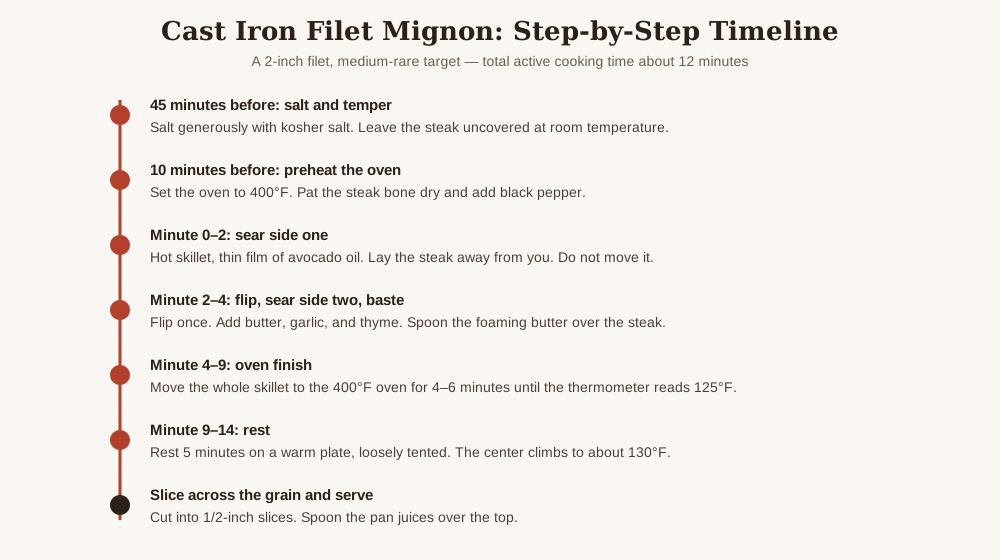
- Temper the steak. Take the filets out of the refrigerator 30–45 minutes before cooking. A cold steak sears unevenly because the outside overcooks while the center stays fridge-cold. This is also when you salt, if you are using the 45-minute method.
- Preheat the oven to 400°F. Do this at least 10 minutes before cooking so it is fully hot when the skillet goes in.
- Pat the steak dry. Press every surface with paper towels until no moisture transfers. This is the single most important step for a good crust. A wet steak steams; a dry steak sears.
- Season. Salt (if you have not already) and add freshly ground black pepper on all sides, including the edges.
- Preheat the skillet. Set the cast iron skillet over medium-high heat for 3–5 minutes. It is ready when a drop of water sizzles and evaporates instantly. Add 1 tablespoon of avocado oil and swirl it to coat the bottom.
- Sear side one. Lay the steak in the pan away from you. Leave it completely alone for 2 minutes. Do not move it, do not peek, do not press it again — every lift breaks the crust that is forming.
- Flip once and sear side two. Turn the steak with tongs and sear the second side for 2 minutes. While it sears, add 2 tablespoons of butter, the crushed garlic, and the thyme to the pan.
- Butter-baste. Tilt the pan slightly toward you and spoon the foaming butter over the top of the steak, again and again, for 30–60 seconds.
- Finish in the oven. Transfer the whole skillet to the 400°F oven. For a 2-inch filet, roast 4–6 minutes for medium-rare. Start checking at 4 minutes — ovens vary, and 60 seconds is the difference between medium-rare and medium.
- Check the temperature. Insert the thermometer into the thickest part of the steak from the side. Pull the steak at 125°F for medium-rare.
- Rest for 5 minutes. Move the steak to a warm plate and tent it loosely with foil. Do not cut into it yet.
- Slice and serve. Cut across the grain into 1/2-inch slices, or serve whole. Spoon the pan juices and melted butter over the top.
That is the entire method. Trust the thermometer over your eyes — the steak will look underdone when you pull it, and that is exactly right.
What internal temperature should you pull filet mignon at?
Pull the steak 5°F below your target doneness: carryover cooking adds roughly 5°F during the rest, so medium-rare means pulling at 125°F and resting to about 130°F.
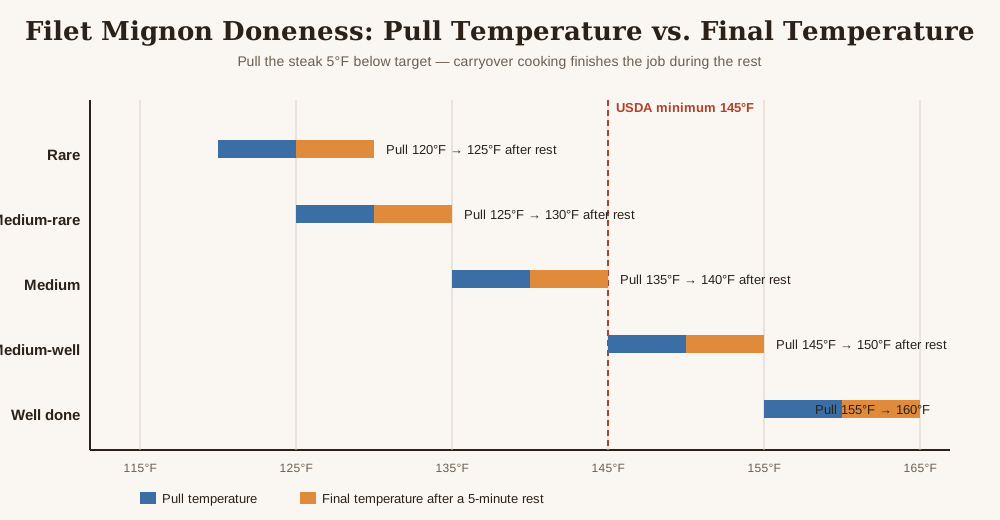
| Doneness | Pull temperature | Final temperature after rest | Center |
|---|---|---|---|
| Rare | 120°F | 125°F | Cool red center |
| Medium-rare | 125°F | 130°F | Warm red center |
| Medium | 135°F | 140°F | Warm pink center |
| Medium-well | 145°F | 150°F | Slightly pink center |
| Well done | 155°F | 160°F | Brown throughout |
One temperature in that table is also a safety line. The USDA recommends cooking whole cuts of beef, including steaks, to a minimum internal temperature of 145°F with a 3-minute rest — the food-safety baseline, landing at medium. Rare and medium-rare steaks sit below the USDA minimum, so extra caution is advised for pregnant people, young children, older adults, and anyone with a weakened immune system. The surface of the steak is seared well past 145°F during cooking, which is where most surface bacteria live.
For most filet mignon, medium-rare is the sweet spot: the cut is so tender it does not need higher heat to be enjoyable, and its leanness means higher temperatures dry it out faster than a fattier cut. If you prefer medium, pull at 135°F and rest to 140°F — still juicy, still pink, and right at the USDA baseline after resting. Insert the probe into the thickest part from the side, so the tip sits in the center of the meat.
How long should filet mignon rest — and why?
Rest the steak for 5 minutes before slicing, and do not skip this step. When meat cooks, the muscle fibers tighten and squeeze juices toward the center. Cutting immediately lets those juices run out onto the plate. During a rest, the fibers relax and the juices redistribute evenly. The carryover heat also finishes the job: a steak pulled at 125°F climbs to roughly 130°F on the plate. Rest on a warm plate, tented loosely with foil — a tight wrap traps steam and softens the crust.
How do you slice and serve filet mignon?
Slice filet mignon across the grain, in slices about 1/2 inch thick. The grain runs lengthwise along the steak, so cutting across it shortens the muscle fibers and makes each bite more tender. Serve on a warm plate with the pan juices spooned over the top; the butter, garlic, and thyme left in the skillet are the best sauce this steak needs. Creamed spinach, roasted asparagus, or garlic mashed potatoes all let the steak lead.
What mistakes ruin cast iron filet mignon?
Most failed filets fail in one of six ways.
Cooking a thin steak. A filet under 1 inch thick overcooks before it browns. Buy 1.5–2 inches thick.
A wet surface. Skipping the paper-towel step is the most common mistake in home kitchens. Moisture has to boil off before browning starts, and that delay produces a gray, steamed surface instead of a crust.
A pan that is not hot enough. If the steak does not sizzle loudly the instant it touches the pan, the pan was not ready. Pull the steak out, keep heating the pan, and try again.
Using the wrong oil. Extra virgin olive oil smokes at around 320°F and burns before the pan is hot enough to sear, leaving a bitter film on the meat. Use refined avocado oil, with a smoke point around 500°F, or grapeseed oil at around 420°F.
Moving the steak during the sear. Every lift breaks contact with the pan and interrupts the crust. Place it once, leave it alone for 2 minutes, flip once, and leave it alone again.
Cutting into it too soon. Slicing a steak the second it leaves the pan floods the plate with juice that belongs inside the meat. Five minutes of rest is part of the cooking.
How do you clean the cast iron skillet after cooking steak?
Let the skillet cool until it is warm, not hot, then wipe out the fat and food bits with a paper towel. Wash it with hot water and a stiff brush, dry it immediately on low heat, and rub in a thin layer of neutral oil while it is still warm. Never soak cast iron, and never put it in the dishwasher — standing water is what starts rust. If the pan already has rust, our guide to getting rust off a cast iron skillet walks through the full restoration, from scrubbing to re-seasoning.
Frequently asked questions
Can you cook filet mignon entirely on the stovetop without the oven?
Yes, for a thinner filet under 1.5 inches, but a 2-inch filet needs the oven finish to cook the center without burning the crust.
How long does it take to cook filet mignon in a cast iron skillet?
About 12 minutes for a 2-inch filet at medium-rare: 2 minutes per side on the stovetop, 30–60 seconds of butter-basting, and 4–6 minutes in a 400°F oven, plus a 5-minute rest.
What is the best oil for searing filet mignon?
Refined avocado oil, with a smoke point around 500°F, is the best choice because it stays stable at searing heat without smoking or turning bitter. Grapeseed oil at around 420°F also works; avoid extra virgin olive oil, which smokes at around 320°F.
Should filet mignon be brought to room temperature before cooking?
Yes, let it sit out for 30–45 minutes before cooking. A cold steak sears unevenly because the outside overcooks while the center stays cold.
Do you need to tie filet mignon with twine?
Only if the steak is tapered or uneven in shape. Tying a tapered filet into an even cylinder helps it cook uniformly, but a well-cut center filet holds its shape on its own.
Is medium-rare filet mignon safe to eat?
Medium-rare filet reaches about 130°F after resting, below the USDA’s recommended minimum of 145°F with a 3-minute rest for whole cuts of beef. The seared surface kills surface bacteria, but extra caution is advised for pregnant people, young children, older adults, and anyone with a weakened immune system.
Cooking filet mignon in a cast iron skillet is a method, not a talent. Buy the steak thick, salt it early or at the last second, get the pan hotter than feels reasonable, trust the thermometer, and rest the steak. Do those five things and the steakhouse result follows — as of November 2026, this is the method published sources agree on.