
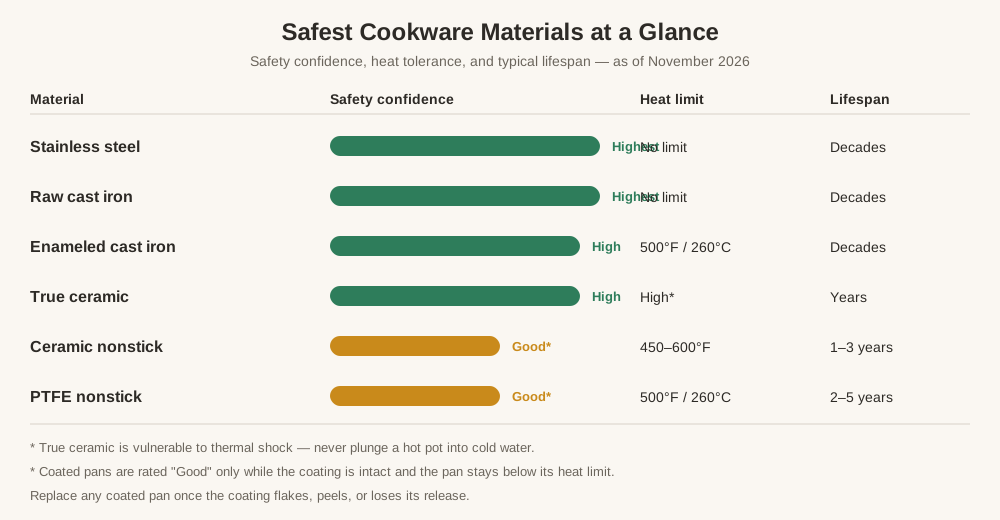
The safest cookware materials overall are stainless steel and cast iron, because neither relies on a coating that can wear out or break down at high heat. Ceramic nonstick and PTFE nonstick are also safe when used within their temperature limits and replaced once the coating is damaged. The real question is not which material is “toxic” but which one stays stable under the way you actually cook.
Kitchen stores compete on safety claims: PFOA-free, ceramic, surgical-grade steel. Most labels describe what a pan does not contain, not how it behaves after two years of daily use. We compared specs, prices, and verified owner reviews rather than running lab tests. Prices are as of November 2026.
What does “safe cookware” actually mean?
A pan is safe when three things hold true: nothing harmful migrates from the pan into food in meaningful amounts, the cooking surface stays stable at the temperatures you use, and the surface does not break down into fragments or fumes as it ages. Leaching is the first test — metals and coatings can release tiny amounts of their ingredients into food, especially with acidic ingredients and long, slow cooking. Heat stability is the second: steel and iron have no coating to degrade, while coated pans have limits set by the manufacturer. Surface condition is the third: a scratched nonstick pan or chipped enamel is a different pan from the one that left the factory.
Which cookware material is safest at a glance?
| Material | What can leach | Heat limit | Typical lifespan | Best for |
|---|---|---|---|---|
| Stainless steel (18/10 or 18/8) | Trace nickel and chromium | No practical limit | Decades | Everyday cooking, acidic sauces, searing |
| Raw cast iron | Iron, more with acidic foods | No practical limit | Decades to generations | Searing, baking, high-heat cooking |
| Enameled cast iron | Nothing; enamel is inert glass | Around 500°F (260°C) | Decades if enamel stays intact | Braising, stews, bread baking |
| True ceramic (100% ceramic) | Nothing; no metal core | High, but thermal shock risk | Years with careful handling | Slow cooking, baking, acidic foods |
| Ceramic nonstick (sol-gel) | Nothing while intact | Around 450–600°F (230–315°C) | 1–3 years | Eggs, fish, low-fat cooking |
| PTFE nonstick | Nothing at normal temperatures | Around 500°F (260°C) | 2–5 years | Eggs, pancakes, delicate foods |
No material wins on every row. The right answer depends on what you cook, how hot you cook, and how often you are willing to replace a pan.
Is stainless steel the safest cookware material?
For most households, yes. Stainless steel has no coating to wear out, tolerates any normal cooking temperature, and does not react with acidic food in any meaningful way. A tri-ply pan bought today can still be in daily use in twenty years — a scratched stainless pan is still a stainless pan.
The alloy is usually 18/10 or 18/8: 18% chromium and 10% or 8% nickel, the rest mostly iron. Small amounts of nickel and chromium can migrate into food, rising with acidic ingredients and long cooking times, but studies consistently find the amounts far below normal dietary intake for most people. People with a diagnosed nickel sensitivity should discuss cookware choices with their clinician.
A fully clad tri-ply pan — stainless steel sandwiching an aluminum or copper core — heats evenly and is worth the premium if you cook daily. As of November 2026, a 12-inch Tramontina tri-ply skillet runs around $50, while an equivalent All-Clad D3 runs around $140 to $160. Both use the same 18/10 food-grade steel; the price difference buys manufacturing origin and warranty, not a different safety profile. One genuine limit: most stainless handles are oven-safe to 500°F or 600°F, so check the rating before sliding a pan under the broiler.
Is cast iron safe to cook with every day?
Raw cast iron is one of the safest materials you can cook with. It is a single piece of iron with a seasoning layer — oil heated past its smoke point until it bonds to the metal. There is no coating to flake, no temperature limit a home stove can reach, and no chemical that degrades with heat. A Lodge 12-inch skillet costs around $20 to $30 as of November 2026 and can outlive its owner.
Iron does migrate into food, more with acidic foods and long cooking, but for most people the amounts are nutritionally trivial. People with iron-overload conditions such as hemochromatosis should discuss it with a clinician. The practical rule: use raw cast iron for searing, frying, and baking, and stainless steel or enameled cast iron for long-simmered acidic sauces.
Seasoning is the safety feature and the maintenance habit in one: a well-seasoned pan resists rust, and rust is a reason to re-season, not to throw the pan away. Our guide to cleaning a cast iron skillet with burnt-on food covers the routine. Note the weight, though — a 12-inch Lodge is around 8 pounds, a poor choice for anyone who struggles to lift a full pan one-handed.
Enameled cast iron removes the seasoning chore entirely. Brands such as Le Creuset and Staub coat the iron in layers of glass enamel, so food never touches bare metal. The enamel is inert and does not leach, which makes enameled Dutch ovens the safest choice for long, acidic braises. The trade-off is the enamel itself: it can chip if you drop the lid or bang a metal utensil against the rim, exposing bare iron that will rust. A chipped enameled pot is not dangerous — it is a pot that needs retiring. As of November 2026, a Le Creuset 5.5-quart round Dutch oven runs around $350 to $420; a Lodge equivalent runs around $70 to $90. Our enameled cast iron vs raw cast iron guide breaks down when each one earns its place.
Is ceramic cookware safe?
Two different products share the word “ceramic”: true ceramic cookware is clay fired into a solid vessel with no metal core and no coating, while ceramic nonstick is an aluminum pan with a sol-gel coating sprayed on the surface.
True ceramic, such as Xtrema, is among the safest materials available: no metal to leach, no coating to degrade, no temperature limit within normal cooking. Its weaknesses are physical: it is brittle, heavy, and vulnerable to thermal shock — plunging a hot pot into cold water can crack it.
Ceramic nonstick is the coating most shoppers actually mean. Brands such as GreenPan and Caraway use a silica-based sol-gel coating with no PTFE and no PFOA, and it performs well when new: eggs slide and cleanup is easy. The safety story is good while the coating is intact — nothing migrates into food from a sound ceramic coating. The durability story is the problem. Ceramic nonstick coatings wear faster than PTFE coatings, typically losing their release within one to three years of regular use, and once the coating thins, food sticks and the exposed aluminum base is doing the cooking. A ceramic nonstick pan is a consumable, not an heirloom — buy it knowing you will replace it.
Is PTFE nonstick safe?
PTFE — the coating sold under brand names such as Teflon — is safe at normal cooking temperatures and unsafe when severely overheated.
PTFE is a stable polymer at everyday cooking temperatures. A US EPA stewardship program led manufacturers to phase PFOA — the processing chemical once used to make PTFE — out of production by 2013, and modern PTFE cookware sold in the United States is made without PFOA. A scratched PTFE pan is a performance problem, not a poisoning risk — the flakes are inert polymer.
The documented risk is heat. PTFE begins to degrade around 500°F (260°C), and at higher temperatures it can release fumes that cause polymer fume fever — flu-like symptoms that are usually temporary in people but can be fatal to pet birds, whose lungs are far more sensitive. An empty nonstick pan on high heat can reach 500°F in a few minutes, which is why every manufacturer warns against preheating an empty nonstick pan and against using it under the broiler. The rule is simple and non-negotiable: never heat a nonstick pan empty, never use it on high heat, and keep it away from the broiler. If you keep birds, avoid PTFE cookware entirely or keep birds far from the kitchen while cooking.
Used within those limits, a PTFE pan lasts two to five years; used on high heat, it lasts months.
What temperature is too hot for each material?
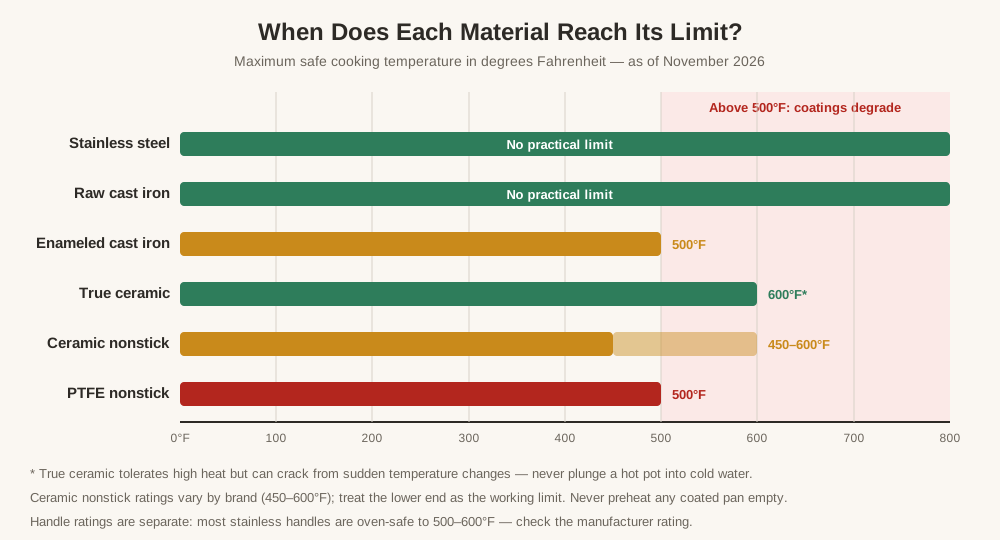
Temperature is where most cookware safety mistakes happen, because the danger zone is invisible: a pan on high heat looks the same at 350°F and at 600°F.
- Stainless steel: no practical limit. The handle rating, usually 500–600°F, is the real ceiling.
- Raw cast iron: no practical limit. It can go from stovetop to oven to broiler without damage.
- Enameled cast iron: around 500°F (260°C) for most brands. Above that, the enamel can craze or discolor, and the knobs on many lids are rated lower.
- True ceramic: high heat tolerance, but sudden temperature changes are the risk. Never plunge a hot ceramic pot into cold water.
- Ceramic nonstick: around 450–600°F (230–315°C) depending on the brand. Treat the lower end of the range as the working limit.
- PTFE nonstick: around 500°F (260°C). Never preheat empty, never use on high heat, never put under the broiler.
When should you replace a pan?
Know when a pan’s useful life is over — check the signs every few months.
Replace a PTFE nonstick pan when the coating is scratched through to the metal, flaking, or peeling, or when food starts sticking despite proper preheating and oiling. A few light scratches are cosmetic; visible metal showing through the coating is the end of the line.
Retire an enameled cast iron pot when the enamel chips deeply enough to expose bare iron inside the cooking surface. A chip on the rim or the exterior is cosmetic; a chip on the interior will rust and can flake enamel into food.
Which cookware material should you choose?
The safest cookware material is the one that matches how you actually cook.
If you cook everything and want one set to last decades, start with stainless steel. A tri-ply stainless skillet and a stainless saucepan cover searing, sautéing, sauces, and anything acidic. Add a raw cast iron skillet for steak and cornbread, and a single PTFE or ceramic nonstick pan for eggs.
If you cook mostly eggs, fish, and low-fat meals and you dislike scrubbing, ceramic nonstick or PTFE nonstick will make your mornings easier — as long as you cook on medium or lower, never preheat the pan empty, and budget for a replacement every couple of years. Our best non-toxic cookware for gas stoves guide lists specific pans that hold up well on gas burners, which run hotter and less evenly than electric.
If you cook at high heat, lean toward steel and iron and keep coated pans for low-heat work only. Gas burners can push an empty pan past 500°F faster than most cooks expect. For a deeper look at one material that often confuses shoppers, our is hard-anodized cookware safe guide explains how the sealed aluminum oxide layer works and where its limits sit.
Frequently asked questions
What is the safest cookware material overall?
Stainless steel and cast iron are the safest overall, because neither has a coating that can degrade and both tolerate any normal cooking temperature.
Is nonstick cookware safe?
Yes, PTFE nonstick is safe at normal cooking temperatures, and modern PTFE cookware is made without PFOA. The risk is heat: PTFE begins to degrade around 500°F (260°C), so never preheat an empty nonstick pan, never use it on high heat, and replace it once the coating is flaking or peeling.
Is ceramic cookware better than nonstick?
True ceramic cookware has nothing to leach and no coating to degrade, but it is brittle and heats unevenly. Ceramic nonstick is easier to use and performs well when new, but its coating typically wears out within one to three years, so treat it as a consumable rather than a lifetime purchase.
When should I throw away a nonstick pan?
Replace a nonstick pan when the coating is scratched through to bare metal, flaking, or peeling, or when food sticks no matter how you preheat and oil it. Light scratches are cosmetic.
The bottom line
Stainless steel and cast iron earn the top safety ranking because they have no coating to fail and no temperature limit a home kitchen can reach. Ceramic nonstick and PTFE nonstick are safe, useful tools with a shorter lifespan and a firm temperature ceiling. Buy steel and iron once, buy coated pans knowing you will replace them, never heat a coated pan empty, and retire any pan whose coating has failed.