
Enameled cast iron wins for braising, baking bread, and acidic dishes, because its glass coating needs no seasoning and never rusts. Raw cast iron wins for high-heat searing, campfire cooking, and anyone who wants a pan that can be re-seasoned forever. The right choice depends on what you cook most — and many kitchens end up owning one of each.
As an Amazon Associate I earn from qualifying purchases.
TL;DR — the verdict for 2026:
- Buy enameled cast iron if you braise, bake bread, or simmer tomato sauces: no seasoning, no rust, stove to table.
- Buy raw cast iron if you sear steaks, cook over a campfire, or want the cheapest pan that lasts a lifetime: a pre-seasoned skillet costs about $25–35.
- Best enameled value: the Lodge 6-quart enameled Dutch oven at about $90–96.
- Best raw value: the Lodge 12-inch pre-seasoned skillet at about $35.
We compared specs, prices, and verified owner reviews rather than testing units in a lab. Prices are typical US street prices as of November 2026 and move often.
What is enameled cast iron, and what is raw cast iron?
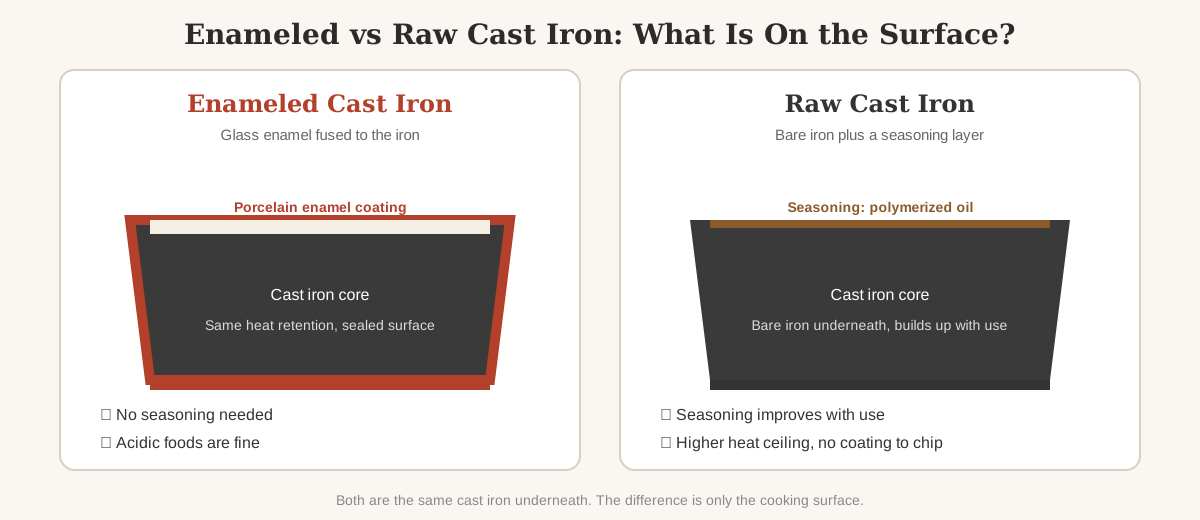
Both start as the same thing: a heavy casting of iron. The difference is only the cooking surface.
Enameled cast iron is bare iron coated in layers of porcelain enamel — powdered glass fused to the metal at very high heat. The coating is smooth, non-reactive, and it seals the iron underneath so it cannot rust.
Raw cast iron is bare iron with only seasoning on it: a thin layer of oil baked on until it polymerizes into a hard, slick surface. The seasoning protects the iron, but it is not a seal: water, acid, and metal tools can all wear it down, and it needs to be maintained.
How do enameled and raw cast iron actually differ?
The surface decides almost everything else: how the pan cooks, what you can cook in it, and how much care it needs.
| Enameled cast iron | Raw cast iron | |
|---|---|---|
| Cooking surface | Porcelain enamel over iron | Bare iron with polymerized-oil seasoning |
| Seasoning needed | Never | Yes, and it improves with use |
| Rusts if left wet | No, the enamel seals the iron | Yes, dry it immediately |
| Acidic foods (tomato, wine) | Excellent, even for long simmers | Fine for short cooks, strips seasoning in long simmers |
| Max oven temperature | About 500°F (knob and enamel limit) | No practical limit |
| Dishwasher | Allowed by some, hand-wash recommended | Never — hand-wash and dry on the stove |
| Metal utensils | Avoid on enamel, they can chip it | Fine, the surface is solid iron |
| Weight, 5.5–6 qt pot | About 13–15 lb | About 13 lb |
| Lifespan | Decades, unless the enamel chips | Effectively forever, re-seasoning restores it |
| Price, Dutch oven | About $90–420 | About $35–70 |
The one line that matters most: enameled cast iron trades a little heat tolerance for a surface that never needs seasoning, never rusts, and handles acid without a second thought.
Which one sears a steak better?
Raw cast iron sears better, because a steak browns through contact with hot, bare metal, and raw iron can be heated past 500°F without damage. It is the better tool for a hard, fast sear, including on the grill or over a campfire.
Enameled cast iron sears well too, especially Staub’s matte black interior, which is designed to brown aggressively — but you should keep the heat moderate to protect the enamel. If your main job is searing, raw iron wins, and our guide to cooking filet mignon in a cast iron skillet and our cast iron vs carbon steel steak comparison.
Which one handles acidic foods and long braises better?
Enameled cast iron handles acidic foods and long braises better, and this is where it earns its price. Tomato sauce, wine, and citrus can simmer for hours in an enameled pot without touching the iron underneath.
Raw cast iron is fine with a quick tomato sauce, but a long, acidic simmer is the one job it does poorly: the acid strips seasoning and can leave a metallic taste in the food.
Which one is easier to care for day to day?
Enameled cast iron is far easier to care for, and it is not close. After cooking, you wash it with hot water and dish soap, dry it, and put it away — no seasoning, no stove-top drying, no oiling.
Raw cast iron has a routine, and it is non-negotiable. Per Lodge’s care guidance, wash with hot water and a stiff brush, dry it on the stove, and rub in a thin coat of oil while it is still warm. Skip the drying step and it rusts, and getting rust off a cast iron skillet — but it is a chore enameled owners never face.
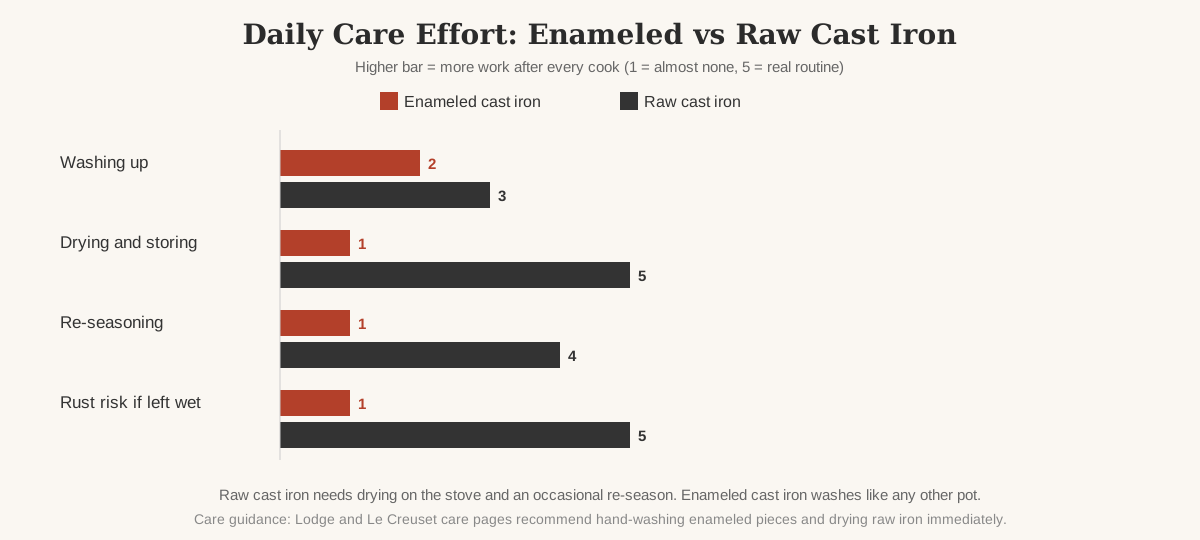
The care gap is the real decision: if you will dry a pan on the stove after every use, raw iron is a joy; if you will not, enameled iron is the honest choice.
How long does each one last?
Raw cast iron lasts longer in practice, because there is nothing on it to break. A raw skillet can rust, but rust is fixable — strip it, re-season it, and it is as good as new. That is why century-old skillets still cook.
Enameled cast iron lasts decades too, but the enamel can chip. Drop the pot, bang the rim against a faucet, or overheat it empty, and a chip exposes bare iron that can rust. A chipped pot still cooks, but the damage is permanent.
How do the prices compare?
Raw cast iron is dramatically cheaper, and the gap is widest at the top end.
| Product | Price (Nov 2026) |
|---|---|
| Lodge 10.25-inch pre-seasoned skillet | About $25 |
| Lodge 12-inch pre-seasoned skillet | About $35 |
| Lodge 6-quart enameled Dutch oven | About $90–96 |
| Staub 5.5-quart round cocotte | About $330–365 |
| Le Creuset Signature 5.5-quart Dutch oven | About $350–420 |
A full raw cast iron setup — a 12-inch skillet and a 10.25-inch skillet — costs about $60, less than a single Lodge enameled Dutch oven. If you want enameled on a budget, see our best Dutch oven under $100 for enameled options that keep the price in check.
The 5 products, head to head
| Lodge Enameled 6 qt | Le Creuset Signature 5.5 qt | Staub Cocotte 5.5 qt | Lodge Skillet 12-in | Lodge Skillet 10.25-in | |
|---|---|---|---|---|---|
| Type | Enameled Dutch oven | Enameled Dutch oven | Enameled Dutch oven | Raw skillet | Raw skillet |
| Capacity / size | 6 qt, 10.75-in dia | 5.5 qt, 12.25-in wide | 5.5 qt, 10.25-in dia | 12-in dia, 2-in deep | 10.25-in dia |
| Weight | About 14.9 lb | About 11.5 lb | About 12 lb | About 8 lb | About 5.3 lb |
| Oven-safe | 500°F | 500°F | 500°F with lid | No practical limit | No practical limit |
| Made in | China | France | France | USA | USA |
| Price (Nov 2026) | About $90–96 | About $350–420 | About $330–365 | About $35 | About $25 |
1. Lodge 6-Quart Enameled Cast Iron Dutch Oven — best enameled value
The Lodge is the enameled Dutch oven to buy if you want the performance without the French price tag.
- Size: 6 qt, 10-3/4 inches diameter, 5 inches deep, about 14.9 lb
- Oven-safe to 500°F, works on gas, electric, ceramic, and induction
- Price: about $90–96, as of November 2026
- Check price on Amazon
2. Le Creuset Signature Enameled Cast Iron Round Dutch Oven, 5.5 qt — best enameled overall
The Signature is the reference Dutch oven: the lightest French pot at about 11.5 pounds, with a stain-resistant sand-colored interior.
- Size: 5.5 qt, 12.25 inches wide, 5.5 inches high, about 11.5 lb
- Oven-safe to 500°F, dishwasher-safe but hand-wash recommended
- Price: about $350–420, as of November 2026
- Check price on Amazon
3. Staub Cast Iron Round Cocotte, 5.5 qt — best for browning
Staub is the other French icon: a matte black enamel interior that hides stains, browns meat aggressively, and a spiked lid that bastes as it cooks.
- Size: 5.5 qt, 10.25 inches diameter, about 12 lb
- Self-basting spiked lid, matte black enamel interior, made in France
- Price: about $330–365, as of November 2026
- Check price on Amazon
4. Lodge 12-Inch Pre-Seasoned Cast Iron Skillet — best raw skillet
The 12-inch Lodge is the default raw cast iron skillet: 12 inches across and 2 inches deep, big enough for a family, and pre-seasoned so it is ready to cook.
- Size: 12-inch diameter, 2 inches deep, about 8 lb, with assist handle
- Pre-seasoned, oven-, grill-, and campfire-safe, made in USA
- Price: about $35, as of November 2026
- Check price on Amazon
5. Lodge 10.25-Inch Pre-Seasoned Cast Iron Skillet — best first skillet
The 10.25-inch Lodge is the same pan in the size most people actually reach for: big enough for two steaks or a frittata, light enough to lift one-handed.
- Size: 10.25-inch diameter, about 5.3 lb, teardrop handle
- Pre-seasoned, oven-, grill-, and campfire-safe, made in USA
- Price: about $25, as of November 2026
- Check price on Amazon
Who should buy enameled cast iron, and who should buy raw?
Buy enameled cast iron if you braise, bake bread, and simmer sauces, and you want a pot that washes up like a normal pan. It is the right choice for most home cooks.
Buy raw cast iron if you sear steaks, cook over fire, and like tools that get better with use. It is cheaper, tougher, and effectively indestructible.
If you cook both ways, buy both: a 6-quart enameled Dutch oven plus a 12-inch raw skillet costs about $125 — a complete cast iron setup for less than a single Le Creuset.
Frequently asked questions
Can enameled cast iron go in the dishwasher?
Some brands allow it, but Lodge and Le Creuset recommend hand-washing to protect the enamel.
Does raw cast iron need seasoning if it comes pre-seasoned?
No. Lodge pre-seasons its skillets with vegetable oil, so a new pan is ready to cook with, and the seasoning builds with use.
Can you cook tomato sauce in raw cast iron?
Yes, for short cooks. A long acidic simmer can strip the seasoning and add a metallic taste, so use enameled for long sauces.
Is enameled cast iron better than raw cast iron for bread?
Yes, for most bakers. An enameled Dutch oven traps steam under its tight lid and releases a finished loaf without sticking.
Does enameled cast iron rust?
No, as long as the enamel is intact — but a chip that exposes bare iron can rust.
The bottom line
Enameled cast iron is the easy, forgiving pot for braises, bread, and acidic dishes; raw cast iron is the cheap, tough, high-heat workhorse. Most kitchens end up with one of each — and that is the right answer.
Buy the Lodge 6-quart enameled Dutch oven for the best-value braising pot, or the Lodge 12-inch pre-seasoned skillet for the best-value searing pan — and if you cook both ways, buy both.