
Quick answer: Yes, solid, uncoated titanium cookware is safe for everyday cooking. Titanium forms a thin oxide layer that keeps it from reacting with food, even acidic food like tomato sauce. But most pans sold as “titanium” are aluminum pans with a PTFE nonstick coating reinforced with titanium particles, so their safety depends on the coating, not the titanium.
The word on the box raises the question, but the label alone cannot answer it. This article explains the three things “titanium cookware” can mean, how each type is made, and how titanium stacks up against stainless steel and plain nonstick. We compared specs, prices, and verified owner reviews; we did not test pans in our own kitchen.
Photo: Frying Pan 1 2019-03-21 by FASTILY, CC BY-SA 4.0 via Wikimedia Commons.
Is titanium cookware safe?
Solid titanium is one of the least reactive metals you can cook on. When titanium meets air, it forms a thin, stable layer of titanium oxide that stops the metal from corroding and reacting with food. The same metal is used for surgical implants and dental fixtures. Under normal cooking conditions, bare titanium is not expected to transfer appreciable amounts of metal into food — acidic ingredients included. Heat is not a concern either: titanium melts at about 1,668°C (3,034°F), far above anything a home stove can produce.
The catch is the label. Most “titanium” pans in stores are not solid titanium. They are aluminum pans with a PTFE nonstick coating that has titanium particles mixed in for hardness. With those pans, you are cooking on PTFE, not on titanium, and the safety questions are the PTFE questions. The FDA has authorized PTFE nonstick coatings for food contact since the 1960s, and its current position is that studies show only negligible amounts of PFAS from these coatings can migrate into food. Read the FDA’s own summary of authorized uses of PFAS in food contact applications. So: solid titanium is safe, and titanium-reinforced nonstick is as safe as any PTFE pan — used the right way, at the right temperature. See our guide to the safest cookware materials.
How is titanium cookware made?
“Titanium cookware” covers three constructions, and the price usually tells you which one you are looking at.
| Type | What touches your food | Typical price |
|---|---|---|
| Pure titanium (Grade 1 or 2) | Bare titanium metal, no coating | About $150 as of November 2026 |
| Titanium-bonded stainless steel | Titanium layers bonded to stainless steel | About $400–$570 as of November 2026 |
| Titanium-reinforced nonstick | PTFE coating with titanium particles | About $55 as of November 2026 |
Pure titanium cookware is made from commercially pure Grade 1 or Grade 2 titanium, which is 99% or more titanium. It is mostly sold as camping cookware: titanium is light and nearly impossible to damage. Some kitchen pans use a clad body instead: titanium over an aluminum core and a stainless steel base, for even heat and induction use.
Titanium-bonded stainless steel is the premium version. Hestan’s NanoBond line bonds thousands of titanium nano-layers directly onto a stainless steel body, with an aluminum core for even heat. Hestan calls it titanium bonded stainless steel made without PFAS, and says it is non-toxic and safe because it does not react with food. See Hestan’s NanoBond page for the construction and prices.
Titanium-reinforced nonstick is the everyday version, and the most common. The base is aluminum or stainless steel, topped with a PTFE coating mixed with titanium particles for hardness and scratch resistance. The titanium sits inside the coating, not on the surface you cook on. T-fal’s own nonstick disclosure confirms its titanium ranges use a PTFE coating.
Before you buy, check the spec sheet, not the box: if it lists PTFE, treat the pan as a PTFE nonstick pan. Look for an explicit “PTFE-free” or “PFAS-free” claim if avoiding fluoropolymers is your goal. The same habit applies to other coated pans — see whether hard-anodized cookware is safe.
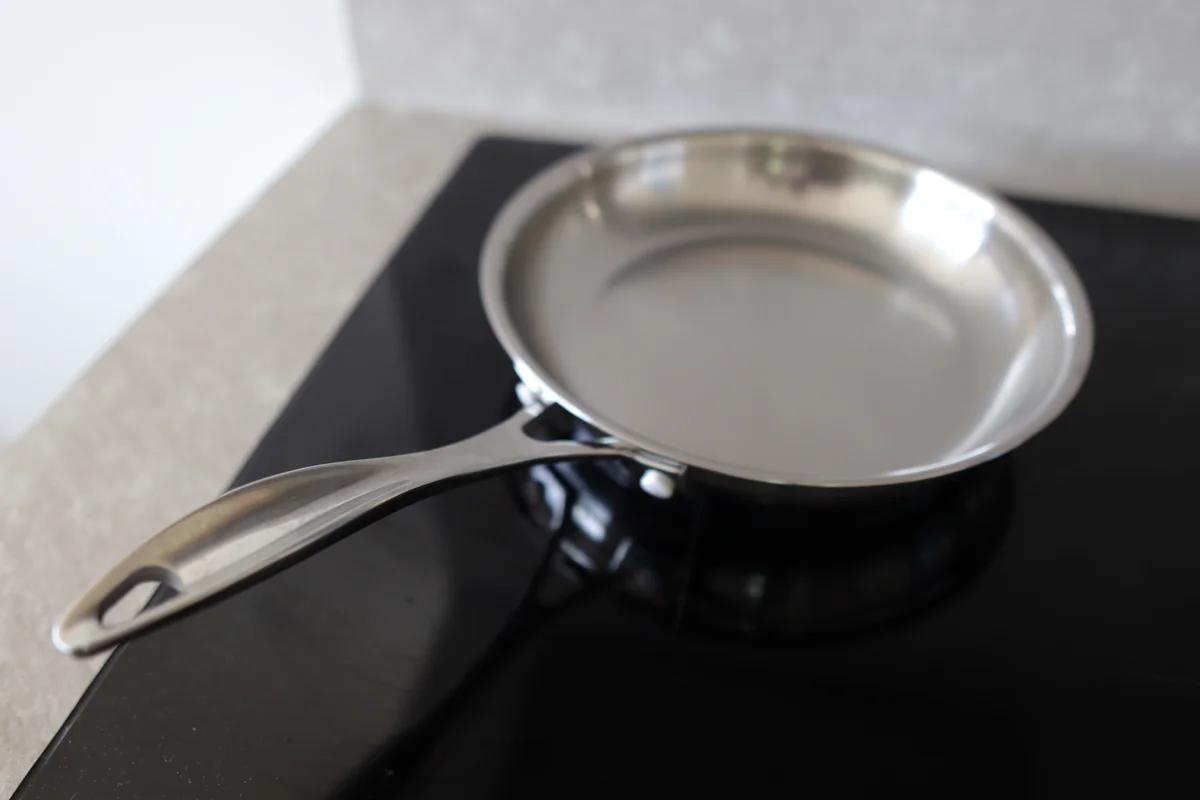
Photo: Stainless Steel Frying Pan by Jim Stonos, CC BY-SA 4.0 via Wikimedia Commons.
How does titanium compare with stainless steel and nonstick?
The right choice depends on what you value most: a slick surface, high-heat searing, or a pan you never have to replace.
| Solid titanium | Stainless steel | Titanium-reinforced nonstick (PTFE) | |
|---|---|---|---|
| Cooking surface | Bare titanium | Bare steel | PTFE + titanium particles |
| Heat limit | No practical limit | Often 500–600°F oven-safe | Keep below 500°F (260°C) |
| Food release | Sticks without oil | Sticks without oil | Slickest of the three |
| Metal utensils | Yes | Yes | No — wood or silicone |
| Lifespan | Decades | Decades | A few years |
| Typical price | About $150 and up | About $70–$300 | About $55 |
Solid titanium and stainless steel behave a lot alike: both need preheating and a little fat, both take metal utensils, and both last for years. Titanium is lighter and resists corrosion even better; stainless steel wins on price and on choice. For a closer look at a hybrid pan vs clad stainless, see HexClad vs All-Clad stainless steel.
Titanium-reinforced nonstick wins on ease: eggs slide, cleanup takes seconds, and the pan costs little. The trade-off: a heat ceiling and a shorter life — PTFE starts to break down above about 500°F (260°C), so high-heat searing is off the table and the coating wears out in a few years. If you cook on gas, see the best non-toxic cookware for a gas stove.
What not to do with titanium cookware
Most problems come from treating a coated pan like a bare-metal one — with a coated pan, these mistakes are the safety issue too.
- Do not preheat an empty coated pan on high. An empty pan can pass 500°F (260°C) in minutes. Above that temperature, PTFE starts to break down and can release fumes that cause polymer fume fever, a short flu-like illness. Always preheat with oil or food in the pan.
- Do not use metal utensils on a coated pan. A metal spatula scratches the PTFE layer, and each scratch shortens the coating’s life. Use wood or silicone on coated pans; metal is fine on solid titanium and bonded stainless.
- Do not put a coated pan under the broiler. A broiler easily tops 500°F, past PTFE’s safe range. Keep coated pans on the stovetop at low to medium heat.
- Do not read “PFOA-free” as “PFAS-free.” PFOA was phased out of Teflon production by 2013, so nearly every new nonstick pan is PFOA-free. PTFE itself is still a PFAS polymer, so a “PFOA-free” pan can still have a PTFE coating.
- Do not use a solid titanium pot on induction unless it has a magnetic base. Pure titanium is not magnetic, so a solid titanium camping pot usually will not work on induction. Clad pans with a stainless steel base do.
When should you replace titanium cookware?
Solid titanium and titanium-bonded stainless steel have no expiry date. Replace them only if the pan warps, the handle loosens, or the surface is deeply gouged. With normal care, either one lasts decades.
A titanium-reinforced nonstick pan is different: the coating is the wear item, not the metal. Replace it when the coating flakes or peels, food sticks even with oil, or bare metal shows through. Our guide on when to replace nonstick pans walks through the exact signs to check for.
FAQ
Is titanium cookware PFOA-free?
Most new titanium pans are PFOA-free: PFOA was phased out of Teflon production by 2013. But PFOA-free does not mean PFAS-free: PTFE, the coating on most titanium-reinforced pans, is itself a PFAS polymer. If you want no fluoropolymer at all, look for a pan that says “PTFE-free” and “PFAS-free,” not just “PFOA-free.”
Can you use metal utensils on titanium cookware?
On solid titanium and titanium-bonded stainless steel, yes — bare metal takes metal utensils without damage. On titanium-reinforced nonstick, no: metal utensils scratch the PTFE coating and shorten its life. Use wood or silicone utensils on any coated pan.
Does titanium cookware leach metal into food?
Bare titanium forms a stable oxide layer and is not expected to transfer appreciable amounts of metal into food, even with acidic foods like tomato sauce. What matters is the coating, not the titanium: the FDA’s position is that only negligible amounts of PFAS from a PTFE coating can migrate into food under normal use.
Is titanium cookware safe for induction cooktops?
Only if the pan has a magnetic base. Pure titanium is not magnetic, so a solid titanium camping pot usually will not heat on induction. Clad titanium pans with a stainless steel base work on induction, and so do most titanium-reinforced nonstick pans with a magnetic base. Check the spec sheet for “induction compatible.”