
Quick answer: In the chef knife vs santoku choice, buy the chef’s knife first if you cook a bit of everything — its curved blade rocks through herbs and handles big jobs. Buy the santoku first if you mostly prep vegetables in a small kitchen — its flat edge and shorter blade make straight push-cuts fast and easy.
If you can buy only one good knife this year, this is the decision that matters most. Both do the same everyday jobs — slicing, dicing, mincing — but with different shapes and motions. We compared specs, prices, and verified owner reviews; we did not test knives in our own kitchen for this article.
This post contains affiliate links. If you buy through them, we may earn a commission at no extra cost to you.
As an Amazon Associate I earn from qualifying purchases.
Photo: Chefs knifes on a wooden cutting board by T. Bjornstad, CC BY-SA 4.0 via Wikimedia Commons.
Chef knife vs santoku: what is the short verdict?
A chef’s knife does more jobs; a santoku does its jobs with less effort. That one line settles most of the decision.
The chef’s knife is the generalist: its curved belly rocks on the board, its pointed tip works in tight spots, and its 8-inch length powers through large food. The santoku is the vegetable specialist: its flat edge sits fully on the board, so each push-cut lands cleanly, and its shorter, thinner blade feels quicker on a crowded board. See our guide to what a santoku knife is used for.
How do you choose between a chef knife and a santoku?
Work through these four steps in order.
- List the three dishes you cook most. Herb-heavy cooking and whole chickens point to the chef’s knife. Stir-fries and salads point to the santoku.
- Check your hands and your board. Small hands and a small board favor the shorter santoku — see our guide to the best chef knife for small hands.
- Picture your cutting motion. Rocking to mince garlic and herbs means the chef’s knife. Chopping straight down and lifting means the santoku.
- Set your budget, then buy one knife well. A good chef’s knife or santoku costs about $40–$50 at the budget end and about $125–$170 at the premium end, as of November 2026.
How do blade shape and cutting motion differ?
A chef’s knife has a curved belly and a pointed tip. The curve lets the tip stay on the board while the heel rises and falls — the rocking motion that minces herbs fast, because the blade never fully leaves the board. The pointed tip reaches into joints and starts cuts into melon or squash. Most chef’s knives are 8 inches long, sometimes 10, and they run thicker and heavier than a santoku.
A santoku has a flat edge and a sheepsfoot tip that curves down to meet it. With almost no belly to rock on, the motion is a straight push forward and down. Most of the edge touches the board at once, so onion dice come out even and tomato slices stay thin. Most santokus are 5 to 7 inches long, thinner and lighter, and the wide blade doubles as a scoop for carrying chopped food to the pan.
Steels split the same way. German chef’s knives like the Wüsthof Classic use X50CrMoV15 steel at about 58 HRC, edged to 14 degrees per side. Japanese santokus like the Shun Classic use harder VG-MAX steel at about 60–61 HRC, edged to 16 degrees per side. The harder steel holds its edge longer but chips more easily on bones and frozen food; the softer steel sharpens more easily. For a deeper look, see our guide on how to choose a chef’s knife by blade, steel, and handle.
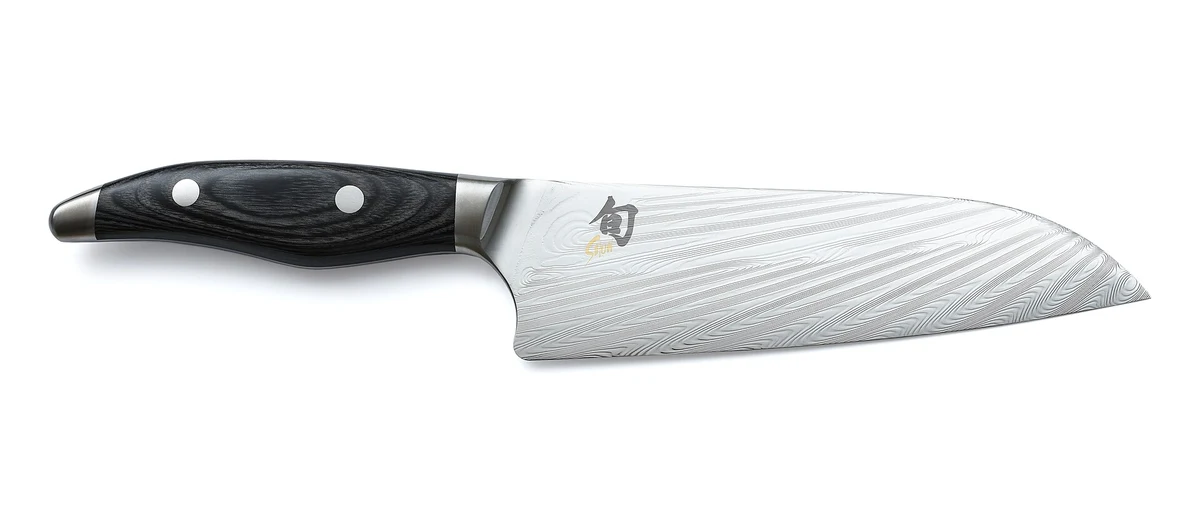
Photo: Santoku-Kai-Shun-Nagare by Simon A. Eugster, CC BY-SA 4.0 via Wikimedia Commons.
Which knife wins each kitchen task?
| Task | Winner | Why |
|---|---|---|
| Dicing onions | Santoku | Flat edge gives even, controlled push-cuts |
| Mincing herbs | Chef’s knife | Curved belly rocks without lifting the blade |
| Slicing tomatoes | Santoku | Thin blade cuts cleanly with little pressure |
| Large squash and melons | Chef’s knife | Length, weight, and pointed tip power through |
| Slicing raw fish | Santoku | Thin blade glides with minimal drag |
| Breaking down chicken | Chef’s knife | Pointed tip works around joints and bones |
| Small boards and small hands | Santoku | Shorter, lighter blade stays in control |
| Scooping chopped food | Santoku | Wide blade carries food to the pan |
The chef’s knife wins the big, forceful, and tip-dependent jobs, while the santoku wins the precise, straight-down vegetable work.
Which knife should you buy first?
Buy the chef’s knife first if you cook a bit of everything; buy the santoku first if you mostly prep vegetables on a small board.
Chef’s knife pick: Victorinox Fibrox Pro 8-inch. About $46–$50 on Amazon as of November 2026. It is an 8-inch stamped blade in X50CrMoV15 stainless steel at about 56 HRC, with a textured Fibrox handle that stays grippy when wet. It weighs about 5.6 ounces, and Victorinox backs it with a lifetime warranty. The downside: it looks plain, and a stamped blade never feels as solid as a forged one.
Check the price of the Victorinox Fibrox Pro 8-Inch Chef’s Knife on Amazon
Santoku pick on a budget: Mercer Culinary Genesis 7-inch. About $40 on Amazon as of November 2026. It is a forged 7-inch santoku in German steel with a 15-degree edge and a Santoprene handle that stays tacky when wet. The downside is the plain black handle and a heavier feel than Japanese santokus.
Check the price of the Mercer Culinary Genesis 7-Inch Santoku Knife on Amazon
Santoku pick to keep for years: Shun Classic 7-inch (DM0702). About $125–$140 on Amazon as of November 2026, against a list price of about $237. It has a VG-MAX core wrapped in 68 layers of Damascus cladding, a 16-degree edge, and a D-shaped Pakkawood handle, handcrafted in Seki, Japan, with free lifetime sharpening from Shun. The downside is care: hand-wash only, and the hard steel can chip on bones or frozen food. For more on what that Damascus pattern actually means, see our Damascus steel chef knife guide.
Check the price of the Shun Classic 7-Inch Santoku Knife on Amazon
If you want the buy-once chef’s knife instead, the Wüsthof Classic 8-inch is the benchmark: forged in Solingen at 58 HRC, about $170 on Wüsthof’s own site as of November 2026.
What should you not do with a chef knife or santoku?
- Do not rock-chop with a santoku. The flat edge is not built for it — rocking lifts the heel and gives uneven cuts.
- Do not use either knife on bones or frozen food. Hard steel chips and soft steel rolls — Shun’s own care guide lists both first among blade-damaging habits.
- Do not put a Japanese santoku in the dishwasher. Shun says never: heat, detergent, and rattling dull the edge and damage the handle.
- Do not cut on glass, marble, or ceramic. Both Wüsthof and Shun warn against hard surfaces — they dull an edge fast. Wood is the safe choice.
- Do not scrape food off the board with the edge. Flip the knife and use the spine instead.
- Do not buy on length alone. A 10-inch chef’s knife is worse than an 8-inch one on a small board, and a 5-inch santoku is too short for a big cabbage.
When should you replace a chef knife or santoku?
A good knife does not have an expiry date — it has a condition. Replace it when the edge will not hold sharpness after proper sharpening, when a deep chip cannot be sharpened out, when the handle is loose or cracked, or when the tip has snapped off.
Most “worn-out” knives are just dull knives. Learn to hone and sharpen first — see our guide to how to sharpen a kitchen knife at home. With hand-washing, a wood board, and sharpening once or twice a year, a $40 knife can last a decade and a $170 knife a lifetime.
FAQ
Can a santoku replace a chef’s knife?
Yes, for most weeknight cooking. A santoku handles slicing, dicing, and mincing of vegetables, fish, and boneless meat. It struggles only with rocking herb-mincing, large food, and work around bones.
Is a santoku better for small hands?
Usually yes. A 7-inch santoku is shorter and lighter than an 8-inch chef’s knife, so it stays in control for smaller hands and on smaller boards.
Which knife is easier to sharpen?
The German-style chef’s knife is easier: its softer steel takes an edge quickly, while the harder Japanese steel of most santokus holds its edge longer but needs a finer stone.
Should I buy a knife set or one knife first?
Buy one good knife first. A single chef’s knife or santoku in the $40–$50 range covers nearly all home prep. Add a small paring knife second, and only then think about a set.