
Quick answer: No, you should not put a wooden cutting board in the dishwasher. Hot water, steam, high-heat drying, and strong detergent hit the board all at once, swelling the wood, stripping its oil finish, and weakening glue joints. The result is a board that warps, cracks, or splits apart. Wash it by hand with hot, soapy water instead.
This guide covers what heat and water do to wood, what to do if your board already went in, how to rescue it, and which boards are dishwasher-safe.
Photo: Wooden cutting board 2017 by Fructibus, CC0 via Wikimedia Commons.
What happens to a wooden cutting board in the dishwasher?
Wood absorbs water, and a dishwasher gives it far more water, for far longer, than hand washing does. The fibers swell as they soak it up, then shrink as the heated dry cycle pulls the moisture back out. That fast swell-and-shrink cycle is what makes a board cup, warp, and crack.
Detergent adds a second kind of damage. It is far stronger than mild dish soap, and it strips the oil finish that protects the wood. Once that finish is gone, bare wood absorbs water even faster. John Boos is blunt in its care instructions: “DO NOT put Boos Block wood cutting boards into the dishwasher.”
The risk is highest for the boards most people own. Most are glued up from strips or blocks — edge-grain and end-grain boards are built that way. Glue is water-resistant, not waterproof, and long hot soaking softens it until the seams open. Bamboo is the most exposed: always laminated from thin strips, it has the most glue surface to attack. Our end-grain cutting board designs guide explains how these boards are built.
The USDA Food Safety and Inspection Service says solid wood boards can be washed in a dishwasher, while laminated boards may crack and split. That is a food-safety statement, not a durability promise. Teakhaus puts dishwasher heat at 140–160°F and calls the dishwasher the top way people ruin quality boards.
How do you wash a wooden cutting board instead?
Hand washing is the whole method. It works for every wooden board and never risks the glue joints.
- Scrape off food first, with a bench scraper or the flat side of a knife.
- Wash with hot, soapy water. Use a sponge or brush and a little mild dish soap, on both faces.
- Rinse right away with clean water. Do not leave the board in the sink.
- Towel it dry with a clean towel so no water pools.
- Stand it on edge to finish drying. Air must reach both faces — a board left flat dries on one side only.
- Sanitize after raw meat. After raw meat, poultry, or seafood, sanitize with 1 tablespoon of unscented liquid chlorine bleach per gallon of water — the USDA’s ratio. Flood the surface, let it stand for several minutes, then rinse and dry. Our best cutting board for raw meat and poultry guide explains why a separate board is worth having.
For oiling, stains, and storage, see our guide on how to care for wooden cutting boards.
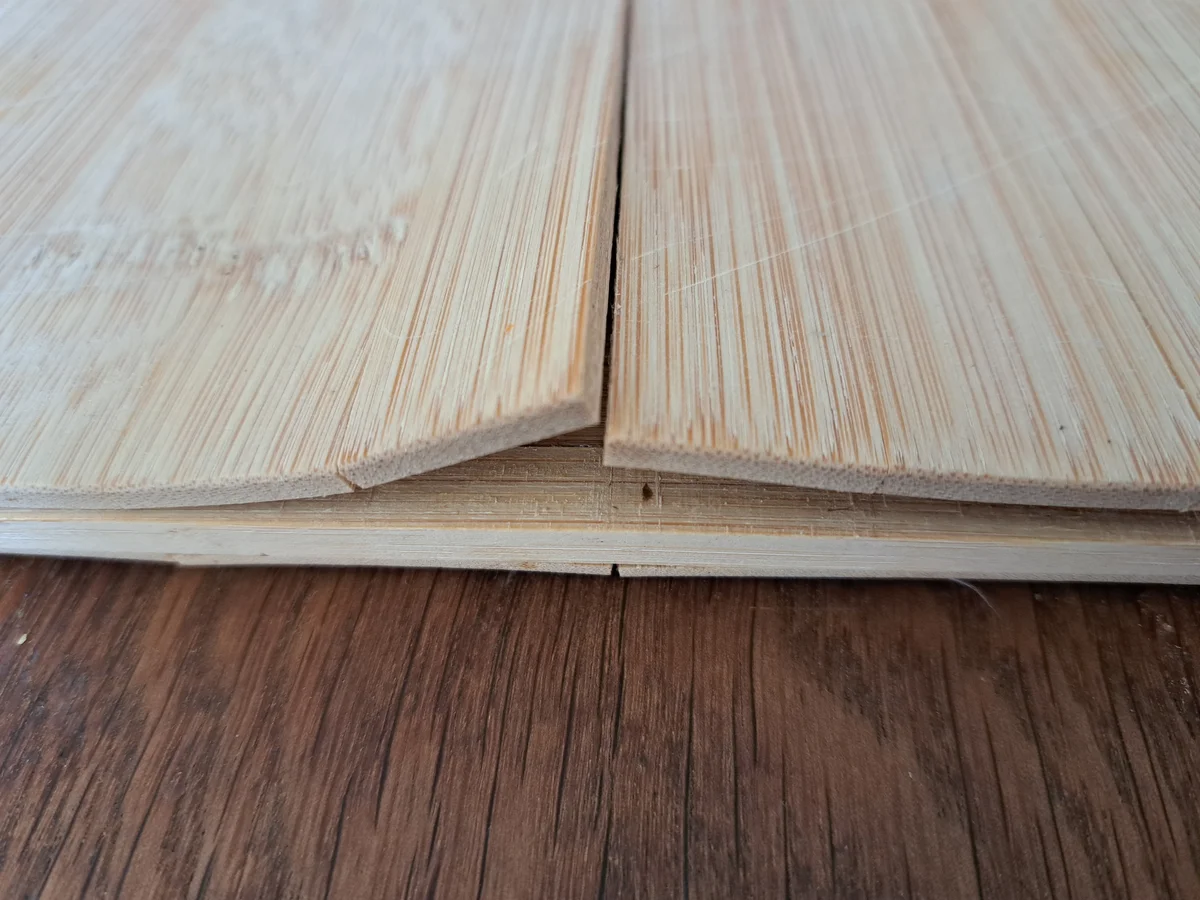
Photo: Broken wooden cutting boards by Roy Zuo, CC BY-SA 4.0 via Wikimedia Commons. Glued boards can break into strips once the glue washes out.
What should you do if your board already went through the dishwasher?
Do not panic. One cycle rarely destroys a board — the damage builds over repeated cycles. Take it out as soon as the cycle ends.
Towel off every surface, then stand the board on edge until it feels dry all the way through. Then check the joints: look along every glue line for gaps or lifted seams, and press the board flat to check for rocking.
Wait before you oil it. The board must be fully dry first — oil will not soak into damp wood — and that can take a day or two. Once dry, rub in food-grade mineral oil, let it soak in overnight, and wipe off the excess.
Watch the board for a week — a warp or split seam can still show up as it finishes drying.
Can you fix a warped or dried-out board?
It depends on how bad the damage is. A board that is only dry and pale is easy to save: let it dry fully, then oil it with food-grade mineral oil and leave it to soak in overnight. John Boos recommends oiling at least once a month, and more often the more a board is washed.
A lightly warped board may flatten with weights. Teakhaus describes the fix: place the board concave-side down, lay a damp (not soaking) towel on top, set weights evenly across it, and leave it for 24–48 hours in a cool, dry place. Severe warping, Teakhaus notes, is usually permanent.
A board with a split glue joint is a different problem. If the strips have separated, as in the photo above, the board is done — washed-out glue cannot be fixed by oiling. Deep grooves that trap food are another end-of-life sign: the USDA says to discard a board once it has hard-to-clean grooves. Sanding can rescue minor scratches — John Boos recommends fine-grit #200 sandpaper, always with the grain.
Which cutting boards are dishwasher-safe?
The answer changes with the material.
| Material | Dishwasher-safe? | Why |
|---|---|---|
| Plastic / acrylic | Yes | Nonporous, no glue joints, made for machine washing |
| Glass | Yes | Nonporous and heat-proof, though hard on knife edges |
| Solid one-piece wood | Technically yes, but not recommended | The USDA allows it; makers say it warps and cracks |
| Laminated or glued wood | No | Glue joints soften and split |
| Bamboo | No | Always laminated strips — the most glue to fail |
| End-grain wood | No | Glued-up blocks with the most joints to fail |
| Epicurean (wood fiber composite) | Yes | A resin-bound composite, not solid wood |
If dishwasher convenience matters, keep a plastic board for raw meat and messy jobs, and the wooden board for produce and bread. Our Epicurean cutting boards guide covers one wood-fiber composite made for the dishwasher, and our best wood for cutting boards guide explains which species hold up best.
What should you not do with a wooden cutting board?
- Do not put it in the dishwasher. Heat, water, steam, and strong detergent warp wood and open glue joints.
- Do not soak it in the sink. Standing water does the same damage.
- Do not use harsh detergents or chemical cleaners. John Boos warns they can permanently damage and discolor wood. Mild dish soap is enough.
- Do not use cooking oil to condition it. Olive and vegetable oils turn rancid in the wood. Use food-grade mineral oil only.
- Do not dry it flat on the counter. One face dries faster than the other, and the board cups. Stand it on edge.
- Do not store it damp. A board put away wet can warp as it dries, and trapped moisture feeds mold.
- Do not use bleach for everyday cleaning. Save it for after raw meat — daily soap and water is enough.
When should you replace a wooden cutting board?
Replace the board when it can no longer be cleaned reliably or used safely. The USDA’s rule: once a board is excessively worn or has hard-to-clean grooves, discard it. A split joint, a crack deep enough to trap food, or a warp that will not press flat are all end-of-life signs.
Surface wear alone is not a reason to replace it. Minor scratches sand out, a pale surface takes oil again, and a flat, solid board is worth keeping. The dishwasher shortens that life: every cycle strips more finish and stresses the joints further.
Frequently asked questions
Can a solid wood cutting board go in the dishwasher?
Yes, in the narrow sense that the USDA says solid wood boards can be washed in a dishwasher. But board makers say never: repeated heat and soaking warp and crack wood. Most boards sold today are laminated — the kind the USDA says may crack and split.
Will one dishwasher cycle ruin my cutting board?
Probably not. One cycle usually leaves the board pale and dry, and the damage builds over repeated cycles. Take it out right away, towel it dry, stand it on edge until fully dry, then re-oil it.
Can bamboo cutting boards go in the dishwasher?
No. Bamboo boards are always glued up from thin strips, giving heat and water far more glue surface to attack than a hardwood board has. They are the most likely to split in a dishwasher, even though bamboo itself resists moisture well.
How do I sanitize a wooden cutting board after raw meat?
Use the USDA’s sanitizer: 1 tablespoon of unscented liquid chlorine bleach per gallon of water. Flood the surface, let it stand for several minutes, then rinse and dry. For everyday cleaning, hot, soapy water is enough.
The short version is simple: keep wooden boards out of the dishwasher, wash them by hand, dry them standing up, and oil them when they look dry.