
Quick answer: The best knives for a home chef are four: the Victorinox Fibrox Pro 8-inch chef’s knife (about $48 as of November 2026) for most cutting, the Mercer Culinary Millennia 3.5-inch paring knife for detail work, the Victorinox Fibrox Pro 10.25-inch bread knife for crusty loaves, and the Tojiro DP 6.7-inch santoku for vegetables. Together they cost about $225.
A home chef does not need a knife block with twelve slots. Most home kitchen work comes down to four jobs: chopping and slicing, peeling and trimming, cutting bread, and fine vegetable work. This guide matches one knife to each job, with real specs, real prices, and an honest downside for every pick. We compared specs, prices, and verified owner reviews; we did not test these knives hands-on.
This post contains affiliate links. If you buy through them, we may earn a commission at no extra cost to you.
As an Amazon Associate I earn from qualifying purchases.
Photo: Chefs knifes on a wooden cutting board by T. Bjornstad, CC BY-SA 4.0 via Wikimedia Commons.
What knives does a home chef actually need?
Four knives. A chef’s knife does the heavy lifting — onions, chicken, herbs, squash. A paring knife handles the small work a big blade cannot: peeling apples, trimming beans, deveining shrimp. A serrated bread knife slices crusty bread without crushing the crumb, and it also cuts tomatoes and cakes cleanly. A santoku covers fine vegetable prep with a shorter, flatter blade.
Which knives should a home chef buy?
| Knife | Blade | Steel | Price as of November 2026 |
|---|---|---|---|
| Victorinox Fibrox Pro chef’s knife | 8 in (20 cm) | High-carbon stainless, stamped | About $48 |
| Mercer Culinary Millennia paring knife | 3.5 in | High-carbon Japanese steel | About $7–$10 |
| Victorinox Fibrox Pro bread knife | 10.25 in | High-carbon stainless, serrated | About $50–$60 |
| Tojiro DP santoku | 6.7 in (170 mm) | VG-10 core, 60 HRC | About $110–$125 |
Best chef’s knife: Victorinox Fibrox Pro 8-inch — about $48
Victorinox stamps the blade from high-carbon stainless steel in Switzerland, and the extra-wide 57 mm blade gives your knuckles room above the board. At 182 grams (about 6.4 ounces) it stays light through long prep, and the textured Fibrox handle stays grippy when wet. See the full specs on Victorinox’s Fibrox Pro chef’s knife page.
The honest downside is the look and feel. It is a stamped knife, not a forged one, so it feels light and plain next to a German blade. The forged upgrade is the Wüsthof Classic 8-inch chef’s knife, about $170 as of November 2026: X50CrMoV15 steel at 58 HRC, 8.5 ounces.
Check the price of the Victorinox Fibrox Pro 8-Inch Chef’s Knife on Amazon
Best paring knife: Mercer Culinary Millennia 3.5-inch — about $7–$10
The Mercer Millennia M22003 is the cheapest knife in this guide and the easiest to recommend. Its 3.5-inch blade is one-piece high-carbon Japanese steel, and the ergonomic handle has textured finger points for a non-slip grip when wet. At 0.1 pounds it is light enough to use in the air, peeling an apple over the sink.
The downside is edge retention. The steel is softer than the Tojiro’s VG-10, so the edge needs honing more often, and the handle runs a little large for very small hands. At this price, that is a fair trade.
Check the price of the Mercer Culinary Millennia 3.5-Inch Paring Knife on Amazon
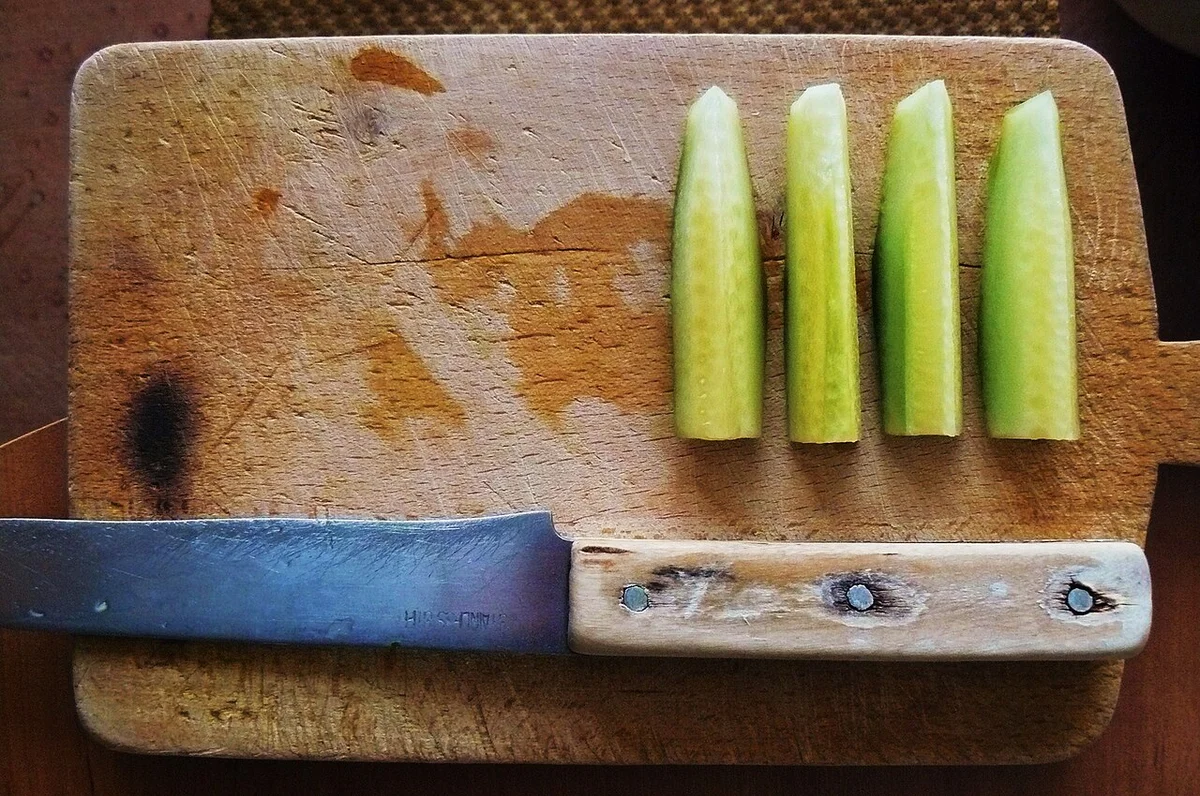
Photo: Board, knife and cucumbers by MOs810, CC BY-SA 3.0 via Wikimedia Commons.
Best bread knife: Victorinox Fibrox Pro 10.25-inch — about $50–$60
A bread knife is the one knife a straight edge cannot replace. The Fibrox Pro bread knife has a 10.25-inch serrated blade that saws through crusty sourdough without crushing the soft crumb inside. The same Fibrox handle gives a secure grip, and the long blade spans wide loaves in a single pass. Beyond bread, ripe tomatoes and layer cakes also slice cleaner with a serrated edge.
The downside is sharpening. Serrated edges are hard to sharpen at home, and most owners either send the knife out or replace it after a few years of heavy use. Keep it for bread and soft foods — the teeth dull fast on hard surfaces.
Check the price of the Victorinox Fibrox Pro 10.25-Inch Bread Knife on Amazon
Best santoku: Tojiro DP 6.7-inch — about $110–$125
The Tojiro DP santoku is the splurge in this set, and it is the pick for cooks who prep a lot of vegetables. Its 170 mm VG-10 core, hardened to 60 HRC, holds an edge longer than the Victorinox or the Mercer. The flatter profile suits straight cuts, and the shorter length fits small boards. Our guide to what a santoku knife is used for explains the shape in more detail.
The downside is care. Harder steel chips more easily than softer steel, so do not use this knife on bones, frozen food, or hard squash rinds. It also costs more than twice the chef’s knife in this guide. If your budget is tight, skip the santoku and let the Victorinox chef’s knife do the vegetable work — our guide to the best Japanese knife under $100 for beginners covers cheaper Japanese options.
Check the price of the Tojiro DP Santoku 6.7-Inch Knife on Amazon
What should you look for in a home chef’s knife?
Three things decide whether a knife fits your kitchen: size, steel, and handle.
Blade length sets the work. An 8-inch chef’s knife suits most home cooks and most cutting boards. A 6-inch blade suits small boards, a 10-inch blade suits bulk prep. The paring knife should stay short — 3 to 4 inches — so it turns easily in your hand. The bread knife should stay long — 9 to 10 inches — so one stroke spans a loaf.
Steel sets the trade-off between sharpness and toughness. Softer steel, around 54 to 58 HRC, sharpens fast and resists chipping, which is why the Victorinox and the Wüsthof suit everyday use. Harder steel, around 60 HRC like the Tojiro’s VG-10, holds an edge longer but chips if you twist it or cut bone.
The handle decides comfort. A textured synthetic handle like the Fibrox grips well when wet and needs no care. Your fingers should clear the board in a pinch grip. Our guide on how to choose a chef’s knife covers blade steel and handle shapes in more depth.
What should you not do when buying kitchen knives?
- Do not buy a big set first. A 12-piece block looks like value, but most of the knives never leave the block. Four good knives beat twelve average ones.
- Do not choose by looks alone. A beautiful Damascus pattern says nothing about edge retention or comfort. Check the steel, the weight, and the handle first.
- Do not put good knives in the dishwasher. Heat, detergent, and rattling dull the edge and crack handles. Hand wash and dry right away, even for dishwasher-safe knives.
- Do not store knives loose in a drawer. Blades bang into each other and dull fast. Use a block, a magnetic strip, or blade guards.
- Do not cut on glass, stone, or ceramic. Hard surfaces roll and chip edges. Use wood or soft plastic boards.
When should you replace a kitchen knife?
Replace a knife when the blade has worn to a narrow strip, the tip snaps off, or the handle cracks or loosens. A wobbling handle is a safety problem — retire the knife.
Most dull knives do not need replacing: a knife that drags through a tomato usually needs honing, not a new blade. Learn the difference with our guides to how to sharpen a kitchen knife at home and how to use a honing steel.
Frequently asked questions
How many knives does a home chef really need?
Four knives cover nearly all home cooking: a chef’s knife, a paring knife, a serrated bread knife, and a santoku. Add a boning knife only if you break down whole poultry or fish often.
Is an 8-inch chef’s knife the right size for a home cook?
Yes, for most home cooks. An 8-inch blade handles onions, chicken, and herbs on a standard board without feeling unwieldy. If your board or hands are small, a 6-inch chef’s knife or a 6.7-inch santoku may feel better.
Can a santoku replace a chef’s knife?
It can replace a chef’s knife for vegetables, fish, and boneless meat. But a santoku cannot rock-chop herbs like a curved chef’s knife, and its blunt tip struggles with scoring. Most cooks keep both.
How often should you sharpen your kitchen knives?
Sharpen once or twice a year; hone with a steel every few uses. Softer steel like the Victorinox needs honing more often; harder steel like the Tojiro holds its edge longer.
Four knives, about $225. Start with the Victorinox chef’s knife at about $48, add the Mercer paring knife for a few dollars, then the bread knife and the santoku as your cooking grows.