
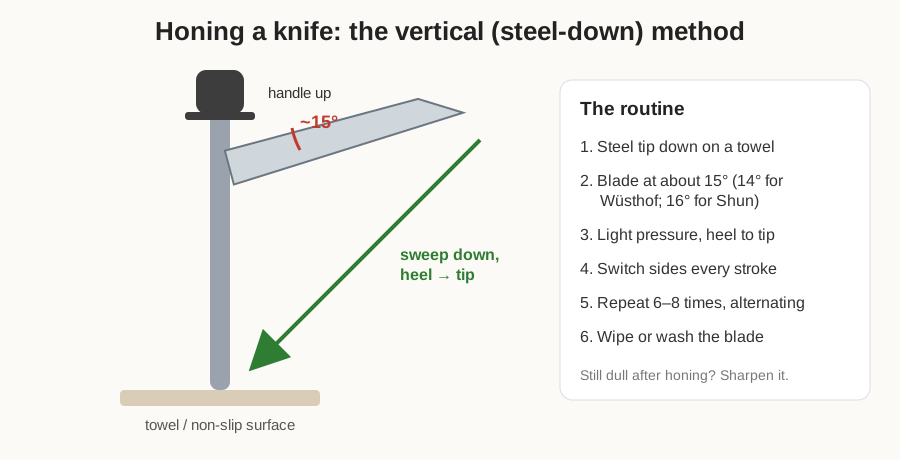
Quick answer: Stand the honing steel tip-down on a towel, tilt the blade to roughly 15 degrees against it, and draw the knife down and toward you from heel to tip with light pressure. Alternate sides and stop after 6–8 passes. Honing straightens an edge that has rolled over; it does not grind a new one, so if the knife is still dull afterward, it needs sharpening.
A honing steel is the long rod that comes in most knife blocks — and the tool most home cooks either never touch or swing around like a TV chef. Used gently and at the right angle, it is the fastest way to keep a good knife cutting cleanly between real sharpenings. Here is the technique, the angles knife makers actually recommend, and the mistakes that do more harm than good.
What a honing steel actually does
With normal use, the very thin edge of a knife bends slightly out of line. The knife still has an edge, but it is pointing a little sideways, so it skates on tomato skin instead of biting. A honing steel pushes that edge back into line.
Knife makers draw the line clearly. Shun’s guide says honing realigns an edge “when it begins to roll” and does not remove metal, while sharpening restores the edge by removing a small amount of metal (Shun: Sharpening vs. Honing). Wüsthof describes honing as realigning “the microscopic teeth on the edge of the blade” and recommends a honing steel for regular maintenance (Wüsthof sharpening guide).
One wrinkle: some rods sold as “sharpening steels” (diamond-coated or very coarse) do take off metal. Wüsthof notes the technique is the same for both, but you use the honing steel for routine upkeep and the sharpening steel only when the edge needs a reset. If your rod is smooth or finely ridged steel, it is a honing steel. For a full edge rebuild with stones, see our guide to sharpening a kitchen knife at home.
How to use a honing steel, step by step
The vertical method below is the safest for beginners because the steel stays still and the blade always moves away from your body and hand.
- Set the steel tip-down. Hold the handle in your non-dominant hand and rest the tip on a folded kitchen towel or cutting board so it cannot slide.
- Find the angle. Place the heel of the knife (the end nearest the handle) against the steel near the top. Tilt the spine away until the blade sits at roughly 15 degrees to the rod. Wüsthof specifies 14 degrees for its German-style knives and 10 degrees for Asian-style knives; Shun’s honing steel has a 16-degree guide built into the hand guard.
- Draw down and back. With light pressure — about the weight of the knife — pull the blade down the steel while sliding it toward you, so the contact point travels from heel to tip in one smooth stroke.
- Switch sides. Move to the other side of the steel and repeat the same stroke at the same angle.
- Repeat 6–8 times, alternating. That is Wüsthof’s recommendation. More strokes rarely help; consistency matters more than count.
- Test and clean. Slice a sheet of paper or a tomato. Then wash and dry the blade — Wüsthof suggests hand washing after honing to remove fine steel particles.
If you are not sure you are holding a consistent angle, color the very edge with a marker before you start. After a few strokes, the ink should be wiped evenly along the whole length. Ink left at the heel or tip means you are lifting or dropping the angle partway through the stroke.
What angle should you hone at?
Match the honing angle to how the knife was sharpened. The numbers from the makers themselves:
- German-style knives (Wüsthof, Zwilling, Henckels and similar): about 14 degrees per Wüsthof’s own guide.
- Japanese-style knives: Wüsthof recommends 10 degrees for its Asian-style blades; Shun builds a 16-degree guide into its honing steel to match Shun’s edge.
- Unknown or mixed knives: 15 degrees is a reasonable middle. Go a few degrees steeper rather than flatter — too low and the steel touches the shoulder of the bevel, not the edge.
Hard Japanese steels are worth special care here. Very hard, thin edges can chip if they are slapped against a grooved steel, so use the lightest pressure, or ask the maker what they recommend for that knife. Our explainer on how blade steel and edge geometry work covers why harder steels behave differently.
How often should you hone a knife?
There is no fixed schedule; it follows how much you cut. Shun says some cooks hone once a week and others every day, and that for most home cooks sharpening about once a year is often enough (source). Wüsthof’s advice for its handheld sharpeners points the same way: use the fine setting regularly and the coarse one only once or twice a year.
A practical rhythm for a home kitchen:
- Cook most days: a few strokes before each big prep session.
- Cook a few times a week: hone about once a week, or whenever the knife starts sliding off onion skin.
- Honing no longer brings the edge back: sharpen. A knife that is dull right after honing has worn past what alignment can fix.
What not to do
- Do not hold the steel in the air and swing toward your hand. The fast “butcher’s flourish” looks impressive and is how people cut themselves. Keep the tip planted.
- Do not press hard. Pressure is what turns honing into scraping. Light, even strokes realign the edge; heavy ones can chip it or create a new burr.
- Do not saw back and forth. Every stroke goes one direction, edge-leading, heel to tip.
- Do not hone a dull knife and expect miracles. If there is no edge left to straighten, honing has nothing to work with.
- Do not skip the wash. Steel particles on the blade end up on your food and the cutting board. While you are at it, a soft cutting surface keeps edges straight longer — see our guide to the best wood for cutting boards.
Honing vs. sharpening at a glance
| Honing | Sharpening | |
|---|---|---|
| What it does | Realigns a rolled edge | Grinds a new edge |
| Removes metal? | No (smooth or fine steel) | Yes |
| Tool | Honing steel or rod | Whetstone, sharpener, or service |
| How often | Daily to weekly | Roughly once or twice a year for most home cooks |
If you are still choosing a knife, the honing routine is the same for nearly every style — from a santoku to a nakiri. Only the angle changes.
FAQ
Can you hone a serrated knife with a honing steel?
Not effectively with a standard round steel. The scallops of a serrated edge need a narrow tapered rod worked into each serration one at a time, and most serrated knives need very little maintenance anyway because the points do most of the cutting.
Is a honing steel the same as a sharpening steel?
They look alike and are used the same way, but they do different jobs. A smooth or finely ridged steel realigns the edge. Diamond-coated or coarse rods remove metal and are sharpening tools. Wüsthof recommends the honing steel for regular upkeep and the sharpening steel only when the knife needs a new edge.
Should you hone before or after sharpening?
After. Honing a freshly sharpened knife with a few light strokes can tidy the edge, and from then on you hone regularly to keep it there until honing stops working.
Why is my knife still dull after honing?
Either the edge is worn and needs sharpening, or the angle is off. Try the marker test: if ink stays on the very edge after a few strokes, you are holding the knife too flat. If the angle is right and it still will not cut paper cleanly, it is time to sharpen.