
Yes, you can use soap on a cast iron skillet. A small amount of mild dish soap will not strip a polymerized seasoning layer, and Lodge’s own care guidance agrees. The no-soap rule dates from lye-based soaps. What actually damages a pan is soaking, the dishwasher, and harsh abrasives — not a drop of dish soap.
If you grew up hearing that soap is the enemy of cast iron, you are not alone — the rule is repeated in cookbooks and argued about in every cast iron forum. It sounds sensible: seasoning is oil, soap removes oil, so soap must remove seasoning. The logic is tidy, and wrong. We compared Lodge’s official use-and-care instructions and verified owner reviews to separate the soaps that are genuinely safe from the cleaners that really do damage a pan.
Why does everyone say never to use soap on cast iron?
The no-soap rule outlived the soap it was written for. A century ago, household soap was commonly made with lye — sodium hydroxide — a caustic alkali strong enough to dissolve grease and eat through a pan’s oil layer. If your great-grandmother washed her skillet with lye soap, the warning was correct.
Modern dish soap is a different product: mild surfactants designed to lift grease from plates without harming hands, far too gentle to break the chemical bond that holds seasoning to iron. The rule survived; the soap changed.
Lodge, which has cast skillets in South Pittsburg, Tennessee since 1896, addresses the question directly. Its advice, as of November 2026, is short: “Wash cast iron by hand with mild soap or none at all. Dry promptly and thoroughly with a lint-free cloth or paper towel. Rub with a very light layer of vegetable oil, preferably while the cookware is still warm.” Its longer care sheet adds: “If no soap is too scary, wash with mild soapy water and dry and oil immediately.”
That is the company that seasons millions of pans a year telling you soap is fine. The myth is not a lie — it is a fossil.
What is seasoning, and why doesn’t mild soap strip it?
Seasoning is not a layer of oil sitting on the surface of the pan. It is oil heated past its smoke point until it polymerizes — bonds chemically — into a hard, slick coating fused to the iron underneath. The oil has changed state and become part of the surface, like varnish on wood.
That distinction is the whole answer. Dish soap dissolves loose grease, but it cannot dissolve a polymerized coating — the oil molecules in seasoning are cross-linked into a solid layer. A brief wash with a few drops of mild soap removes the grease and food residue on top of the seasoning while leaving the seasoning itself intact.
Seasoning is broken by sustained chemical attack — lye, oven cleaner, dishwasher detergent over a long hot cycle — by metal abrasives, or by rust forming underneath it when the pan stays wet. A 30-second hand wash with mild soap does none of those things.
One caveat: seasoning on a brand-new, factory-pre-seasoned pan is thin — often a single layer. It is more fragile than the deep seasoning on a pan that has cooked a hundred meals. A new pan will not be ruined by soap, but give it the gentlest routine: hot water first, soap only when the pan is actually greasy, and always the dry-and-oil finish. Our guide to how to season cast iron explains how to build that layer up.
Which soaps are safe, and which should you avoid?
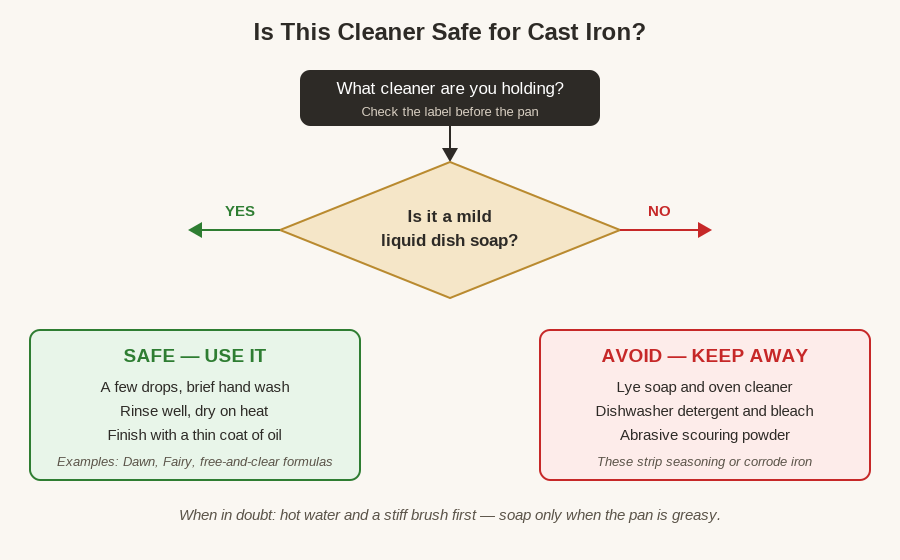
Not every cleaner under the sink is safe for cast iron. The line is simple: mild, short-contact dish soap is fine; strong alkalis, solvents, and abrasives are not.
| Cleaner | Safe for seasoned cast iron? | Why |
|---|---|---|
| Mild liquid dish soap (Dawn, Fairy, and similar) | Yes | Gentle surfactants lift grease without breaking polymerized seasoning |
| Lye soap or homemade soap with lye residue | No | Caustic alkali dissolves seasoning, the original reason for the no-soap rule |
| Oven cleaner | No | Extremely alkaline; strips seasoning to bare iron by design |
| Dishwasher detergent (pods, powder, gel) | No | Harsh detergents plus a long hot cycle strip seasoning and invite rust |
| Bleach or chlorine cleaners | No | Corrosive to iron and unnecessary — a hot pan is already sanitized by heat |
| Abrasive powder cleansers (scouring powder) | No | The grit grinds seasoning away along with the food |
The practical rule: if you would wash a nonstick pan with it, you can wash a seasoned cast iron skillet with it. If you would wear gloves to handle it, keep it away from your skillet.
How do you wash a cast iron skillet with soap, step by step?
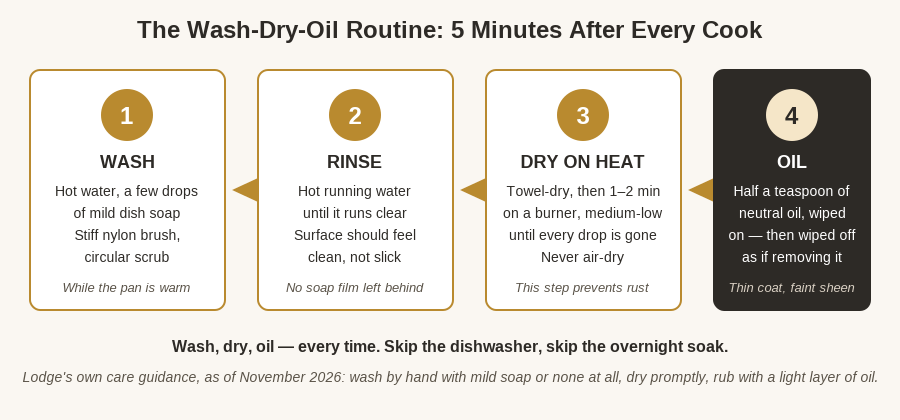
The correct routine takes about five minutes and follows Lodge’s three-word summary: wash, dry, oil. Use soap only when the pan needs it — after frying bacon or searing meat. After a quick sauté of vegetables, hot water and a brush are often enough.
- Wash while the pan is still warm. Let the skillet cool for 5–10 minutes, until you can hold the handle comfortably — a warm pan releases food far more easily than a cold one.
- Scrape out the loose food. Push out crumbs and residue with a wooden spatula or a plastic pan scraper before water touches the pan.
- Add hot water and a small amount of mild soap. A few drops is enough. Scrub in circles with a stiff nylon brush or a non-metal scrub pad, covering the cooking surface and the sloped sides.
- Rinse thoroughly under hot running water. Rinse until the water runs clear and the surface feels clean, not slick — leftover soap leaves a dull film.
- Dry immediately — towel first, then heat. Towel-dry the pan, then set it on a burner over medium-low heat for 1–2 minutes until every drop of water has evaporated. This step prevents rust, and it matters far more than whether you used soap.
- Wipe on a thin coat of oil. While the pan is still warm, add about half a teaspoon of a neutral oil — vegetable, canola, or grapeseed — spread it with a folded paper towel, then wipe it out as if removing it all. The surface should look dry with a faint sheen, not wet or pooled.
That is the entire routine. For food that will not lift with soap and a brush, do not reach for a harsher cleaner — use a different method instead. Our guide to how to clean a cast iron skillet with burnt-on food covers the salt scrub and the simmer method, which clear stubborn crust without touching the seasoning.
What actually strips seasoning?
Seasoning fails for a short list of reasons, and every one of them is avoidable.
- Long soaking. Water works its way under the polymerized layer, rust forms underneath, and the seasoning flakes off.
- The dishwasher. Its detergent is far harsher than hand dish soap, and the cycle keeps the pan hot and wet for an hour or more.
- Oven cleaner and lye. Designed to dissolve baked-on grease at a chemical level, they do not distinguish between cooking grease and seasoning — both are gone afterward.
- Metal scouring pads and steel wool. Steel wool is harder than seasoning and grinds the polymerized layer off. A stiff nylon brush or chain-mail scrubber on a well-seasoned pan is the safe alternative.
- Cooking highly acidic foods in a new pan. Tomatoes and wine sauces can dull thin, new seasoning — Lodge advises cooking them only once seasoning is well established. A temporary caution, not a permanent ban.
- Leaving the pan wet. Rust is seasoning’s real enemy, and a pan left to air-dry can show orange spots within hours. Dry on heat, every time.
Notice what is missing from the list: mild dish soap. Lodge’s list of things that harm seasoning is dishwashers, metal scouring pads, and harsh detergents.
What should you do if the pan feels dry or sticky after washing?
Two common complaints after washing with soap have simple explanations — neither means the soap damaged your pan.
The pan feels dry or looks dull. That is normal: soap removes the surface grease, so a freshly washed skillet looks matte instead of glossy — that is what clean cast iron looks like. The thin oil coat in step 6 restores the sheen, and cooking something fatty — bacon, cornbread in butter — brings the gloss back.
The pan feels sticky. Stickiness means too much oil was left on the pan, not that soap failed. A thick oil layer does not polymerize; it stays tacky and can turn rancid. Fix it by heating the empty pan on medium heat for a few minutes and wiping it out; next time, wipe the oil coat off as if you were trying to remove it entirely. The correct coat is nearly invisible.
Food starts sticking after washing. If a well-seasoned pan suddenly grabs eggs, the seasoning may have thinned — usually from a long soak or a dishwasher cycle, not from soap. A few fatty meals will restore the surface. If the pan has visible rust or large bare patches, our guide to how to get rust off a cast iron skillet walks through the rescue, and how to season cast iron covers rebuilding the layer.
Can you put a cast iron skillet in the dishwasher?
No. This is the one cleaning rule that really is absolute. Dishwasher detergent is formulated to strip baked-on grease at high temperatures over a long cycle, and it treats seasoning as baked-on grease — then the long, hot, wet cycle leaves bare iron exposed to moisture, which is how rust forms. Lodge lists dishwashers alongside strong detergents and metal scouring pads as not recommended, stating that they remove seasoning. Hand-washing takes five minutes; a dishwasher cycle takes an hour and damages the pan.
Does the same soap rule apply to enameled cast iron?
Yes — and with enameled cast iron, soap is not just allowed, it is the normal routine. The glass-like coating means there is no seasoning layer to protect and nothing for soap to strip. Hot water, a soft sponge, and a little dish soap are the entire routine; Le Creuset even allows soaking enameled pieces to loosen stuck food — the exact opposite of the rule for bare cast iron.
The cautions with enamel are citrus-based cleaners, which Lodge warns can damage the coating, and abrasive pads, which can chip it. If you are unsure whether your pan is enameled or bare, our comparison of enameled cast iron vs raw cast iron explains how to tell them apart.
Myth vs fact: soap and cast iron
| Myth | Fact |
|---|---|
| Soap strips seasoning | Mild dish soap cannot break the polymerized bond of seasoning; it removes only loose grease on top |
| You must never let soap touch cast iron | Lodge’s care guidance says to wash by hand with mild soap or none at all — soap is optional, not forbidden |
| A pan washed with soap needs re-seasoning | A brief soapy wash needs only drying and a thin oil coat; full re-seasoning is for stripped or rusted pans |
Frequently asked questions
Can you use Dawn dish soap on cast iron?
Yes. Dawn is a mild liquid dish soap, and a few drops will not damage a properly seasoned skillet. Wash by hand, rinse well, dry on heat, and wipe on a thin coat of oil.
Will soap remove the seasoning from my cast iron skillet?
No. Seasoning is oil chemically bonded to the iron, not loose grease, and mild soap cannot break that bond — only lye, oven cleaner, dishwasher detergent, and abrasives can.
Should I use soap every time I wash cast iron?
No. Hot water and a stiff brush are enough after light cooking — Lodge’s guidance is “mild soap or none at all.” Use soap when the pan is greasy, skip it when it is not.
Can you use soap on a new cast iron skillet?
Yes, but gently. A new pre-seasoned pan has only a thin seasoning layer, so use hot water first and add a drop or two of mild soap only if the pan is greasy, then dry on heat and oil it.
What happens if I accidentally soak my cast iron skillet?
Dry it immediately on a hot burner and wipe on a thin coat of oil. If rust spots appear, scrub them off and re-oil — one short soak rarely causes lasting damage, but repeated soaking thins the seasoning.
The bottom line
Yes, you can use soap on a cast iron skillet — a few drops of mild dish soap, a quick hand wash, and the pan is fine. The no-soap rule belonged to lye soap, and lye soap belonged to another century. What protects your skillet is washing by hand, drying on heat, and finishing with a thin coat of oil. Do those three things, skip the dishwasher and the overnight soak, and the pan will outlast the argument.