
The best cutting board for raw meat and poultry is a dedicated board you use only for raw meat, made from a material you can sanitize thoroughly after every use. For most kitchens, a thick HDPE plastic board like the OXO Good Grips Utility is the safest pick: non-porous, dishwasher-safe, and cheap enough to replace when grooves get deep.
As an Amazon Associate I earn from qualifying purchases.
TL;DR — our verdict: Buy one board for raw meat and never let it touch anything else. The OXO Good Grips Utility (around $15) is the best value — it goes straight in the dishwasher. The Joseph Joseph Folio set (around $70) is the best cross-contamination system, with a color-coded board for raw meat. Wood lovers should get the John Boos end-grain block (around $284) — but it needs hand washing and regular oiling.
What makes a cutting board safe for raw meat and poultry?
A board is safe for raw meat when three things are true: it does not hold bacteria in deep grooves, you can clean and sanitize it completely after use, and it never shares a surface with ready-to-eat food. Raw chicken and turkey carry Salmonella and Campylobacter, and the USDA recommends separate boards for raw meat and ready-to-eat foods, hot soapy washing after each use, and replacing boards with deep cuts where bacteria can hide.
Two properties decide cleanability: porosity and heat tolerance. Non-porous surfaces (plastic, composite, stainless steel) do not absorb meat juices, so washing removes the contamination. Dense hard maple is porous but dries out bacteria quickly if washed promptly and dried fully. And a board that survives the dishwasher gets a hot sanitizing rinse hand washing cannot match.
The 6 best cutting boards for raw meat at a glance
| Board | Material | Size | Dishwasher-safe | Price (as of Nov 2026) | Best for |
|---|---|---|---|---|---|
| OXO Good Grips Utility | HDPE plastic | 10.5″ x 15″ | Yes | ~$15 | Best overall value |
| Joseph Joseph Folio, Large | Polypropylene set | 14.1″ x 10.2″ boards | Yes | ~$70 | Best cross-contamination system |
| John Boos CCB End Grain | Hard maple, end grain | 20″ x 15″ x 2.25″ | No | ~$284 | Best premium wood |
| Epicurean Kitchen Series | Composite (Richlite) | 14.5″ x 11.25″ | Yes | ~$32 | Best thin, light board |
| Greener Chef Bamboo Set of 3 | Moso bamboo | 12″ x 9″ to 18″ x 12.5″ | No | ~$30–$40 | Best budget wood set |
| GUANCI Double-Sided | 304 stainless + PP | 16″ x 11″ | Yes | ~$19–$24 | Best non-porous steel |
1. OXO Good Grips Utility Cutting Board — best overall value
The OXO Good Grips Utility is our first choice for most home cooks: a single slab of thick, non-porous polypropylene, 10.5 by 15 inches, with a juice groove and non-slip rubber grips. At around $15 as of November 2026, it is cheap enough to dedicate to raw meat and replace every year or two when the surface gets scored — and a $15 board replaced on schedule is safer than a $150 board kept for a decade after the grooves go deep.
Pros: Non-porous and dishwasher-safe; juice groove; grippy edges; cheap enough to replace on schedule. Cons: Knife marks accumulate; no color coding.
2. Joseph Joseph Folio 4-Piece Cutting Board Set, Large — best cross-contamination system
If more than one person cooks in your house, the Joseph Joseph Folio set solves the problem by design. Four color-coded boards live in a slim case: one is marked with a raw-meat icon, the others for fish, vegetables, and cooked food. Grab the red board for chicken and there is nothing to remember. The Large boards measure 14.1 by 10.2 inches — big enough to break down a whole chicken — and the case stores them upright with air circulating, so they dry fully instead of sitting damp in a stack. At around $70 as of November 2026, you are buying a system, not a single board.
Pros: Color-coded meat board; slim case keeps boards dry; dishwasher-safe; big enough for whole birds. Cons: Around $70; plastic still scores; the case takes space.
3. John Boos CCB End-Grain Chopping Block — best premium wood
The John Boos CCB2015-225 is for cooks who want wood and will care for it: a 20-by-15-inch block of hard maple, 2.25 inches thick and 21 pounds, built end-grain, so a knife slides between the upright fibers instead of slicing across them. That keeps the surface smooth far longer than edge-grain boards and is gentler on knife edges. At around $284 as of November 2026 (list $295.95), it needs hand washing, prompt drying, and regular oiling — never the dishwasher, never a soak. Our how to care for wooden cutting boards guide walks through the routine. Wood is safe for raw meat when maintained — and less forgiving than plastic when it is not.
Pros: End-grain maple resists deep cuts and is kind to knives; huge and stable; made in the USA; lasts decades with care. Cons: Around $284; hand wash only; needs oiling; 21 pounds.
4. Epicurean Kitchen Series Cutting Board — best thin, light board
Epicurean boards are made from Richlite, a composite of paper and resin pressed into a thin, dense sheet. The 14.5-by-11.25-inch Kitchen Series board is only a quarter inch thick and weighs under two pounds, so it lifts and rinses like a sheet pan — handy when raw chicken needs the sink fast. At around $32 as of November 2026, it is non-porous and dishwasher-safe, and its thin profile dries fast. The trade-off is feel: it flexes slightly under a heavy cleaver and is louder under the knife than wood. Read our safety breakdown in are Epicurean cutting boards safe before you decide.
Pros: Non-porous and dishwasher-safe; light and easy to store; heat-resistant to 350°F; made in the USA. Cons: Flexes under heavy chopping; harder on knife edges than wood; no juice groove.
5. Greener Chef Bamboo Cutting Board Set of 3 — best budget wood set
The Greener Chef set gives you three bamboo boards — small (12 by 9 inches), medium (15 by 11), and extra-large (18 by 12.5) — for around $30–$40 as of November 2026. Use the XL for raw meat, the medium for vegetables, and the small one for fruit and garnish. Bamboo is harder and denser than most wood, which helps it resist the grooves that harbor bacteria, and each board has a juice groove. The one rule: hand-wash only — bamboo splits and warps if it soaks or goes through the dishwasher. Oil it occasionally, and retire it the moment deep grooves appear.
Pros: Three boards for the price of one; juice grooves; hard bamboo resists grooving; lifetime replacements. Cons: Hand wash only; harder on knife edges than maple; needs oiling.
6. GUANCI Double-Sided Stainless Steel Cutting Board — best non-porous steel
Stainless steel is the most non-porous cutting surface you can buy, and the GUANCI board pairs a food-grade 304 stainless steel face with a wheat-straw polypropylene face in one 16-by-11-inch board. Cut raw meat on the steel side and flip it for vegetables. At around $19–$24 as of November 2026, it is dishwasher-safe, does not absorb juices, stain, or hold odors — so it is genuinely easy to sanitize. The honest downsides: steel is hard on knife edges, so expect to sharpen more often, and it is noisy and slippery-feeling under the knife. See our stainless steel cutting board pros and cons for the full picture.
Pros: Fully non-porous and odor-proof; dishwasher-safe; two surfaces in one board; very affordable. Cons: Hard on knife edges; noisy and slippery under the knife; thin steel can feel flimsy.
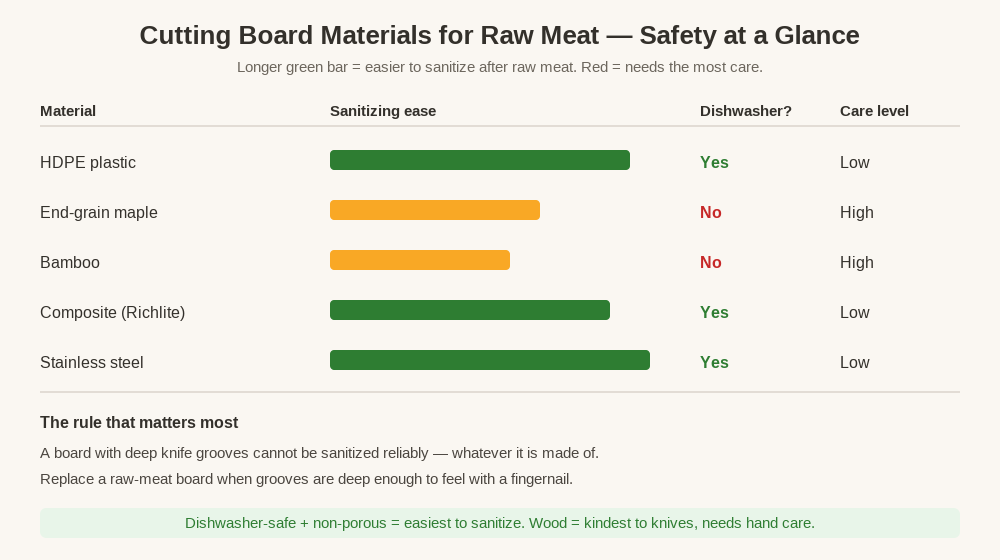
Which cutting board material is safest for raw meat?
No material wins on every measure — the safest board is the one you will clean properly every time. Plastic and steel win on sanitizing; wood wins on knife care but demands a routine you cannot skip.
| Material | Porous? | Dishwasher-safe? | Knife-friendly? | Main risk with raw meat |
|---|---|---|---|---|
| HDPE plastic | No | Yes | Good | Grooves hide bacteria |
| End-grain maple | Slightly | No | Excellent | Needs prompt washing and drying |
| Bamboo | Slightly | No | Fair | Dulls knives; splits if soaked |
| Composite (Richlite) | No | Yes | Fair | Flexes; no juice groove |
| Stainless steel | No | Yes | Poor | Dulls knives fastest |
Avoid glass: it destroys knife edges and shatters if dropped. For wood species, our best wood for cutting board guide ranks maple, walnut, and teak for heavy use.
How do you prevent cross-contamination when cutting raw meat?
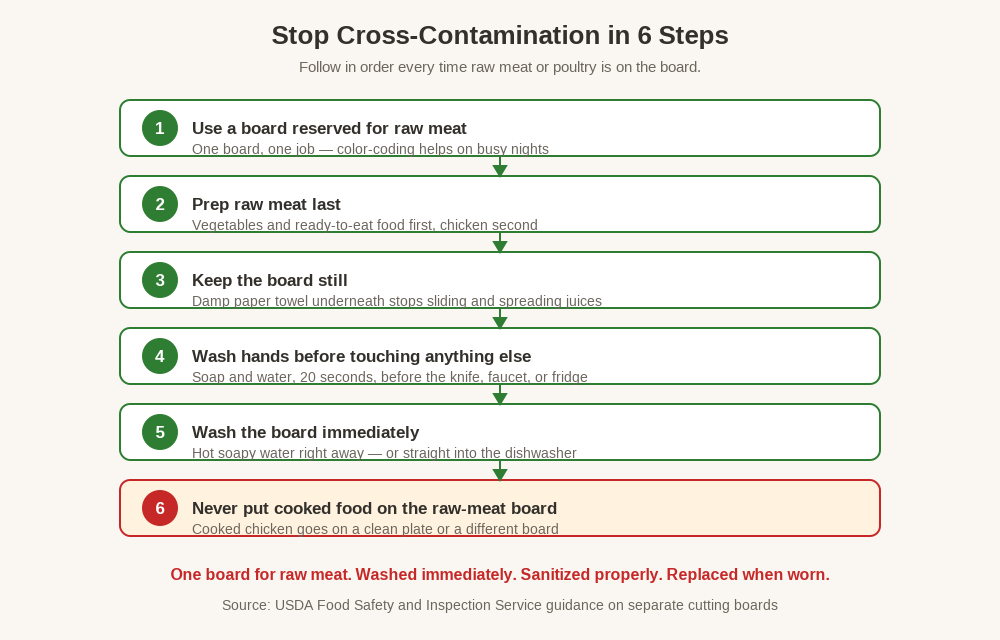
Cross-contamination is the real risk here, and the board is only half of it — the other half is habit:
- Use a board reserved for raw meat. One board, one job — color-coding helps on busy nights.
- Prep raw meat last. Cut vegetables and anything eaten raw first, then the chicken.
- Keep the board still. A damp paper towel underneath stops it sliding and keeps raw-meat juices from spreading.
- Wash hands before touching anything else. After handling raw meat, wash with soap and water for 20 seconds before touching the knife, faucet, or fridge.
- Wash the board immediately. Do not leave a raw-meat board in the sink — wash it right away or put it straight in the dishwasher.
- Never put cooked food on the raw-meat board. Cooked chicken goes on a clean plate or a different board — never back onto the surface that held it raw.
How do you clean and sanitize a cutting board after raw meat?
Cleaning has two stages: washing removes the visible juices, sanitizing kills what washing leaves behind.
For plastic, composite, and stainless steel, wash with hot soapy water, rinse, and run the board through a hot dishwasher cycle.
For wood and bamboo, wash with hot soapy water and a stiff brush, rinse, and dry immediately, then stand the board upright so air circulates on both faces. Do not soak wood or put it in the dishwasher — both crack the board and open new places for bacteria to hide. A monthly rub with food-grade mineral oil keeps it sealed.
Whatever the material: a board with deep cuts or grooves should be discarded or resurfaced — no washing reliably cleans a groove you cannot reach.
When should you replace a cutting board used for raw meat?
Replace the board when the surface tells you to. The signs: deep grooves you can feel with a fingernail, dark stains inside cuts that do not wash out, a warped or cracked board that no longer sits flat, or a smell that survives washing. Any one means the board can no longer be sanitized reliably.
As a rough guide, a plastic board used for raw meat several times a week lasts about one to two years before the grooves get deep. A well-maintained end-grain maple block can last decades — but only if the oiling and drying routine actually happens. Bamboo falls in between, typically two to four years. The cheapest board here costs about $15 — the wrong place to save money.
Frequently asked questions
Is plastic or wood better for cutting raw meat?
Plastic is the safer default: non-porous and dishwasher-safe, so it is easier to sanitize. Wood is safe as hard maple, kept dry and washed immediately — but less forgiving.
Can you use the same cutting board for raw chicken and vegetables?
No — not without washing it in between. Use separate boards, or prep vegetables first, then wash the board before the chicken.
Should you use a separate cutting board for raw meat?
Yes. The USDA recommends separate boards for raw meat and ready-to-eat foods — raw-meat juices transfer bacteria to food that will not be cooked.
How do you sanitize a cutting board after cutting raw chicken?
Wash with hot soapy water, then sanitize: plastic, composite, and steel boards go through a hot dishwasher cycle. For wood and bamboo, wash, rinse, and dry completely — never soak or dishwash wood.
Is bamboo safe for cutting raw meat?
Yes, with the same care as wood. Bamboo is dense and resists grooves well, but it must be hand-washed and dried promptly — never soaked or dishwashed.
Does stainless steel dull knives?
Yes — steel is the hardest surface here and dulls knife edges fastest. If you choose steel for its hygiene, expect to sharpen more often.
Which cutting board should you buy for raw meat?
If you want one answer: buy the OXO Good Grips Utility, use it only for raw meat, run it through the dishwasher after every use, and replace it when the grooves get deep. At around $15, it is the cheapest insurance there is.
If more than one person cooks in your house, spend the extra on the Joseph Joseph Folio set — the color-coded meat board removes the one failure point no cleaning routine can fix: grabbing the wrong board. And if you love wood and will oil it, the John Boos block is the board you will still be using in twenty years.
Whatever you choose, the board matters less than the system: one board for raw meat, washed immediately, sanitized properly, replaced when worn. Get that right and the material is a detail.