
Yes, you can use a cast iron skillet on a glass top stove — with care. Lodge says cast iron is safe on glass-top electric and induction ranges, as long as you lift the pan instead of sliding it and keep the bottom smooth and clean. The real risk is dragging a heavy, rough-bottomed pan across glass.
If you just moved into a home with a smooth glass cooktop, or you finally bought the cast iron skillet everyone raves about, the question is the same: will this pan wreck my stove? The short answer is reassuring, but the honest answer has a split — the pan maker and the stove maker do not say exactly the same thing. We compared Lodge’s official use-and-care guidance, GE’s cooktop manuals, and verified owner reviews to lay out what actually scratches glass, what cracks it, and the habits that keep both safe.
What do the manufacturers actually say?
Here is the tension, stated plainly. Lodge, which has cast skillets in South Pittsburg, Tennessee since 1896, says cast iron is safe on glass-top electric and induction ranges. Its guidance, as of November 2026: lift the cookware rather than slide it, use a pan with a smooth, flat bottom, and choose the burner closest to the size of the cookware.
GE Appliances, one of the biggest makers of glass-top ranges in the US, takes a stricter line. Its owner manuals list raw cast iron as “not recommended — unless designed specifically for glass cooktops” — it “will scratch the cooktop surface” — and its support pages say not to use cookware with a rough bottom “such as cast iron,” and never to slide cookware across the glass.
The difference is perspective: Lodge describes a pan handled correctly; GE writes for the worst case — millions of owners, many of whom will slide a heavy pan out of habit — and a glass surface that, once deeply scratched, cannot be repaired. GE’s support page states it plainly: glass cooktops are scratch-resistant, not scratch-proof, and deep scratches are not removable.
One point of full agreement: porcelain-enamel-covered cast iron — a smooth, glossy coating over the whole pan, like a Le Creuset or Staub Dutch oven — is recommended by GE, as long as the pan is covered completely with smooth porcelain enamel. For the lowest possible risk on glass, enameled cast iron is the safest choice.
What can actually go wrong on a glass top?
| Risk | What causes it | How to prevent it |
|---|---|---|
| Scratches on the glass | Sliding a heavy pan, a rough or burred pan bottom, or grit trapped underneath | Lift the pan every time you move it; inspect and clean the pan bottom |
| A cracked cooktop | Dropping a heavy skillet onto the glass, or a sharp impact on one spot | Set it down gently with two hands |
| Burnt-on marks and stains | Grease, seasoning residue, or food on the pan bottom baking onto hot glass | Keep the pan bottom clean |
| A warped or cracked pan | Heating too fast on high, or a pan much larger than the burner | Preheat slowly; match the pan to the burner |
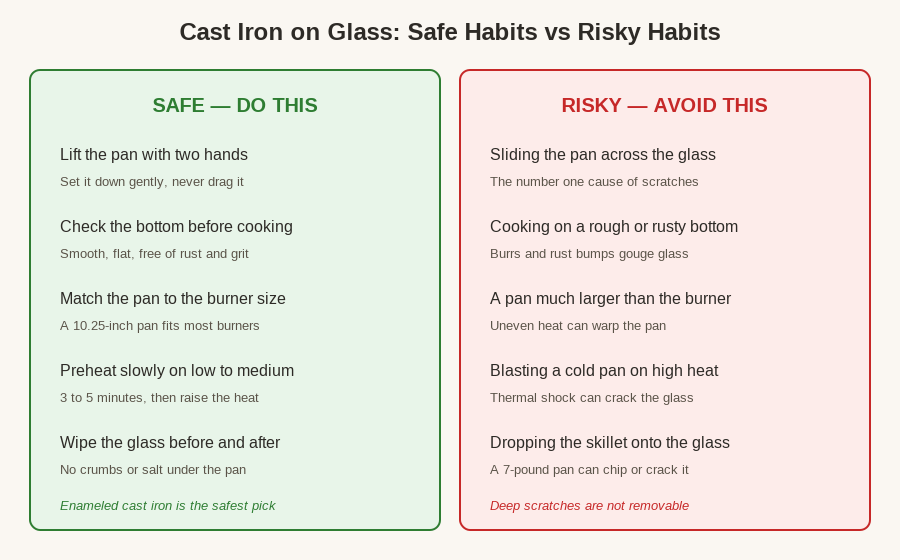
The scratch risk deserves the most attention, because it is the one most owners meet first. Cast iron is heavy — Lodge lists its 10.25-inch skillet at 5.66 pounds and its 12-inch at 7.69 pounds — and a standard Lodge leaves the factory with a pebbly, sand-cast texture on its base. Drag that texture across glass with a grain of salt trapped underneath, and the grit acts like sandpaper. GE’s support guidance makes the same point: coarse particles such as salt or ground pepper can get trapped between the pan and the cooktop and cause scratches.
The crack risk is rarer but more expensive. Glass-ceramic cooktops are tough, but they are still glass: a 7- or 8-pound skillet dropped from even a few inches onto one spot can chip or crack the surface, and a cracked cooktop is a repair job, not a cleaning job.
Thermal shock is the risk most people have never heard of. A very hot skillet set onto a cold section of glass, or a cold pan onto a burner already at full heat, forces one part of the glass to expand faster than the rest. Heat the pan and the burner up together, starting low and rising gradually.
How do you cook with cast iron on a glass top safely?
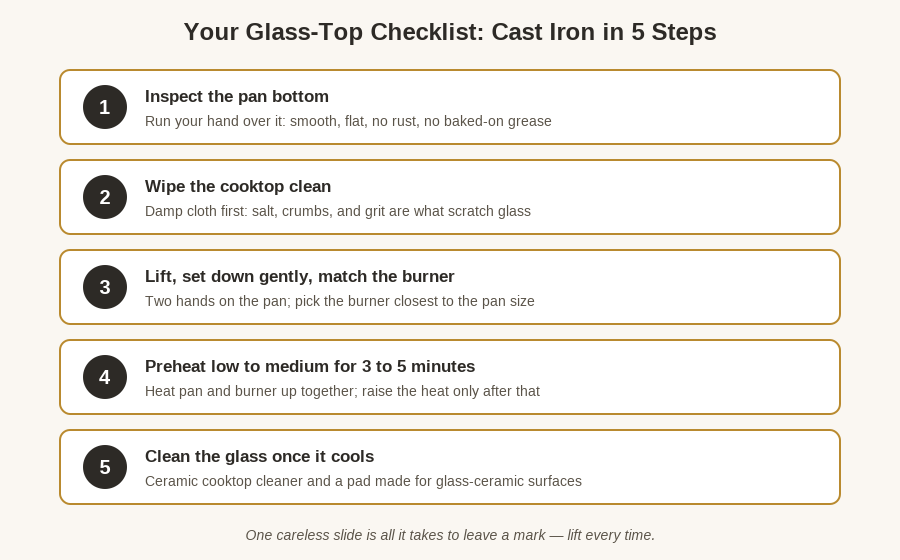
Four habits cover it. None is hard; the trick is doing them every time, because one careless slide is all it takes to leave a mark.
1. Check the pan bottom and wipe the cooktop. Run your hand over the pan’s base. If you feel raised casting lines, rust bumps, or baked-on grease, clean it up before cooking — GE’s manuals tell owners to check flatness with a straight edge and skip pans with rounded, curved, ridged, or warped bottoms. Then wipe the glass with a damp cloth: the salt grains and crumbs that do the actual scratching take ten seconds to remove.
2. Lift, never slide. This is the rule Lodge repeats, and the one GE’s manuals repeat too. When you need to move the skillet, pick it up clear of the glass and set it down gently, using both hands and the helper handle on larger skillets. Sliding is the fastest way to mark a glass surface — and the habit carried over from gas cooking, where sliding is harmless.
3. Match the pan to the burner and preheat gently. Choose the burner closest to the size of your skillet: a pan much larger than the burner heats unevenly, and Lodge warns that uneven heat can warp or even crack cookware. Preheat on low to medium for 3 to 5 minutes, as Lodge recommends, then raise the heat as needed. Cast iron holds heat so well that you will usually cook at a lower setting than you expect.
4. Clean the glass after it cools. Once the cooktop is cool, wipe up any grease or food that escaped, using a cleaner made for glass-ceramic surfaces. Spills left on the glass bake into permanent-looking stains the next time the burner heats up.
If you are still building the habit of caring for your skillet, our guides to how to season cast iron and how to clean a cast iron skillet with burnt-on food cover the pan side of the routine in detail.
Which cast iron pans are safest on a glass top?
The bottom finish matters more than the brand name. The table below is the quickest way to judge a pan you already own — or one you are thinking of buying.
| Pan type | Bottom finish | Risk on glass | Verdict |
|---|---|---|---|
| Enameled cast iron (Le Creuset, Staub, Lodge enameled) | Smooth, glossy porcelain enamel | Lowest — the coating glides on glass | Best choice for a glass top |
| Smooth-bottom raw cast iron (Stargazer, Field, vintage pans) | Machined or polished flat, no casting texture | Low — smooth iron still needs lifting | Very good, if you always lift |
| Standard raw cast iron (Lodge Classic, most budget skillets) | Pebbly sand-cast texture | Moderate — texture plus grit can scratch | Usable with care; inspect the bottom first |
| Rough or damaged cast iron | Rust bumps, burrs, warped or ridged base | High — will mark glass even when lifted gently | Do not use on glass until repaired |
Enameled cast iron earns its top spot for a practical reason: the enamel is a hard, smooth glaze, so no exposed iron texture can catch on the glass. It is heavier and more expensive than raw cast iron, which is why most kitchens own raw skillets instead. That is fine — a standard Lodge is perfectly usable on glass — but it means the habits in the previous section are not optional. They are the whole safety system.
If your raw skillet’s bottom is genuinely rough, sand it smooth with 80-grit followed by 120-grit sandpaper and re-season the bottom, or reserve the rough pan for the oven and the grill and cook on the glass top with a smoother pan. For more on choosing between the two metals, see cast iron vs carbon steel for steak. A 12-inch skillet on an 8-inch burner overhangs the heat zone and loads weight onto unsupported glass — a 10.25-inch skillet is the sweet spot for most standard 8- to 9-inch burners. And if your skillet has rust, fix the pan first — how to get rust off a cast iron skillet walks through the process — and keep it off the glass until the base is smooth again.
What should you do if the glass gets scratched?
First, work out what you are looking at. Not every mark on a glass cooktop is a scratch. Metal marks — grey streaks left by aluminum or by a pan dragged across the surface — and hazy residue from burnt-on food often look like scratches but sit on top of the glass. These usually come off with a ceramic cooktop cleaner and a cleaning pad made for glass-ceramic surfaces, once the cooktop is cool. GE notes that small scratches typically become less visible after cleaning, while deep scratches are not removable.
If the mark is a genuine scratch, run a fingernail across it. If your nail catches, the groove is deep, and it is permanent. It will not affect how the cooktop cooks — the heating element is underneath the glass — but it will not polish out either. Cosmetic damage is almost never covered by a stove warranty, and a replacement glass panel plus labor often costs several hundred dollars, so prevention really is the cheaper option.
If the glass is cracked rather than scratched, stop using that burner immediately and call the manufacturer’s service line or a qualified appliance technician; a crack can spread when the glass heats and cools, and moisture can reach the electrical parts below.
When should you use a different pan instead?
Cast iron is a great pan, but it is not the right pan for every moment on a glass top. Reach for stainless steel or carbon steel instead when any of these apply:
- You are in a hurry or cooking with kids underfoot. The lift-don’t-slide rule fails most often when someone is rushed. A lighter pan forgives a slide; a cast iron skillet does not.
- Your skillet’s bottom is rough, rusty, or warped. Until the base is smooth and flat, the pan belongs in the oven, on the grill, or on a gas burner — not on glass.
- Your stove manual explicitly forbids it. Some manufacturers are stricter than GE. The manual that came with your range is the final word for your model; if it says no cast iron, follow it, because a warranty claim can hinge on it.
- You need fast, precise heat changes. Cast iron heats slowly and holds heat for a long time, which is wonderful for searing a steak — see how to cook filet mignon in a cast iron skillet — but frustrating for sauces or delicate fish, where a responsive stainless pan is the better tool.
Frequently asked questions
Can I use a cast iron skillet on a glass top stove?
Yes — Lodge says its cast iron is safe on glass-top electric and induction ranges, provided you lift the pan instead of sliding it and keep the bottom smooth and clean. Check your stove manual too, since some manufacturers are stricter.
Will a cast iron skillet scratch a glass top stove?
It can, if you slide it or the bottom is rough, rusty, or dirty. Scratches come from grit trapped under the pan and from the pebbly texture of a standard cast-iron base dragging across glass — so lift the pan, wipe the cooktop first, and inspect the pan bottom.
Can a cast iron skillet crack a glass top stove?
A dropped skillet can chip or crack the glass, and a very hot pan set on a cold section can cause thermal shock. Set the pan down gently with two hands, and heat the pan and burner up together from low.
Is enameled cast iron better than raw cast iron on a glass top?
Yes. Enameled cast iron has a smooth porcelain coating over the whole pan, and GE specifically recommends it. Raw cast iron works too, but only with careful lifting and a clean, smooth bottom.
What do I do if my glass top is already scratched?
Clean it first with a ceramic cooktop cleaner — many marks are residue, not scratches, and small scratches become less visible after cleaning. A deep scratch that catches your fingernail is permanent but harmless to cooking; a crack means stop using that burner and call a technician.
The bottom line
You do not have to give up cast iron when you switch to a glass top stove — just one habit: stop sliding the pan. Lift it, keep the bottom smooth and clean, match it to the burner, and preheat gently, and your skillet will cook happily on glass for years.